
Jensen Huang's Return to Nvidia: Saved the Stock But Didn't Address Surrounding Financial Fragility
Summary
Jensen Huang's return swiftly restored confidence in Nvidia's stock, but it did not resolve the fragility of funding and debt surrounding the AI ecosystem, nor the questions of governance and risks associated with China.
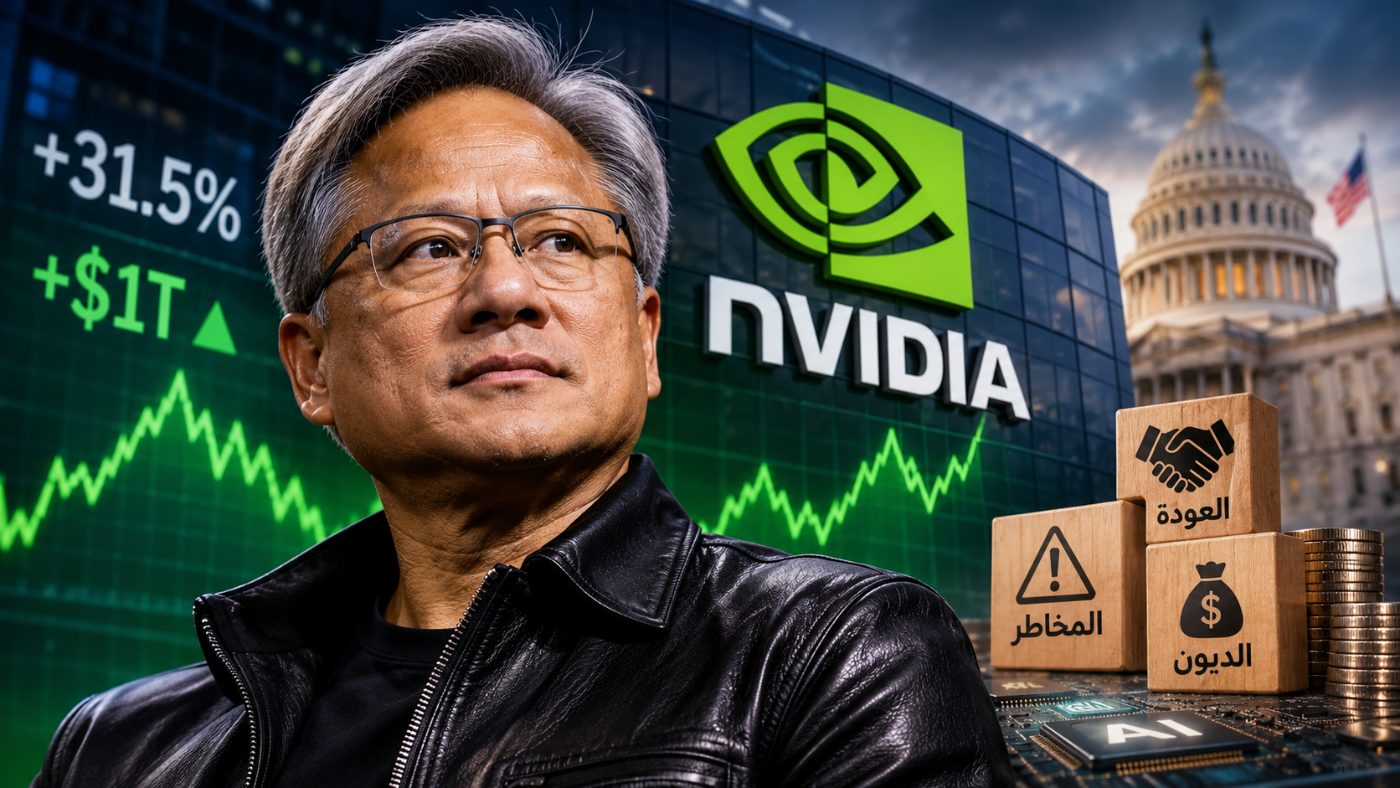
Between Jensen Huang's resignation on November 12 and his return on November 23, Nvidia lost about $1.16 trillion of its market capitalization, recovering $952 billion of it during the return session, according to a Financial Times analysis. Between the two numbers lies a single decision: a unanimous vote by the board of directors to reinstate Huang to the helm of the company he founded. President Donald Trump told CNBC: "I'm the one who made the deal." The question worth examining is: did the return restore confidence in Nvidia, or did it temporarily conceal the fragility of an AI ecosystem increasingly reliant on cross-funding and debt?
What is established in sources is that the return followed direct intervention from Trump and reassurances from top levels of the U.S. government, after a sharp drop in the stock and doubts regarding the leadership of interim CEO Colette Kress. As for linking the return to funding fragility, that is an analytical inference not stated by any party, and this article tests it with evidence.
What Settled the Decision?
Nvidia announced Huang's resignation on November 12 in an 8-K filing and appointed Kress, the CFO, as interim CEO. Five days later, Board Chair Harvey Jones said the company did not intend to bring him back, because his personal behavior was inconsistent with the code of conduct, according to Reuters. The board then backtracked, stating it had received "input from senior levels of the U.S. government" and was confident the return posed no risk to national security. Trump stated his administration provided assurances to that effect. Three people familiar with the board's thinking told CNBC that a personal promise from Trump that Huang had not violated national security laws settled the decision, while the stock drop and questions about Kress's leadership accelerated it.
Files Not Yet Closed
An independent board committee is investigating whether Huang was the target of a foreign intelligence operation, alongside SEC and DOJ investigations, and a shareholder lawsuit accusing the company and Huang of concealing his relationship with a woman reported to have links to Beijing—which Beijing denies. The internal investigation had not concluded when the board voted on his return.
A Trillion Dollars in a Single Session
The stock closed up 31.5% on the day of the return, adding nearly a trillion dollars according to Reuters, climbing from around 3 trillion to nearly 4 trillion according to Fortune. Wall Street posted its best day since April 2025, following a sell-off that erased nearly $8 trillion from equity market value in six weeks, according to Fortune. But relief was short-lived: the stock dropped more than 5% in early Tuesday trading amid reports of new tariffs on China.
Why Does Huang Matter in the Funding Equation?
CNBC describes Nvidia as the "Central Bank of AI" because it invests in its customers, buys from them, and guarantees them. Following Huang's resignation, the network questioned whether the company would continue pumping capital into ecosystem firms. Capital decisions in a company with such a role are tied to its leadership, and the leader's absence unsettles both lenders and customers. This is an analytical reading, not a corporate disclosure.
The commitment items here vary in nature and cannot appropriately be lumped into a single figure. According to its quarterly report to the SEC, its outstanding equity investments in ecosystem companies reached $99 billion as of July 26. Future commitments add to this: $25 billion in investments, and $36 billion to purchase cloud services, which decrease as power is utilized. CNBC adds contingent guarantees of up to $105 billion for an Ohio project, and potential support of up to $125 billion from a funding program targeting $500 billion, based on MOUs.
Columbia finance professor Stijn Van Nieuwerburgh estimated the total at around $400 billion, an estimate that combines items of different natures. He noted that for all guarantees to default simultaneously, the company itself would have to be on the brink of collapse.
Where Does the Risk Lie?
A large portion of the risk lies in Nvidia's periphery rather than showing on its direct debt. Moody's projected on October 27 that spending by the top five U.S. cloud providers alongside CoreWeave would approach $1 trillion in 2027, and that a wave of loans maturing between 2027 and 2029 would test weaker borrowers' ability to refinance at higher rates. On October 13, the IMF recorded the mega-cap tech share of global investment-grade bond issuances rising from less than 1% in 2024 to 10%. It counted 14 circular deals since 2023 that injected roughly $300 billion in equity and $650 billion in debt into financially weaker AI companies, against $1.4 trillion in future revenue commitments. Nevertheless, the IMF's stress tests showed that global banks maintain sufficient capital buffers.
CoreWeave: Debt Testing Confidence
CoreWeave is such a cloud partner, and a customer of Nvidia. Any pressure on it reaches Nvidia through two doors: demand from borrowing-dependent customers, and Nvidia's own commitments to partners. This is an inference, not a disclosure.
CoreWeave's debt reached $35.6 billion on June 30, with $10.6 billion scheduled for repayment through the end of 2027, including the second half of 2026. It held $5.5 billion in cash and total liquidity of $15.6 billion, including roughly $10 billion in undrawn facilities. On November 9, its credit default swap spread exceeded 1,240 basis points, up 50% in a month.
Huang told Bloomberg on October 15 that CoreWeave's cost of capital was falling, even as its credit default swaps hit a record high on the same day. This does not necessarily imply a contradiction—the two metrics differ—but it raises questions about the alignment between the market's assessment of credit risk and the picture he presented.
A Board Under Testing and an Interest Under the Microscope
Within five days, the board reversed a position announced by its chair—and before the internal investigation had concluded—a move governance experts speaking to Reuters said weakens claims of independence. Trump holds between $11 million and $55 million in Nvidia stock, according to a Reuters review of his disclosures, and the agency noted that the return-day surge may have boosted his net worth by up to $17 million. The White House maintains that his portfolio is managed by independent entities and neither he nor his family directs it. Senate Minority Leader Chuck Schumer said Trump prioritized his financial interest over national security—an allegation belonging to its speaker. Criticism was not absent from Republican ranks either, as Senator Pete Ricketts said the return "does not exempt Nvidia from answering" national security concerns and unaccounted-for chips.
China: The Chip as a Bargaining Chip
Trump visited Shenzhen days ago and spoke with Xi Jinping about Huang, while Chinese customers said they canceled orders or hesitated to place them during his absence, according to Reuters. On the very day of his return, November 23, Washington added Singapore-based Megaspeed—linked to the espionage investigation touching Nvidia—to its trade blacklist. The chip market here is a bargaining chip before it is revenue.
Two Upcoming Tests: Huang's Testimony and 2027 Maturities
On December 1, Huang faces a closed-door interview before three House committees, followed by a public hearing before the Senate Banking Committee on December 3. As for 2027, it is a financial test window, not a hearing date: it is when the ability of weaker borrowers to refinance will become clear.
Huang's return addressed the short-term leadership confidence crisis, but it did not address the ecosystem's reliance on massive cross-funding, nor the debt maturity schedules. Some of these mechanisms recall what Hyman Minsky, an American economist (1919–1996) known for the financial instability hypothesis, described as economies shifting during long booms from hedge finance to more fragile forms. Economist L. Randall Wray summarized his idea in three words: "Stability is destabilizing." Describing the ecosystem as having reached Ponzi finance is premature and could only be proven if cash flows fail to service obligations. The board restored calm to the stock in 11 days. The maturity schedule, however, does not move that fast, nor does it accept political assurances.

Ibrahim Gamal Ibrahim is an Egyptian journalist and expert in digital media, economic and financial journalism, with more than 20 years of experience across the Middle East and North Africa (MENA) markets. He specializes in leading editorial teams, developing content and digital growth strategies, and integrating artificial intelligence into newsrooms, with extensive experience covering financial markets, monetary policy, and the banking sector. He has held editorial positions at Argaam, Veto, Besraha, Al Mal, and Mubasher.
Profile and all their articlesBeyond The Number

الحساب يجمع.. أرباح أرامكو لا تكشف وحدها إيراد النفط في موازنة السعودية 2027
190 مليار ريال عجزًا.. هل تصمد تقديرات ميزانية السعودية 2027 أمام الاختبار ؟

أندرويد ينضم لترميز البطاقات في مصر: تأخر زمني وحكم مؤجل للأرقام
Equity Issuances Plummet Over 90% in Saudi Arabia and the UAE: Freeze or Depression in Wartime?
Weekly Newsletter
Read between the lines before everyone else. Decode the most important economic, tech, and decision-maker movements in the region.. in 5 minutes every Saturday.