
The Truck Passed All Inspections... and 31 People Died
Summary
The driver was sober, the speed was 66 km/h, and the truck passed tests for tires, electrical wiring, spark arrestor, and tank shell. Every inspection box was checked — yet 31 people are dead. So which box was missing?
The Truck Passed All Inspections... and 31 People Died
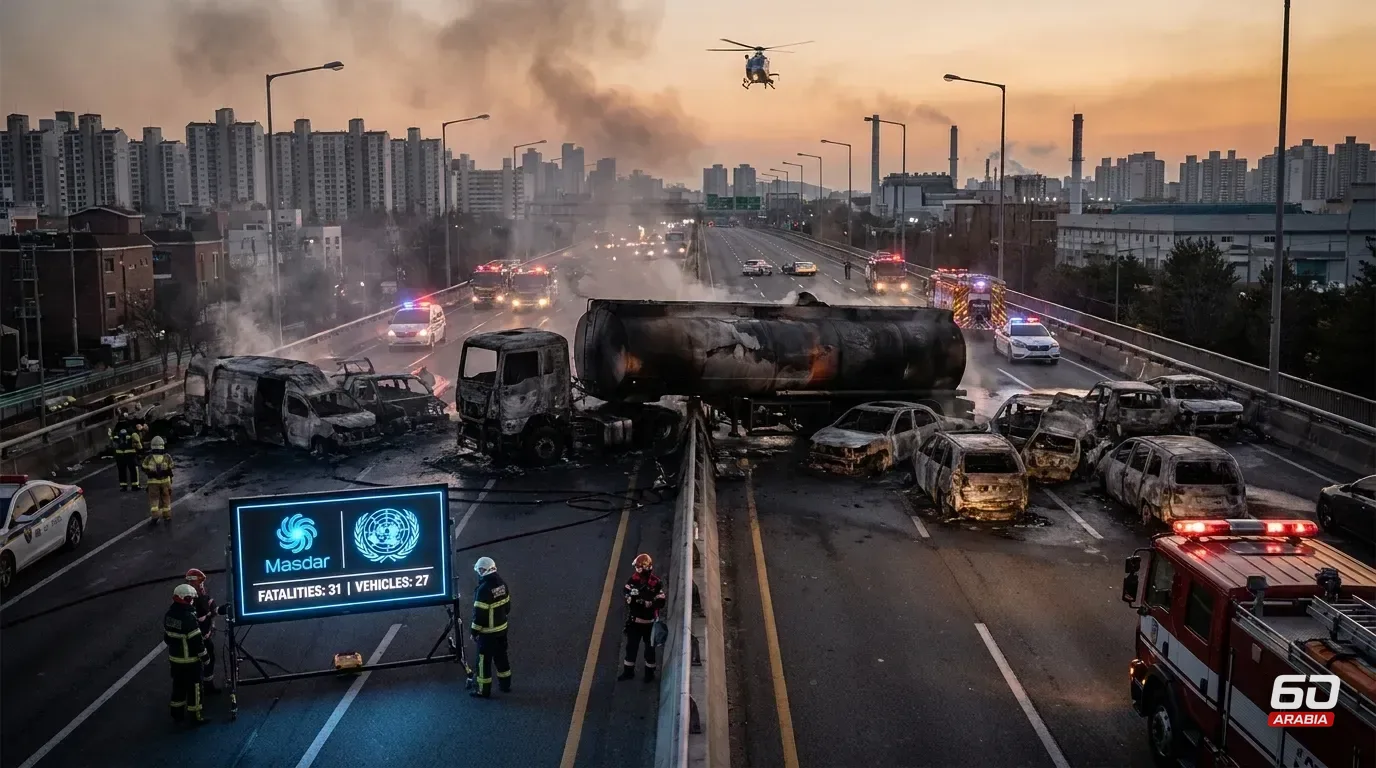
Thirty-one people left their homes on Wednesday morning and never returned. Twenty-seven vehicles were turned into charred frames on the Ring Road near Warraq. The prosecution ordered DNA testing to identify those who could not be identified.
Then preliminary investigations revealed what should change the entire question.
The truck passed all required technical inspections before the accident: tires, electrical wiring, spark arrestor, tank body, and tracking device. The driver — 45 years old, from Menofia — tested negative for drugs. The speedometer recorded that he did not exceed 66 kilometers per hour during his trip prior to the collision.
No speeding. No drugs. No dilapidated truck. No missed inspection.
Every box on the checklist was checked. And 31 people died.
This means the question is not "Who made a mistake?" — but rather which box was never on the checklist to begin with?
Chemistry Explains Combustion... Not the Death Toll
Scientific coverage of the incident explained the chemistry accurately, and it is correct: gasoline evaporates at normal temperatures, and it is the vapor-air mixture that burns, not the liquid itself. Gasoline and LPG vapors are heavier than air, so they crawl along the ground, pool in depressions, and travel far from the leak source. Spilled liquid ignites as a "pool fire" extending under vehicles. LPG stored under pressure, if heated by flames, experiences rising pressure and weakened metal; if it ruptures, part of its liquid rapidly vaporizes in what is known as a Boiling Liquid Expanding Vapor Explosion (BLEVE) — a fireball, pressure wave, metal shrapnel, and potentially a "domino effect" on adjacent tankers. Death comes from radiant heat, carbon monoxide binding to hemoglobin and depriving the heart and brain of oxygen, and smoke inhalation that damages the airways even without extensive burns.
All of this is accurate. And none of it explains the casualty count.
Because gasoline burns with the exact same chemistry in Rotterdam as it does in Warraq. But a tanker overturning on a highway in an open industrial environment kills its driver and perhaps one other person. A tanker overturning above a tunnel on the Ring Road in Warraq's traffic congestion kills thirty-one.
The difference is not chemical. The difference is exposure-based — who was nearby, how many, and whether they could escape.
That is why the most important number in the accident is not 31. It is 27: the number of charred vehicles. A single tanker does not kill that many people. The ignition of 27 vehicles trapped in traffic above a tunnel is what kills them. And each of those twenty-seven cars carried its own fuel, plastic, and rubber — meaning each one became an additional source of fire and smoke.
A single tanker does not kill 31 people. The ignition of 27 vehicles trapped in traffic congestion is what kills them.
The Number That Ends the Debate: 800 Meters
In internationally recognized emergency response guidebooks, the recommendation for a burning gasoline tanker is an isolation distance of 800 meters in all directions. For a burning LPG tanker: 1,600 meters.
Now place this circle on the map.
Imbaba — under whose administrative jurisdiction Warraq falls — spans approximately 8.28 square kilometers and is home to nearly 1.47 million residents. That is a density of roughly 177,000 residents per square kilometer. It is described as having the densest urban residential layout in the world.
A circle with an 800-meter radius covers an area of about 2.01 square kilometers. At that density, it encompasses approximately 356,000 people.
And a 1,600-meter circle for LPG covers about 8 square kilometers, or nearly 1.42 million people.
These numbers are estimates, of course — density is not evenly distributed, and part of the circle falls on the Nile and Warraq Island. But even with a wide margin of error, the conclusion remains the same:
The isolation recommendation is not an evacuation plan at this location. It is an acknowledgment that there is no plan.
When you cannot create distance after the accident, the only available distance is what is created before it. In other words, for the payload not to be there in the first place.
The Missing Box: Route and Timing
And here lies the crux of the matter. The Egyptian inspection system — as the investigations reveal — inspected the truck, and inspected the driver. But nobody inspected the exposure.
The question was never raised: Should tens of tons of highly flammable liquid pass over Tunnel No. 10 on the Ring Road in Warraq, at an hour when 27 vehicles are just meters away from it?
This is neither a theoretical question nor a novel concept. It is an established control measure enforced internationally.
Under European regulations for the road transport of dangerous goods (ADR), tunnels are categorized into categories from A to E based on the severity of potential incidents inside them: major explosion, large toxic release, or major fire. Gasoline (UN number 1203) carried in a tank bears the code D/E — meaning it is prohibited from passing through Category D and E tunnels. The truck is not merely inspected and approved; rather, the route is classified and the cargo is restricted.
The same logic extends to dedicated dangerous goods routes, time windows for passage, special speed limits, electronic monitoring, and avoiding dense urban areas wherever possible.
To be fair in our characterization: the accident occurred above the tunnel, not inside it, so it would be inaccurate to say a tunnel regulation was breached. The issue is deeper than that: the regulatory framework — in the sense of classifying roads and restricting what travels on them — does not seem to have been part of the equation at all.
And the harshest detail in the entire file is this: the truck was equipped with a tracking device, which proved that the driver did not exceed 66 km/h.
The exact same device could have prevented him from entering that road at that hour.
The hardware exists. The function is the difference: it was used for verification after the disaster, not for prevention before it. One technology, two purposes — one forensic, the other preventive. And the first function was chosen.
And in the Tanker Itself
There remains a second engineering layer worth mentioning, with an important caveat.
Known recommendations for fuel tankers include: internal baffles to reduce liquid sloshing during sharp turns or sudden braking, anti-rollover stability systems, emergency shut-off valves, pressure relief systems, and impact protection for tank openings; along with periodic inspections of the tank, tires, and brakes, securing gas cylinders, and specialized driver training for such cargoes.
The caveat: the choice of measure depends on identifying the mechanism, and the mechanism has not yet been determined.
If what occurred was a BLEVE — which requires continuous external flame heating of the vessel for minutes — the remedy is thermal protection and pressure relief. But if it was a mechanical rupture from impact followed by immediate ignition, thermal protection is useless, and the remedy lies in shell integrity, equipment protection, and rollover resistance.
The wrong diagnosis buys the wrong measure. That is why the most critical outcome of the technical investigation will not be assigning fault — but determining what exploded and how.
And This Is Not an Egyptian Issue Alone
In most of our countries, fuel is transported by trucks through dense cities because pipeline networks are limited and distribution is decentralized. The exact same equation exists from Cairo to Baghdad to Beirut to Amman: tankers passing during peak hours on roads that contain everything except distance.
What makes the lesson transferable is that the required measures are neither prohibitively expensive nor technically complex. Classifying roads and tunnels, designating routes and time windows for hazardous materials, and linking existing tracking devices to restriction rules rather than just post-incident logs — these are administrative decisions before they are financial investments.
Conclusion
The inspection system asked: Is the truck fit for the road? And the answer was: Yes, in every box.
And nobody asked: Is the road fit to receive this payload, at this hour, in this traffic congestion, in the densest residential spot imaginable?
And because nobody asked, what happened on Wednesday was not a system failure. It was the system working as designed — and that is the bitter discovery.
So will the question of the road be the box added after thirty-one?

Amro is an industrial expert and scientist with more than 27 years of experience. Throughout his career, he has focused on developing new technologies that reduce pollution and emissions while optimizing operations. His contributions have earned him several industry accolades, including the 2020 and 2021 Gold Stevie Awards. His work was also highlighted by the UK Science Council in an article ahead of COP26 in Glasgow. Amro is a Fellow and Chartered Scientist of the Institute of Science and Technology (FIScT, CSci), a Fellow and Chartered Chemist of the Royal Society of Chemistry (CChem, FRSC) in the UK, a Full Member of Sigma Xi (The Scientific Research Honor Society), and a Fellow and Council Member of the Institution of Engineers in Scotland. He is also a researcher and writer for multiple newspapers and magazines across the Middle East, focusing on the adoption of new technologies. On a personal level, Amro recently received an award from the Kuwaiti government for finding and returning a highly valuable stolen painting.
Profile and all their articlesNovaTAQA

من منع اتفاق أنطاليا؟ ليس من تتوقّعه

بريطانيا لم تعُد إلى أوروبا.. عادت إلى جدارها الكربوني
Canada is Building a Path to Asia... and the Gulf's Seat is on the Line
Iran's Exports Hit Zero... So Who Takes Its Seat in the Chinese Market?
Weekly Newsletter
Read between the lines before everyone else. Decode the most important economic, tech, and decision-maker movements in the region.. in 5 minutes every Saturday.