
Canada is Building a Path to Asia... and the Gulf's Seat is on the Line
Summary
Canada sold 90.8% of its hydrocarbons to a single customer, paying ~$21 billion annually for that reliance. Now it is building a pipeline toward Asia... right where the Gulf sits.
$21 Billion Annually: The Price of a Single Customer... Canada Searches for an Exit
In 2024, the United States bought almost all of Canada's natural gas exports—everything except 0.01%. By volume, 90.8% of Canada's total hydrocarbon exports went south, across the border.
This is not a commercial relationship. This is a company with a single client.
In 2025, 3.9 million barrels per day of Canadian crude flowed to US refineries—representing 63.4% of all US crude oil imports. Ottawa says it wants to change that: aiming for 55% of gas exports to non-US markets by the mid-2030s. From 0.01% to 55%.
The question the headlines aren't asking: Why now? And the answer isn't Trump.
The Figure That Explains Everything
When you have only one customer, they set the price.
Heavy Canadian crude—Western Canadian Select (WCS)—sells at a permanent discount relative to West Texas Intermediate (WTI). Part of the discount is natural and justified: Canadian crude is heavier, higher in sulfur, requires advanced processing refineries, and is costly to transport. But the other part is neither geology nor logistics. It is simply what happens when you have no alternative.
In 2024, the average discount was around $14.73 per barrel. Over the decade, the average was closer to $17. In late 2018, when pipelines were full and there was no outlet, the differential widened to nearly $50 per barrel.
Fifteen dollars on 3.9 million barrels per day equals about $21 billion a year. Every single dollar shift in this differential moves Alberta's revenue by an estimated CAD 740 million.
This is the price Canada paid—year after year, quietly, without tariffs, crises, or news headlines—because it built its entire export system facing in one direction.
New US tariffs—50% on roughly $20 billion worth of Canadian goods in August, and 50% on autos, parts, and steel starting January 1, 2027—didn't create the problem. They merely rendered what was once acceptable unacceptable.
Geography gave Canada a nearby customer. Then it turned out that proximity itself was the constraint.
What Canada Is Actually Building
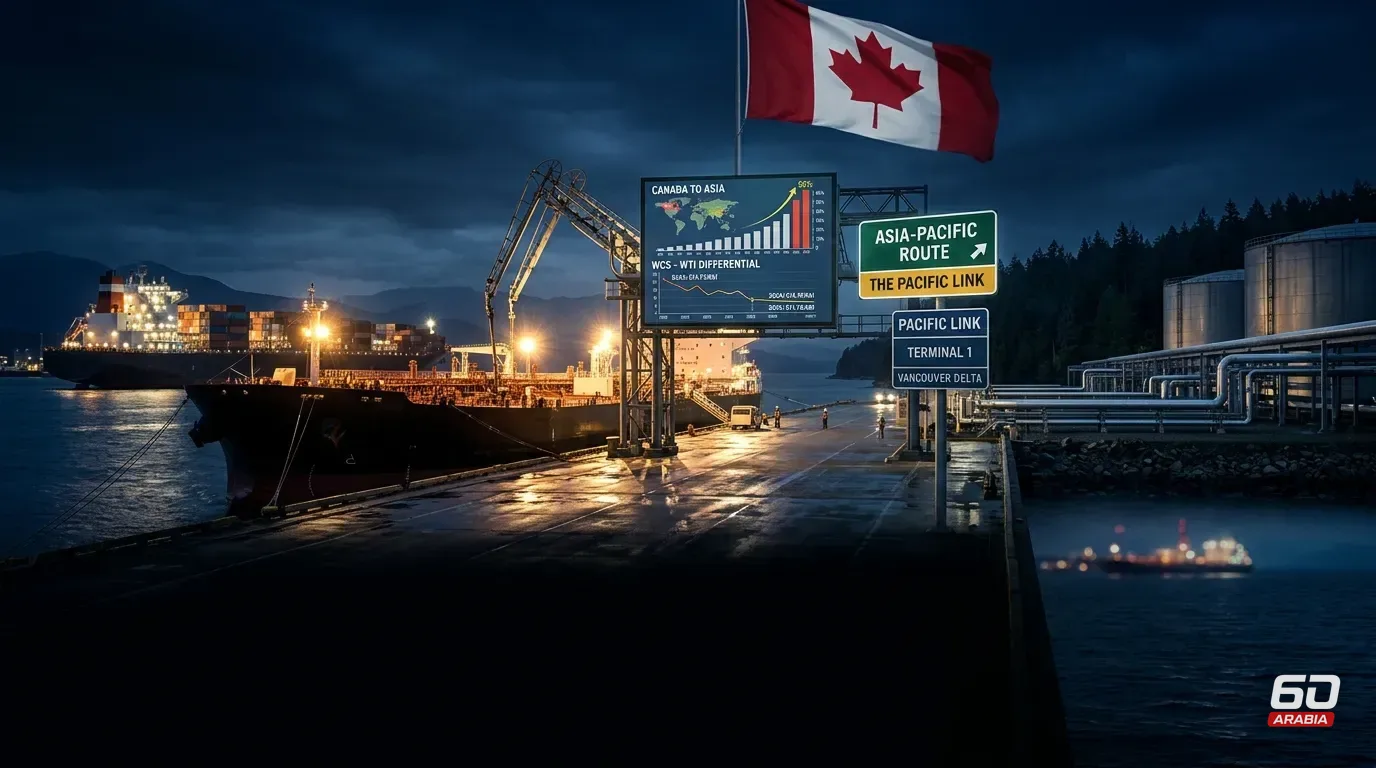
The project is named "Pacific Link": approximately 1,250 kilometers from Bruderheim, Alberta, to Delta, British Columbia, with a capacity of up to 1 million barrels per day destined for Asia. Official estimate: CAD 35.2 to 43.7 billion. Joint ownership split evenly between the federal government and Alberta, with a minimum 10% for First Nations and 10% for Pembina. It is the first project designated under the "Building Canada Act."
Alongside it, on the gas front: Ksi Lisims LNG signed an agreement with Germany's Uniper for up to 2 million tonnes per year for up to 20 years, starting in 2032. Meanwhile, Woodfibre is expanding with CAD 200 million to boost its capacity by 25% to 2.6 million tonnes.
As for Alberta, it targets 8 million barrels per day from oil sands by 2035, estimating additional revenue at CAD 205 billion through 2040 and CAD 1.3 trillion through 2060—driven by a new royalty system starting at 2% of gross revenue for the first five years for projects producing 5,000 bpd or more, then rising by 1 percentage point annually to 6% in years nine and ten.
Prime Minister Mark Carney met with President Xi Jinping at the APEC summit in Shenzhen. Canadian exports to China rose 40% in the first nine months of the year.
All of this is real. And none of this means the oil will move.
Three Things Standing in the Way
First: The cost estimate itself is unrealistic.
Canada has a very recent experience building a pipeline in this exact corridor. Trans Mountain was estimated in 2017 at CAD 7.4 billion. It ended up at 34.2 billion—more than four and a half times higher. The toll rate came out to around $11.50 per barrel, compared to an original target close to $5. And the line added just 590,000 barrels per day.
Pacific Link is estimated at CAD 35 to 44 billion. Same corridor, same mountains, same country, same regulators—and only once in recent history was this type of estimate tested against reality. The result was 4.6 times higher.
Second: The courts.
This is the part most coverage ignores. Nine First Nations in British Columbia filed eight judicial reviews before the Federal Court against the project's designation, joined by Cold Lake First Nations in Alberta—ten nations in total. The argument: consultation was inadequate, and the "Building Canada Act" conflicts with the 2021 United Nations Declaration on the Rights of Indigenous Peoples Act.
And the precedent is not theoretical. In 2016, courts quashed the Northern Gateway project entirely. In 2018, they quashed the approval for Trans Mountain itself. The reason in both cases: inadequate consultation.
The designation was issued on October 1, 2026. Ottawa aims to finalize federal requirements by September 1, 2027. This means the primary risk facing this project is not economic—it is legal, and it is already filed.
Third: Timing does not solve the stated problem.
Tariffs are hitting now. Pacific Link—under the best scenarios, assuming no judicial quashing and no cost overruns—will not load a single barrel onto a tanker before the mid-2030s.
This is not a way out of tariffs. This is a ten-year hedge against a ten-year-old problem.
And Why Does This Matter to Us in the Gulf?
Here lies the point that the original source did not mention.
The stated purpose of Pacific Link is to deliver 1 million barrels per day to Asia. Not Europe, nor a hypothetical market. Asia.
And that is precisely the market Gulf producers are defending right now with their deepest discounts since the COVID pandemic—as discussed in part nine of this series: Aramco offers discounts at the port, but shipments are effectively delivered at much higher levels after freight and insurance absorb the price gap.
Even worse from a competitive standpoint: heavy sour Canadian crude perfectly fits the coking units built by Chinese and Indian refineries specifically to process Middle Eastern heavy crude. It is not a generic competitor—it is a direct competitor within the same grade, for the same processing units, and on the same long-term contracts.
The battle for the Asian seat is happening today. At the same time, a new path is being forged toward it for the mid-2030s.
The Lesson That Extends Beyond Canada
Canada's problem was never geology. It has vast reserves and a sought-after commodity.
Its problem was building its entire export infrastructure facing a single customer, simply because that customer was close and the infrastructure leading to it was cheaper. The decision was economically sound in every single year it was made. Then, the convenient choice turned into dependency, dependency into a discount, and the discount into $21 billion per year.
The price of exiting now: CAD 40 billion and ten years—if the courts allow it.
This question is not Canada's alone. A region that moves nearly a fifth of global oil trade through a single strait, and routes an increasing share of its exports to a single major market in East Asia, recognizes this pattern from within. Concentration always looks like efficiency—until a single factor changes on the other end.
Could the Canadian lesson be that market diversification must be built when it does not seem necessary—because by the time it becomes necessary, the price tag is forty billion dollars and a court ruling?

Amro is an industrial expert and scientist with more than 27 years of experience. Throughout his career, he has focused on developing new technologies that reduce pollution and emissions while optimizing operations. His contributions have earned him several industry accolades, including the 2020 and 2021 Gold Stevie Awards. His work was also highlighted by the UK Science Council in an article ahead of COP26 in Glasgow. Amro is a Fellow and Chartered Scientist of the Institute of Science and Technology (FIScT, CSci), a Fellow and Chartered Chemist of the Royal Society of Chemistry (CChem, FRSC) in the UK, a Full Member of Sigma Xi (The Scientific Research Honor Society), and a Fellow and Council Member of the Institution of Engineers in Scotland. He is also a researcher and writer for multiple newspapers and magazines across the Middle East, focusing on the adoption of new technologies. On a personal level, Amro recently received an award from the Kuwaiti government for finding and returning a highly valuable stolen painting.
Profile and all their articlesNovaTAQA
Iran's Exports Hit Zero... So Who Takes Its Seat in the Chinese Market?
إطعام الآلة
برنت هبط 17% في خمسة أيام.. فهل انتهت أزمة النفط حقاً؟
حين يتوقف النظام لأنه لا يعرف.. درس من سماء أمريكا
Weekly Newsletter
Read between the lines before everyone else. Decode the most important economic, tech, and decision-maker movements in the region.. in 5 minutes every Saturday.