

The Largest Chimpanzee Community is at War... and Scientists Don't Know Why
Summary
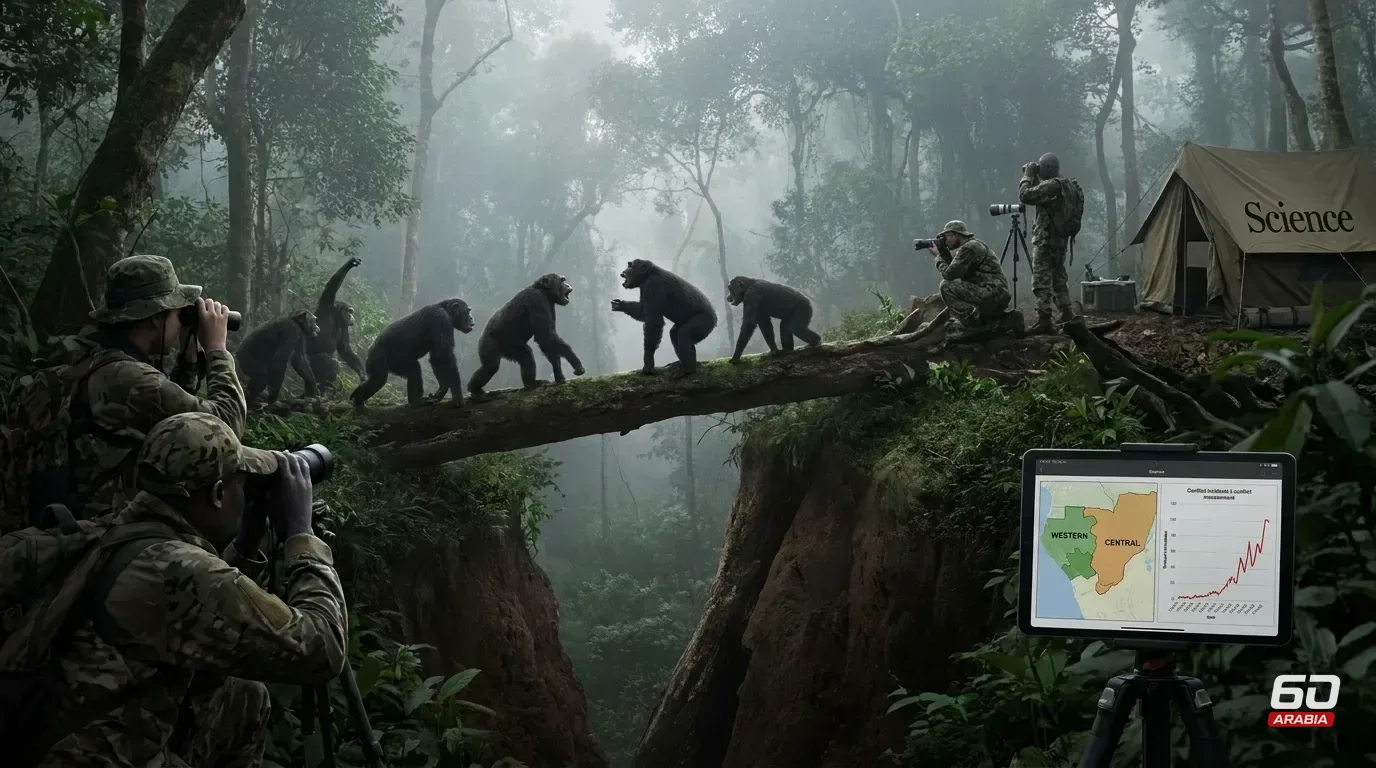
A study published in the journal Science shows that changes in social networks alone can split communities and drive them to violence, after documenting the split and deadly fighting within Uganda's largest chimpanzee community.
In the Kibale Forest of Uganda lives a community of chimpanzees that scientists have been observing since 1995.
Thirty years of daily observation. Names for every individual, records for every birth, and maps of every friendship and alliance.
The Ngogo community was exceptional even in the world of chimpanzees: around 150 to 200 individuals, making it the largest cohesive group of wild chimpanzees ever recorded in history.
Then, slowly, it began to split.
And in 2018, the two halves began killing each other. And they haven't stopped yet.
What Exactly Happened?
On April 9, 2026, the journal Science published a paper titled "Lethal conflict following a mass fission in wild chimpanzees," prepared by a team led by Aaron Sandel from the University of Texas at Austin, with co-authors including John Mitani, one of the foremost researchers of this site.
The timeline documented by the paper is worth reading slowly:
2015: The first signs of division appear. Two social groups gradually differentiate. The last inter-group pregnancy is recorded in March of that year.
2016: Boundary patrols begin, mostly conducted by one of the two groups.
2017: The two groups use separate areas of the forest.
2018: Researchers conclude that the split has become permanent. They name the two groups the Central and Western communities.
Then the killing begins.
The Numbers
Between 2018 and 2024, the Western group carried out 24 attacks on the Central group, killing at least seven adult males and 17 infants.
To put that into true perspective, researchers calculated the mortality rate in the Central group at around 3,376 per hundred thousand annually. That means roughly 3.4% of the group's members are killed each year.
And the typical average in other chimpanzee communities? Around 100 per hundred thousand.
That is more than thirty times higher.
Sandel notes that the true figure is likely higher, as other individuals disappeared without a clear cause. Furthermore, attacks continued into 2025 and 2026, beyond the timeframe of the paper's data.
Why Is This So Rare?
Because this is only the second documented case in the history of chimpanzee research.
The first case occurred in Gombe, Tanzania, in the early 1970s, observed by Jane Goodall and dubbed the "Four-Year War."
Researchers estimate that such an event occurs roughly once every five hundred years.
We are therefore witnessing an event that humans have observed only twice in the entire history of science.
The Unanswered Question: Why?
And here is where things become truly disturbing.
Scientists do not know.
They examined the usual explanations:
Was food scarce? Sandel says his initial impression was that food was not a limiting factor, though he admits it is difficult to be certain.
Was the group too large? James Brooks of the German Primate Center, who was not involved in the study, suggests that the group may have exceeded the size at which it could remain cohesive.
Was it an external shock? In 2014, five adult males and one adult female died. In 2015, the alpha male changed. In 2017, a respiratory epidemic of human origin killed 25 individuals in the community.
What about an aggressive nature? Liran Samuni, from the same center, notes that Ngogo was already one of the most violent known communities toward its neighbors. Between 1998 and 2008, its members killed at least 21 individuals from neighboring groups.
Yet, the question remains open. None of these factors alone explains why lifelong friends turned into targets.
A Hypothesis Worth Considering
The study proposes what it calls the "relational dynamics hypothesis": that shifts in social bonds themselves are capable of reshaping group identities, and that this alone can lead to collective violence.
In Sandel's wording, the study shows that social networks on their own can split a group and drive it to collective violence, without race, religion, or political ideology.
Pause here, because this is the most important sentence in the entire story.
We are accustomed to explaining wars by their causes: this is a religious war, that one is ethnic, a third is over resources, and a fourth is ideological. We assume that the cause precedes the division, and that division precedes violence.
But what happened in Ngogo turns that order upside down.
Chimpanzees have no religion, no nationality, no flags, and no historical narrative to fight over. Yet, they split and killed.
This raises an uncomfortable possibility: that the formation of group identity itself—the mere crystallization of "us" and "them" out of a once-connected social network—may be enough. And that what we call "causes of war" might partly be a justification added after the split, rather than the cause that produced it.
A Note on Scale
There is another detail worthy of attention: Ngogo was the largest cohesive chimpanzee community ever recorded.
And it is the one that split.
Not the poorest, nor the weakest, nor the one under the most external pressure. But the largest.
This aligns with a longstanding observation in sociology and organizational studies: group cohesion has a numerical ceiling. When the number of individuals exceeds the network's capacity to keep everyone connected to everyone else, the group begins to cluster, then differentiate, and ultimately split.
This is merely an analogy, not proof. But the scene is familiar to anyone who has watched an organization grow until it turns into two camps that no longer speak to each other.
Before We Jump to Conclusions
Let us be precise, as the researchers themselves are cautious about jumping to conclusions.
First, regarding terminology. Sandel hesitates to use the term "civil war," because it has a specific meaning in human contexts and chimpanzees do not have states. Michael Wilson of the University of Minnesota, who was not involved in the study, prefers the phrase "mass fission followed by fighting."
Second, and most importantly: bonobos.
Bonobos are just as closely related to us as chimpanzees are. Yet they form distinct, stable groups without lethal collective conflict.
Brooks states it clearly: "Our evolutionary past does not dictate our future."
In other words, we have two models in our evolutionary family tree, not just one. And nothing in biology compels us to choose one over the other.
Conclusion
Thirty years of observation in a single forest yielded a simple and disturbing insight: a community that lived cohesively for decades, with no religion, race, or ideology to divide it, split purely through its own social network, and then spent eight years killing those who were once its own.
And we don't know why. We may never know.
And perhaps that is precisely the lesson. We spend our time debating the causes of divisions, assuming that addressing the cause will prevent the outcome.
But Ngogo suggests something else: that the division itself may be the danger, and that the causes may only come later to justify it.
The question worth leaving open is: How many of our own divisions actually started for the reason we think?

Amro is an industrial expert and scientist with more than 27 years of experience working in the oil and gas industry for such companies as Halliburton, Schlumberger and Baker Hughes. Currently, worked as a global Technology and Sustainability leader for AK Well Services based in Aberdeen. He has worked in most Middle East countries, the United Kingdom, all North Africa, and Azerbaijan. During his career, he has focused on new technology developments that reduce pollution, and emissions and optimize operations. His contribution resulted in winning several industrial awards and winning 2020 and 2021 Gold Stevie Awards. Amro's work has been highlighted by the UK Science Council in an article prior Cop26 in Glasgow. Amro is a Fellow of The Institution of Engineers in Scotland (FIES), Fellow (FRSC) and Chartered Chemist (CChem) of the Royal Society of Chemistry (RSC), Fellow (FIScT) and Chartered Scientist (CSci) of the Institute of Science & Technology, a full member of Sigma Xi, The Scie
Profile and all their articlesNovaTAQA
حين يتوقف النظام لأنه لا يعرف.. درس من سماء أمريكا

A Loophole in the Chip War That Laws Cannot Plug... Its Name Is Humans

A Climate Phenomenon Doing to Chokepoints What War Did.. The Great El Niño

النفط السعر الذي تقرأه ليس السعر الذي يُدفع
Weekly Newsletter
Read between the lines before everyone else. Decode the most important economic, tech, and decision-maker movements in the region.. in 5 minutes every Saturday.