
Why Is Oil Demand Rising Despite Clean Energy's Victory?
Summary
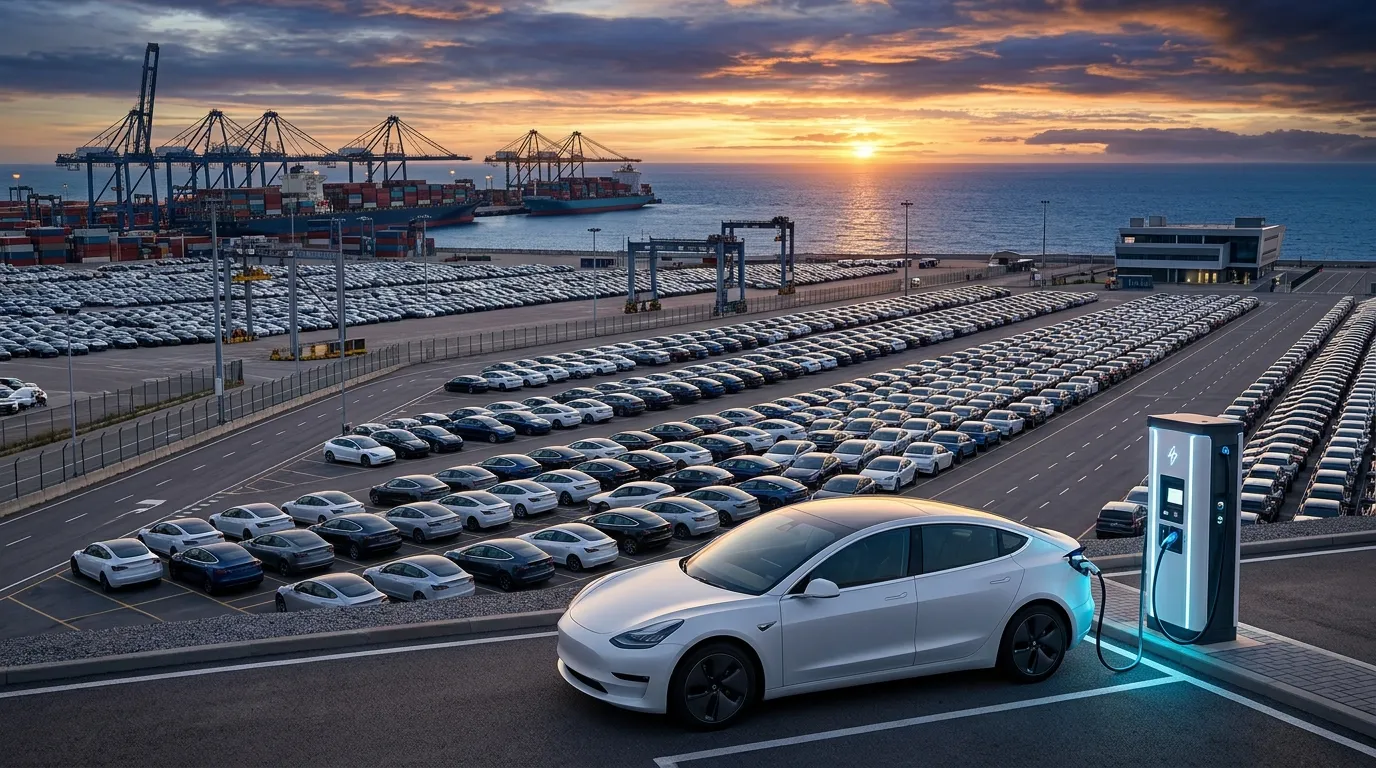
The energy transition goes through three stages starting with sales and later reaching consumption, as electric vehicles displace only about 2% of oil despite combustion engine car sales declining since 2017.
In 1973, the world's first mobile phone was demonstrated. Yet, the number of landlines continued to rise until 2006.
Thirty-three years of growth, after the emergence of the technology that would kill it.
And an even stranger example: the number of horses in the United States peaked in 1920, more than three decades after the appearance of the first practical internal combustion engine car.
Remember these two numbers well, because they are the key to today's most confusing energy debate.
The Question Dividing Experts
In his book "More and More and More," French historian Jean-Baptiste Fressoz put forward a shocking thesis: Energy sources do not replace one another; rather, they stack on top of one another.
His evidence is simple and troubling. Coal did not eliminate firewood; it joined it. Oil did not eliminate coal; today, the world burns more coal than ever before. And renewable energy? It joined them all.
Looking at total global figures, he seems entirely correct. Despite trillions of dollars invested in clean energy, fossil fuel consumption remains near record levels.
Is the transition an illusion, then?
No. But we are measuring it with the wrong yardstick.
The Right Yardstick: Three Stages, Not One
Here lies the heart of the matter, which explains the mobile phone, the horse, and oil altogether.
Displacement does not happen all at once; rather, it goes through three successive stages, separated by long time gaps:
The First Stage: New Sales. Here displacement appears first, and here the battle begins and is decided.
The Second Stage: Existing Fleet. Previously sold cars do not disappear; they remain on the road for fifteen years or more. And the fleet continues to grow even after sales decline.
The Third Stage: Fuel Consumption. This last one does not decline until the fleet itself begins to shrink.
Then come total global statistics at the end, years after all of that.
This is precisely what happened with landlines. Starting in 1973, the battle began in sales, but installed lines kept increasing for three decades, because installing a new line was faster than dismantling an old one. And when the equation finally flipped, it collapsed rapidly.
Anyone looking at the global total and concluding that the transition has not started is like someone who looked at landlines in 1995 and declared the mobile phone a failure.
Where Are We Really?
Let us apply the three-stage yardstick to cars.
In Sales: Internal combustion engine car sales peaked globally in 2017, according to data from "Our World in Data." By 2024, they had fallen by about a third, while electric vehicle sales surpassed 17 million cars.
The battle in this stage is effectively decided.
In the Fleet: Analyst Michael Liebreich estimates that around 58 million electric cars were on the road by the end of 2025, representing slightly under 4% of the global vehicle fleet.
Only four percent. Here, the battle is just beginning.
In Fuel Consumption: These cars displace slightly over 2 million barrels per day of oil.
To put this number in context: global demand hovers around one hundred million barrels per day. That means all electric cars in the world displace only about 2% of demand.
The International Energy Agency projects in its 2026 report that displacement will reach about 5 million barrels per day by 2030, and around 9 million by 2035 under current policies.
Nine out of a hundred. Ten years from now.
This is neither a failure nor a victory. It is the natural shape of the substitution curve at its midpoint.
And in Electricity, the Story Goes Much Further
If you want to see what happens when displacement matures, look at Europe.
In 2025, wind and solar generated 30.1% of the European Union's electricity, compared to 29% from all fossil fuel sources combined, according to "Ember" data. Just a decade ago, fossil fuel generation was nearly three times that of wind and solar combined.
Globally, wind and solar provided 20% of electricity by 2025, according to BloombergNEF, after annual installations rose from 300 GW in 2021 to 815 GW four years later.
And here is a hidden factor that multiplies the impact: efficiency.
An internal combustion engine wastes most of the fuel's energy as heat, whereas an electric car converts a far higher proportion into motion. And a heat pump gives you three or four units of heat for every single unit of electricity.
This means replacing a unit of fossil fuel energy with an electric unit is not a one-to-one swap; rather, it eliminates the need for several units. For this reason, electricity's share of useful energy rose from about 10% in 1970 to around 30% today, according to Liebreich.
The effect shows up in macroeconomic numbers: the global economy grew by about 50% over fifteen years, while emissions rose by only 9%. This is not complete decoupling, but it is a real decoupling that has begun to widen.
The Angle That Concerns Us: When a Solar Panel Frees Up a Barrel
Here the story reaches our region, with a paradox that is rarely mentioned.
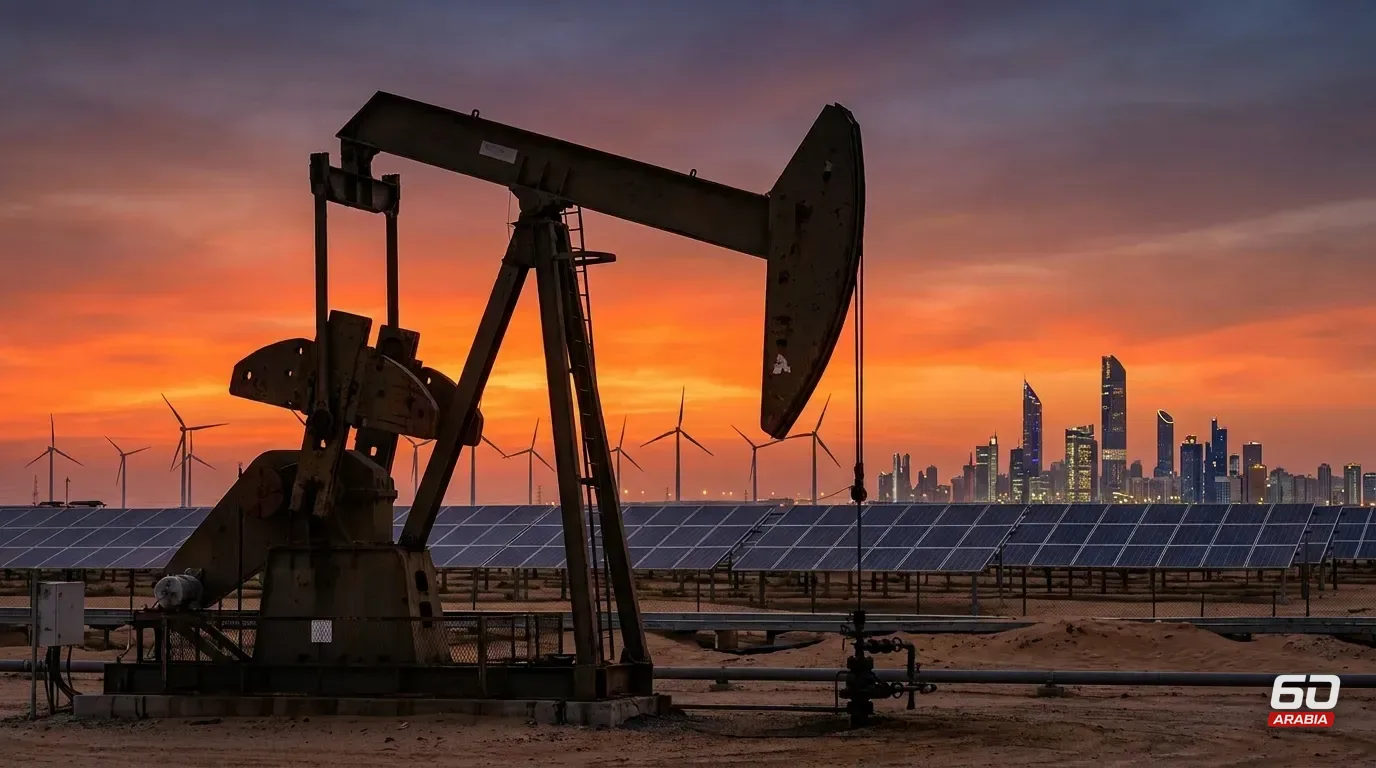
Saudi Arabia burns massive quantities of liquid fuels to generate electricity and desalinate water, as the power sector consumes nearly 1.4 million barrels per day during summer peak demand, with an annual average of about 1.1 million barrels per day. The difference between winter and summer alone is nearly one million barrels per day.
The Kingdom targets over 100 GW of renewable energy, mostly solar, by 2030, alongside increasing gas production.
Now, the question: what happens when solar and gas replace those barrels?
The barrels do not disappear. They are exported.
Meaning that the victory of clean energy inside the Gulf implies, in the near term, more oil in the global market, not less. This is a rare case where local energy transition is an economic win-win for the exporter: domestic savings and additional saleable barrels.
It is also an additional reason explaining why overall global figures remain stubborn: clean energy wins in one place, while the freed-up fuel moves to another place to be burned there.
Displacement is local, while fuel movement is global.
And Where Is There No Battle At All?
Let us be fair to the full picture. There are sectors where the first stage has not even begun, let alone the second or third:
Aviation, as there is no large-scale commercial alternative to jet fuel. Maritime shipping, which is in the experimental phase. Cement and steel, where the problem is not just energy but the chemistry of the process itself. And petrochemicals, which are the most vital in the Gulf, because oil there is not a fuel to be burned but a raw material that enters the structure of the product, and cannot be replaced by electricity no matter how cheap it gets.
The latter forms what can be called the demand floor. Even if every car in the world were electrified, significant demand for oil as a raw material would remain.
When Does the Shrinkage Actually Begin?
The author of the original thesis suggests a clear metric worth remembering:
The moment when clean energy growth exceeds total energy demand growth.
Before that moment, the increase in global demand consumes everything clean energy adds, keeping fossil fuels at their level, making the transition look like an addition rather than a substitution. After that moment, the decline in fossil fuel supply becomes mathematically inevitable, not optional.
This is the point the region must monitor, not climate conference headlines.
Conclusion
Coal did not displace firewood, and oil did not displace coal. This is true.
But the horse was indeed displaced, and the landline was indeed displaced. Both took decades after the appearance of their alternative, and both appeared during those decades as if unbeatable.
The transition is real, but it always starts in a place we are not looking at: in new sales, not in the global total.
And the question that must be asked in Riyadh, Cairo, and Abu Dhabi is not: Will the oil age end? Rather: At what stage of the curve are we now, and how much time does that give us?
Whoever has a precise answer to this question has a plan. And whoever waits for total figures to tell them will find out too late, just as landline manufacturers found out in 2006.

Amro is an industrial expert and scientist with more than 27 years of experience working in the oil and gas industry for such companies as Halliburton, Schlumberger and Baker Hughes. Currently, worked as a global Technology and Sustainability leader for AK Well Services based in Aberdeen. He has worked in most Middle East countries, the United Kingdom, all North Africa, and Azerbaijan. During his career, he has focused on new technology developments that reduce pollution, and emissions and optimize operations. His contribution resulted in winning several industrial awards and winning 2020 and 2021 Gold Stevie Awards. Amro's work has been highlighted by the UK Science Council in an article prior Cop26 in Glasgow. Amro is a Fellow of The Institution of Engineers in Scotland (FIES), Fellow (FRSC) and Chartered Chemist (CChem) of the Royal Society of Chemistry (RSC), Fellow (FIScT) and Chartered Scientist (CSci) of the Institute of Science & Technology, a full member of Sigma Xi, The Scie
Profile and all their articlesNovaTAQA

Gulf Petrochemicals: An Advantage That Isn't Enough

A Jump of Seconds and the World Believed It: Musk's Car Between Reality and Science Fiction

Emerging Market Easing Dilemma: Rate Cuts Are No Easy Fix

Nobel 2026... The Story That Began in a Pond and Ended with Light for the Brain
Weekly Newsletter
Read between the lines before everyone else. Decode the most important economic, tech, and decision-maker movements in the region.. in 5 minutes every Saturday.