
Nobel 2026... The Story That Began in a Pond and Ended with Light for the Brain
Summary
An innocent question about an alga swimming toward light led to a technology that ignites a specific neuron in a living brain. The 2026 Nobel Prize in Medicine goes to three scientists.
On October 5, the Nobel Committee awarded the Prize in Medicine to three scientists. But the prize, at its core, went to a single-celled organism swimming in a pond.
American Karl Deisseroth and Germans Peter Hegemann and Georg Nagel won the 2026 Nobel Prize in Physiology or Medicine for their discoveries concerning light-gated ion channels and optogenetics. The technique, as described by Thomas Perlmann, Secretary-General of the Nobel Assembly, allows turning the activity of single neurons in a living brain on or off.
But no one was looking for that when the story began.
A Question That Didn't Seem Important
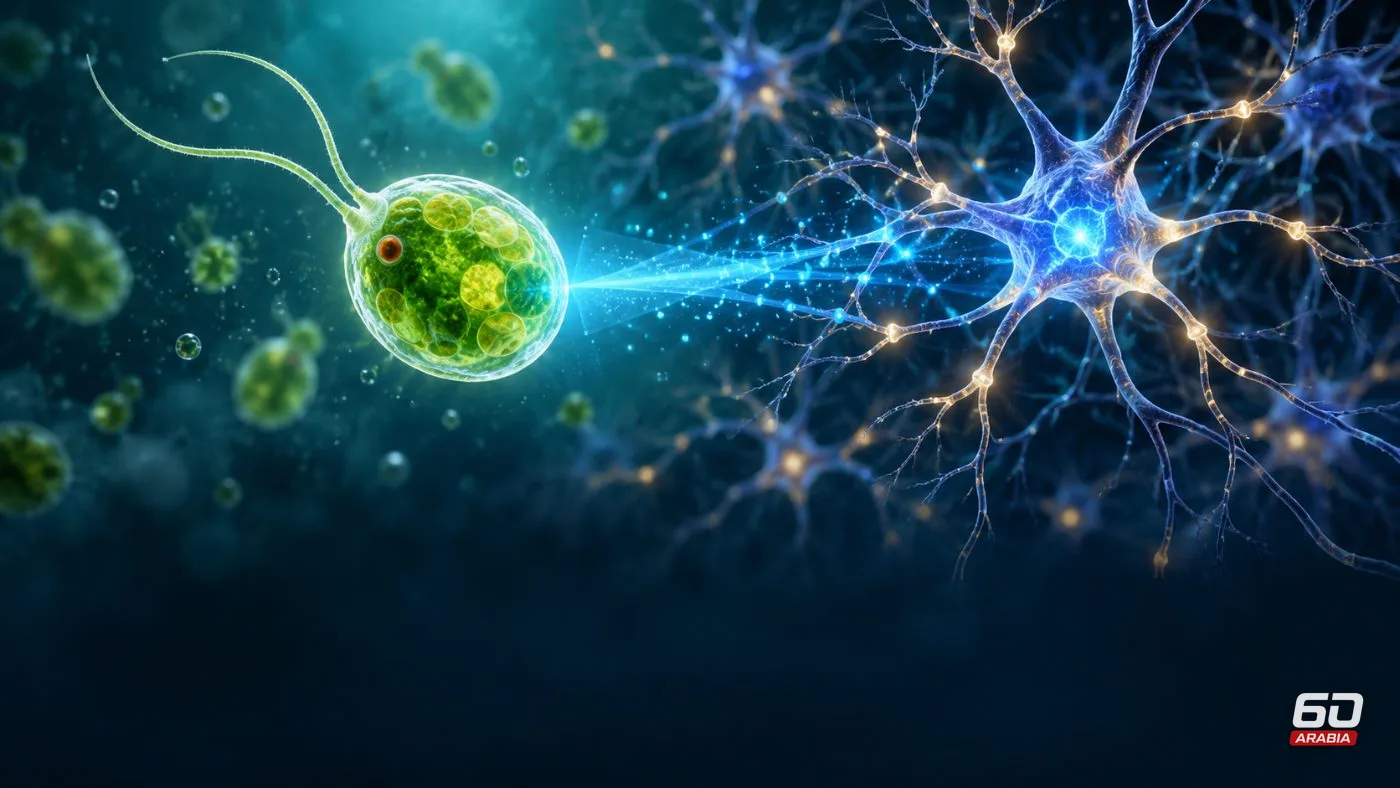
At the turn of the millennium, Peter Hegemann was preoccupied with a seemingly marginal question: How can a single-celled alga called Chlamydomonas move toward a light source?
A microscopic organism in stagnant water, swimming toward the light. The question had nothing to do with the brain, blindness, or depression.
In collaboration with Georg Nagel, the two discovered the protein responsible and named it channelrhodopsin, located on the cell surface. When blue light shines on it, it opens a channel through which charged ions cross into the cell, generating an electrical pulse.
Then came the observation that changed everything: The protein works in any cell it is inserted into. Introduce it into a cell that was never light-sensitive, and it becomes light-sensitive.
From the Pond to the Brain
This is where Karl Deisseroth stepped in—not only a neuroscientist but a practicing psychiatrist who sees patients with depression and schizophrenia in his clinic.
Deisseroth introduced the channelrhodopsin gene into rat neurons, then shone blue light on them, generating a neural signal. He demonstrated this in rat cells in 2005, and the method was named Optogenetics in 2006.
Later, he succeeded in applying the mechanism inside the brains of living mice. In one experiment, he controlled the movement of a mouse's whiskers by activating specific neurons in the motor cortex.
Imagine the meaning: a light switch for a single cell, in a working brain, of a moving organism.
Why Is This Truly a Revolution?
Before optogenetics, scientists could observe the brain and stimulate it electrically in a crude manner affecting thousands of cells at once. It was like trying to understand a city by turning off electricity for an entire neighborhood.
Now, however, it has become possible to ignite or turn off a specific cell, and then observe what changes in behavior. This is the difference between observation and causality: knowing that this specific cell causes this specific behavior.
The method has allowed the identification of neural circuits responsible for specific memories, emotions, and behavioral responses associated with neurological and psychiatric diseases. Per Svenningsson, chairman of the Nobel Committee, stated that optogenetics enables mapping the brain in a way that was once nothing but a dream.
Has It Reached Patients?
Partially, and with caution.
The closest application is restoring vision. In conditions like retinitis pigmentosa, photoreceptor cells die while other retinal cells remain alive. The idea is to confer light sensitivity to those remaining cells by introducing an opsin gene into them.
Results from a Phase 2b clinical trial in patients with advanced disease showed improvement in visual function in a subset of treated patients following a single intravitreal injection, with acceptable safety. However, the sample size was small, not exceeding 27 patients, and the results have not yet received final regulatory approval.
Another promising application is being proposed in cochlear implants, where optical stimulation could allow higher precision in stimulating the auditory nerve than current electrical devices provide.
Fairness requires stating: optogenetics today is a first-rate research tool, and a treatment in its infancy. It requires introducing a foreign gene into human cells and delivering light deep into tissue—both of which are real obstacles outside the eye, where light naturally enters. As Anna Wedell of the Nobel Committee put it, a new era in neuroscience has opened, but it is only the beginning.
The Lesson That Goes Beyond the Prize
If Hegemann's project had been presented to a funding committee demanding immediate impact, their question would have been: What is the use of knowing why an alga swims toward light?
The honest answer back then was: No clear use.
Nearly twenty years later, the answer has become: It is how we read the circuits of memory, fear, and addiction, and perhaps how we restore sight to those who lost it.
This is the essence of basic research. It does not promise an application; rather, it builds the reservoir from which applications are later drawn. Countries that fund curiosity alone reap after two decades what cannot be bought off the shelf.
Here lies the question that concerns us in the Arab world. Research budgets in the region mostly lean toward projects with immediate and specific returns—an understandable choice for economies under pressure. Yet not a single country has built a genuine scientific foundation solely by funding applications. Applications can be bought, but basic knowledge cannot be imported; even if you import it, you remain a follower to whoever owns it.
And a Small Human Detail
When the committee called the three winners, their reaction was unanimous: each said that the best part was sharing the prize with the other two, describing one another as "my friends."
Three researchers, in two countries, over twenty years, each building on what the other left behind. No competition, no race for priority.
In an era where science is measured by publication speed and citation counts, perhaps this detail is the second lesson of the story.
If you were asked today: Which question seems trivial now, yet will shape the medicine of 2046?



Weekly Newsletter
Read between the lines before everyone else. Decode the most important economic, tech, and decision-maker movements in the region.. in 5 minutes every Saturday.