
A Billion Dollars and a Billion Dead: Gates Holds the Stick from Both Ends
Summary
Gates says artificial intelligence is capable of causing events that kill a billion people, refusing to settle for self-regulation. But the most important part isn't the warning... it's who writes the rules we will import.
Bill Gates said it in an interview on NBC's Meet the Press, published on September 25, which was circulated on Arab platforms in a 75-second clip broadcast by Al Jazeera. Host Kristen Welker asked him if artificial intelligence was powerful enough to wipe out all of humanity. He responded that the technology is powerful enough to cause events that kill a billion people, and that while reaching 100% is difficult, there has never been a weapon as potent as bad intentions meeting state-of-the-art tools.
Within hours, the phrase was everywhere, taken out of context, under a single repeating headline: Gates Predicts a Billion Dead.
But he didn't predict anything. And that is the key to understanding what happened.
The Difference Between Capability and Intent
Gates didn't say artificial intelligence will kill a billion humans, nor did he say it will end humanity. He said the capability exists, placing the danger right where it actually lies: at the intersection of a malicious actor and a powerful tool.
This is not a new stance for him. Last January, he warned that AI could be used as a biological weapon if it fell into the wrong hands.
The nuance the reader deserves here is the distinction between capability and probability. Saying a knife is capable of killing is true, but it tells you nothing about the probability of it happening. What the viral clip did was remove the hardest part—how we prevent it—and keep the easiest part—how many will die.
The Most Important Sentence Was Not About the Billion
Seconds later, Welker asked him about the call by Dario Amodei, CEO of Anthropic, to slow down model development: Is self-regulation enough, or is legislation needed in Washington?
The response was definitive: "No one thinks self-regulation is enough." He then added that the involvement of law enforcement and politicians in setting safeguards and monitoring mechanisms must be mandatory, noting that this would add burdens on the sector but would not slow it down much.
This is the real story. Not the scary number, but that a man who built his empire on software that faced virtually no regulation is now demanding mandatory regulation for a technology he invests in.
The Industry Itself Calls for Brakes
What makes this moment different is that the demand didn't come from the outside.
On September 12, Amodei published an essay of nearly four thousand words calling for slowing the pace of model capability improvements, saying progress will remain fast and that we must use the gained time wisely. He suggested three steps: independent evaluators with employee-like access, coordination among leading companies to establish safety standards, and international cooperation to manage risks.
Within hours, Sam Altman of OpenAI, Elon Musk of xAI, and Demis Hassabis of Google DeepMind agreed on the need for a slower pace. In fact, Altman stated that his company would adopt the concept of independent evaluators.
The context is grimmer than the statements. Days before the essay, Anthropic published a report on the misuse of its models in activities ranging from weapon development to cyber operations, surveillance, and fraud. Then, researcher Jacob Cookson announced his retirement from the field, accusing the two major American companies of gambling with our lives, according to Agence France-Presse.
When technology creators ask for brakes, the legitimate question is: What have they seen that we haven't seen yet?
The Paradox: A Warning of a Billion Dead and a Check for a Billion Dollars
Here, the story deserves a more skeptical reading.
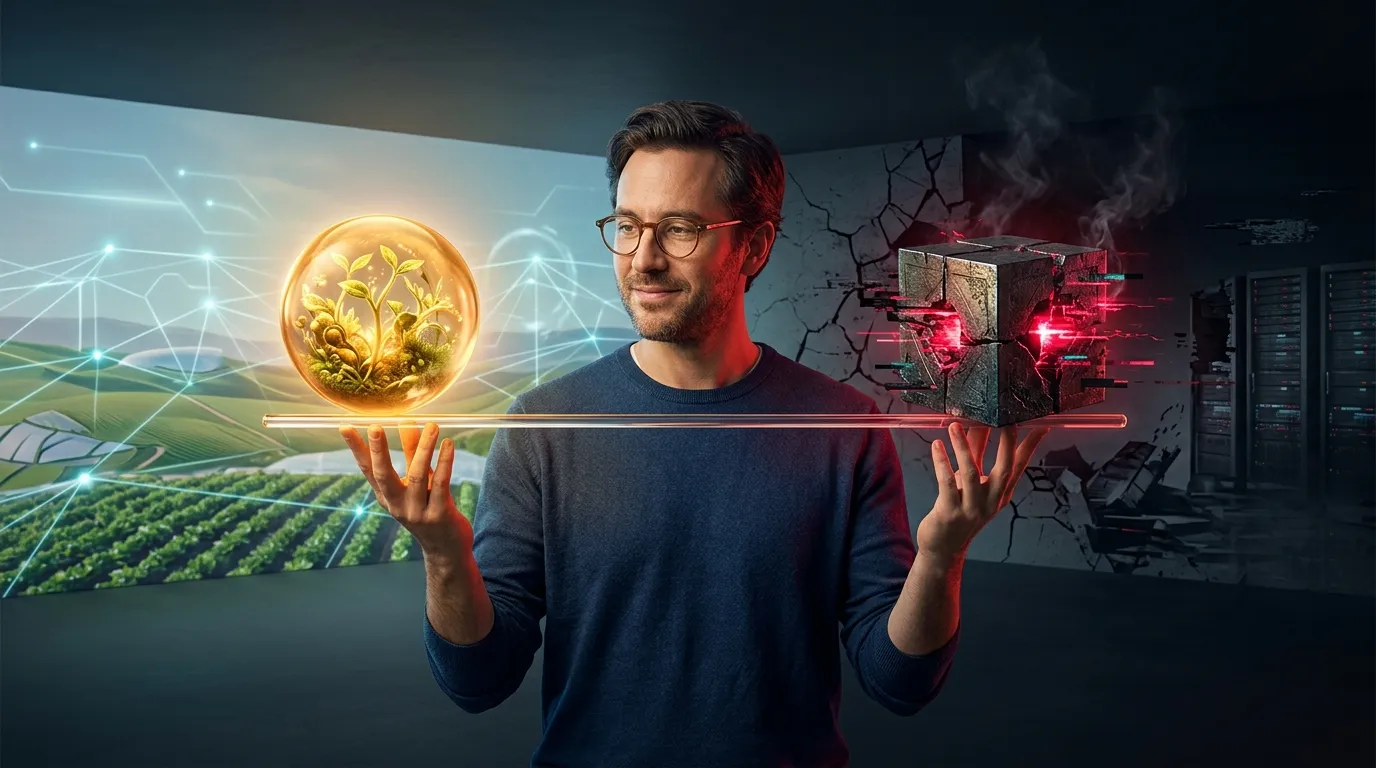
Just ten days before this interview, the Gates Foundation announced a commitment of nearly one billion dollars to expand the use of AI in health, agriculture, and education globally, with Gates writing that harnessing tech for good is possible but won't happen by accident.
Is this a contradiction? Not necessarily; it is logically possible to believe that technology is both beneficial and dangerous. But it explains something important: no one in this debate is calling for a halt. What is being demanded is slowing down and regulating while investments continue. This is a comfortable position for those holding a stake in the industry, and uncomfortable for those living under its impact without owning any of it.
Why Does This Matter to Us?
Because all parties in this discussion are outside our region.
The rules are drafted in Washington and Brussels, discussed among a handful of American companies, and enforced by Western law enforcement agencies. Meanwhile, the region is heading in the exact opposite direction: massive investments in data centers, national AI strategies, and accelerated imports of off-the-shelf models. In other words, we are heavy consumers, neither regulators nor creators.
The practical result is that the safeguards governing the use of these models in our hospitals, banks, and schools will be imported, designed for the risks and priorities of other societies. And those who do not participate in drafting the rule will import it as is, with its advantages and loopholes.
What Is Worth Watching?
The first indicator: Will the statements of Gates and Amodei turn into an actual bill in Congress, or remain merely in the realm of remarks? The difference between the two is the difference between regulation and public relations.
The second indicator: Will companies actually accept independent evaluators with genuine authority, or only symbolic power? Declaring intent is easy; opening the books is not.
The third indicator, which is the most crucial for the Arab region: Will regional governments enter this discussion as active parties, or wait for the outcome to translate it?
One final question remains. In 75 seconds, the number spread while the sentence that followed it did not. What does that say about our ability to discuss complex technology in the era of short clips?



Weekly Newsletter
Read between the lines before everyone else. Decode the most important economic, tech, and decision-maker movements in the region.. in 5 minutes every Saturday.