
Gulf Petrochemicals: An Advantage That Isn't Enough
Summary
The Hormuz crisis drove polymer prices up by over 50% and widened the Gulf's cost advantage. Yet, one company saw its prices jump 45% while its profit dropped 1%. Where does the advantage go?
The prevailing narrative about Gulf petrochemicals this year is simple and comforting: the crisis did not touch its cost advantage.
It is a true narrative, but it is incomplete to the point of being misleading.
Let us start with the comforting numbers first.
The Bright Side of the Story
The Middle East exported 18.7 million tons of polyethylene in 2025, out of total global exports of 43.8 million tons, representing about 43% of global trade. North America came in second with 15.6 million tons.
Since March, polyethylene and polypropylene prices have surged by over 50%.
More importantly, a UN analysis in August showed that Middle Eastern exports of polypropylene dropped by only 24% between April 2025 and April 2026, making it the least affected among twelve major commodities. Compare that to the rest: total exports dropped 54%, LNG 95%, urea 83%, methanol 80%, and ammonia 75%.
In the language of financial analysis, this is an exceptional performance amidst a disaster.
Why Did Costs Hold Up? The Answer Lies in Ethane
Here, the reader needs a brief technical understanding that explains everything.
Ethylene plants globally fall into two types. The first type, prevalent in Asia and Europe, operates by cracking naphtha—a liquid derivative of oil refining—so its price tracks crude oil prices. The second type, prevalent in the Gulf and North America, operates by cracking ethane—a gas extracted alongside associated natural gas.
The decisive difference is that ethane in the Gulf is not market-priced; rather, it is administratively allocated at a low, stable price as a national resource directed toward building local industry.
Then comes the intriguing paradox: when oil prices rise—as happened this year with Brent topping $100—naphtha costs rise alongside them, while Gulf ethane remains unchanged.
Meaning that the crisis that pushed oil prices up widened the Gulf's competitive advantage gap, rather than narrowing it.
This explains what happened in Asia, where higher-cost producers reduced operating rates in early 2026, either because naphtha became too expensive or simply because it was stuck at the Strait of Hormuz. In Europe, the sector has been downsizing capacity and closing plants since the 2022 energy crisis.
Why Did Polymers Survive While Gas Sank?
The question worth asking: how did LNG exports fall by 95% while polymer exports dropped by only 24%, when both leave from the same ports?
The answer lies in the nature of shipping.
LNG requires specialized cryogenic tankers with a limited global fleet, where every voyage represents a highly delicate insurance transaction. If the risk premium rises or an insurer refuses coverage, the shipment halts completely. And there is no alternative, as LNG cannot be placed in a standard container.
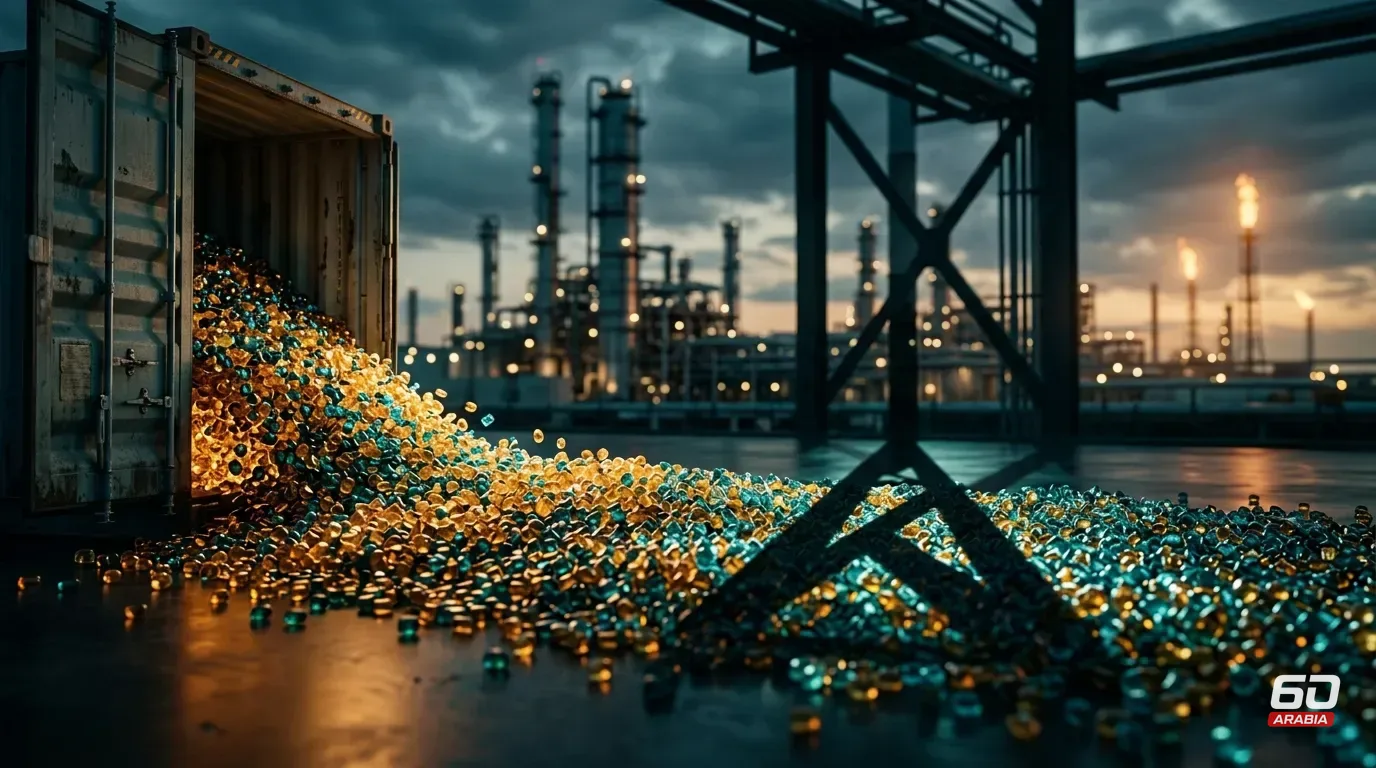
Polymer granules, on the other hand, are shipped bagged in standard containers or bulk in ordinary carriers. These can be rerouted, loaded onto other vessels, partially transported overland, and absorb higher insurance costs within the price per ton.
In short: a solid product is far more resilient than a refrigerated one. This is a silent logistical advantage unrelated to manufacturing costs, yet it saved the sector.
Here the Article Pivots
All of the above is true, yet the picture is not rosy. The evidence lies in the data of a single company.
UAE-based Borouge reported its Q2 2026 results, showing that average selling prices rose 45% year-on-year, driven by record premiums and higher benchmark prices. Revenue rose 8% to $1.4 billion.
Up to this point, the story looks great.
However, production volumes fell 24% over the same period. And net profit? It declined 1% to $191 million.
Read the two figures together: selling price rose 45%, yet net profit declined.
In the first-half results, the picture was clearer and harsher: revenue down 5%, and net profit down 27% at $347 million.
The Ruwais complex sustained damage on April 5, before returning to full capacity by the end of June following expedited repairs. The company stated that it utilized alternative logistical routes to reduce reliance on the Strait of Hormuz.
The Lesson Unspoken by Cost Figures
What these numbers reveal is the distinction between two concepts that are constantly confused.
Cost advantage is measured per ton produced. It remains in the Gulf's favor—in fact, it grew.
Profit, on the other hand, is measured per ton delivered and paid for. Between the two lie freight costs, insurance premiums, extra turnaround days, longer routes, and working capital trapped in stagnant inventory.
Harshest of all is idle capacity. A petrochemical plant's cost structure is largely fixed: depreciation, financing, maintenance, and labor. These do not drop when production falls by 24%. In fact, the cost per ton increases when volumes drop, because fixed costs are spread over fewer tons.
Meaning that the ethane advantage was partially eroded from within, rather than by competitors.
And that is precisely what happened: 45% higher prices, and profit that didn't budge.
Who Is the Real Winner Then?
The answer the region does not want to hear: the US producer.
American producers combine two advantages simultaneously: cheap domestic feedstock like the Gulf, and a route to market that passes through no contested straits. Dow reported that second-quarter sales in its Packaging & Specialty Plastics segment reached $6.4 billion, up 27% year-on-year. CFO Jeff Tate noted during the earnings call that this was primarily driven by higher polyethylene prices, which pushed domestic prices up by over 40%.
Notice the difference: the US company benefited from rising prices without paying the price of the crisis. Meanwhile, the Gulf company paid the price and captured only part of the gain.
A global price surge is a public good benefiting everyone, whereas corridor disruption is a private cost paid by whoever sits on it.
And What After the Crisis?
Here, a larger problem awaits the region, and it is coming regardless of Hormuz.
The global sector is already suffering from overcapacity following a massive wave of expansions, particularly in China. Europe is shutting down plants not because it lost expertise, but because the equation no longer works. When Gulf supply returns to full capacity, polymer prices will also return to levels determined by this abundance, rather than by the crisis.
And then the real question becomes: what remains once the temporary factor fades?
What remains is permanent: cheap ethane, and large, modern complexes. That is good, but it is not a strategy.
Feedstock superiority places you at the bottom of the cost curve for commodity products where everyone competes on price. That is a defensive position, not a growth position. Unerodeable advantage, however, lies in high-value-added specialty products and integration with local industry rather than exporting raw granules.
Conclusion
The Gulf's cost advantage remained—and even widened. Morningstar analyst Christian Fleming told Reuters that buyers still make their decisions based on price. A BASF spokesperson suggested that Gulf producers will maintain their importance in polymer markets over the long term.
All of that is true.
However, the year 2026 taught the industry an unexpected lesson: being the cheapest is a necessary condition, but not a sufficient one. The card that generates profit is not the price per ton at the factory gate, but your ability to deliver it.
Therefore, the smartest investment in the region over the coming years may not be in a new cracker complex, but in corridors, ports, and storage within consumption markets.
For what is the use of the cheapest ton in the world if it is stuck in a warehouse a hundred kilometers away from its buyer?

Amro is an industrial expert and scientist with more than 27 years of experience working in the oil and gas industry for such companies as Halliburton, Schlumberger and Baker Hughes. Currently, worked as a global Technology and Sustainability leader for AK Well Services based in Aberdeen. He has worked in most Middle East countries, the United Kingdom, all North Africa, and Azerbaijan. During his career, he has focused on new technology developments that reduce pollution, and emissions and optimize operations. His contribution resulted in winning several industrial awards and winning 2020 and 2021 Gold Stevie Awards. Amro's work has been highlighted by the UK Science Council in an article prior Cop26 in Glasgow. Amro is a Fellow of The Institution of Engineers in Scotland (FIES), Fellow (FRSC) and Chartered Chemist (CChem) of the Royal Society of Chemistry (RSC), Fellow (FIScT) and Chartered Scientist (CSci) of the Institute of Science & Technology, a full member of Sigma Xi, The Scie
Profile and all their articlesNovaTAQA

A Jump of Seconds and the World Believed It: Musk's Car Between Reality and Science Fiction

Emerging Market Easing Dilemma: Rate Cuts Are No Easy Fix

Nobel 2026... The Story That Began in a Pond and Ended with Light for the Brain

One Sea... Two Policies
Weekly Newsletter
Read between the lines before everyone else. Decode the most important economic, tech, and decision-maker movements in the region.. in 5 minutes every Saturday.