A Loophole in the Chip War That Laws Cannot Plug... Its Name Is Humans
Summary
An investigation into a personal relationship rocked the world's most valuable chipmaker. But the real story isn't the scandal; it's a Singapore-based company suspected of smuggling chips... and who pays the price.
Nvidia's stock dropped 4.27% on Monday. The reason was not financial results, nor a new competitor, nor a government decision.
The reason was an internal memo sent by the CEO to his employees.
And when a $4.5 trillion company moves due to a personal matter, the matter is no longer personal. This is not an invitation to eavesdrop, but a legitimate question about the structure of the system governing the world's most important commodity today.
What Is Proven, and What Is Merely an Allegation
Let us start with the distinction that most coverage overlooks.
What is proven: Jensen Huang, CEO of Nvidia, admitted in a memo to employees on Sunday, November 8, that he had not been faithful to his wife, apologizing to his family, colleagues, and shareholders. The company's board of directors formed an independent investigative committee overseen by outside legal counsel.
What is not proven, and this is most important: The New York Times published an investigation in late October reporting that US intelligence officials believe a woman named Alice Huang, a Chinese national and former executive at Megaspeed, was recruited by Beijing to gather intelligence on Huang and potentially influence chip sales to China. The two share no family relation despite the common surname.
Notice what remains unknown: It is not known whether she obtained any information, whether anything reached Beijing, or what Huang knew. No criminal charges have been filed against any party. Alice Huang has not responded publicly, and her whereabouts are unknown.
Nvidia stated there is no reason to believe US national security or company information was compromised.
Beijing's position: Chinese Foreign Ministry spokesperson Guo Jiakun described what he called the "Chinese spy narrative" as groundless, saying it was "purely defamation against China."
Washington's position: President Donald Trump defended Huang during a White House press conference on Monday, saying: "We'll look into it. I know the FBI is looking into it regarding something else." He added: "I think he'll be fine." He was quoted referencing Huang's statement that he had no idea she was a spy, commenting: "I really believe him."
This is the full record. Everything else is speculation.
And Now, the Real Story
Forget the personal aspect, and look at a single word in the news: Megaspeed.
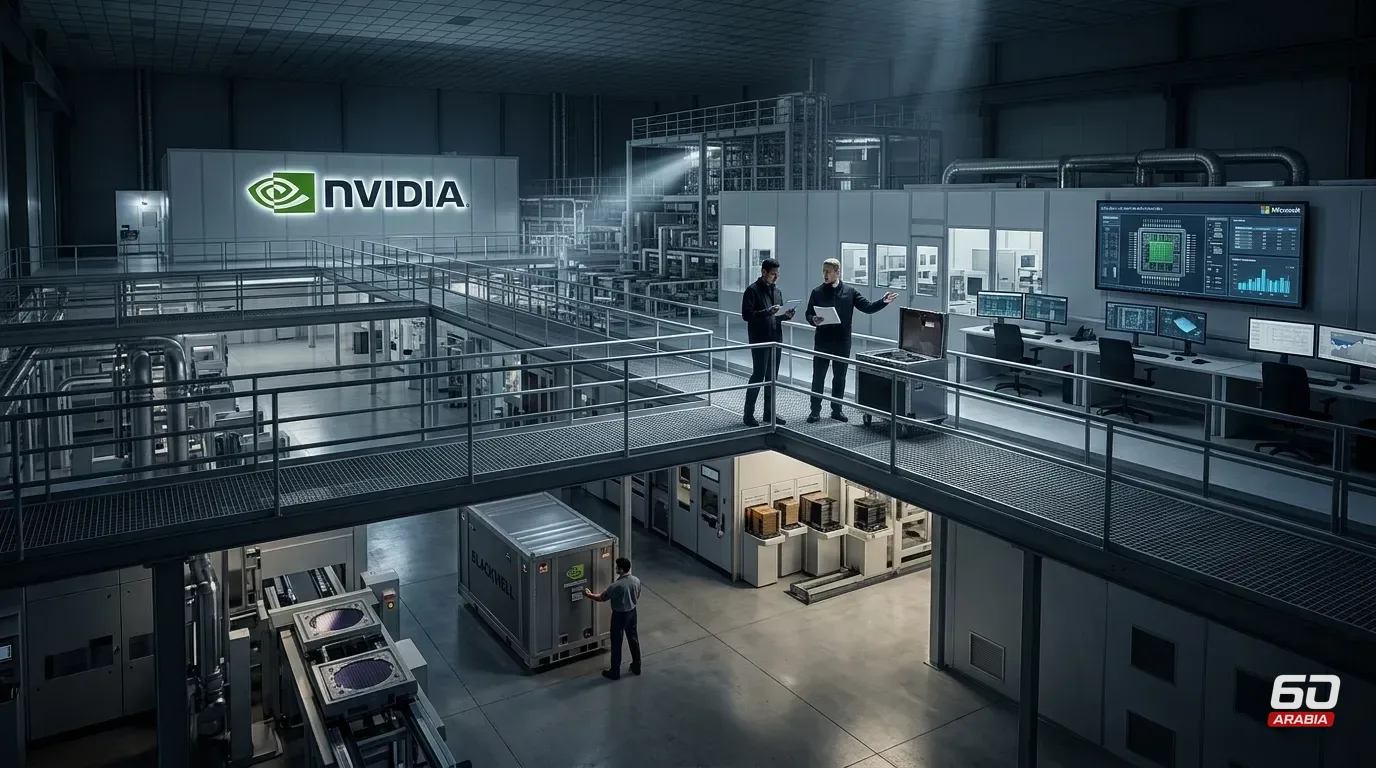
A Singapore-based company providing AI computing infrastructure. US authorities have been investigating it since 2024 on suspicion of helping China obtain advanced Nvidia chips, in violation of export restrictions.
And herein lies the entire story.
The tech war between Washington and Beijing is managed using a single tool: export controls. Advanced Blackwell chips are banned from China. Washington has expanded the ban to include Chinese-owned companies operating outside China.
However, the law governs the shipment, not the network surrounding it. In a world where ownership overlaps across Singapore, Hong Kong, and offshore islands, the question "Who is the end buyer?" becomes far harder than "What is the product?".
And this incident, whatever its outcome, exposed the most critical loophole in the system: export controls guard the boxes, but they do not guard the humans who decide who gets the boxes.
And it doesn't even require espionage. Merely knowing who the next customer is, which license will be granted, or what production capacity is allocated to a specific region is information worth billions in a market where Nvidia monopolizes an estimated 80 to 90% of the GPUs that power advanced AI models.
And Where Does the Gulf Stand in All of This?
This is where the bill reaches us.
Today, the region is building the largest AI projects outside the United States and China. Most of these projects rely on Nvidia chips. Obtaining them is not a purchase process, but a licensing process.
The numbers tell the story. In September 2025, the US Department of Commerce licensed Microsoft to transfer Nvidia chips internally to the UAE. In November 2025, it authorized the sale of 35,000 units directly to G42 Group. Yousef Al Otaiba, UAE ambassador to Washington, stated that the first batch of advanced chips arrived in May, after months of waiting for approval and an additional six months of shipping. Saudi Arabia's Humain received similar approval, and its shipment arrived in December.
To understand why, the six Gulf states fall under D:3 and D:4 classifications in the US Export Administration Regulations. This means they are neither among exempted allies like Britain and Japan, nor among banned nations. They are in the grey area: allowed, but only after extended scrutiny and case-by-case approval.
Changing this classification requires agreement among four US government agencies and often intervention from the White House itself, according to Thea Kendler of Mayer Brown.
The region has adapted to this. G42 divested from Chinese technology investments as part of its partnership with Microsoft, an arrangement described by geopolitical consultant Rostam Asadi as the "gold standard" for introducing US technology while preventing leakage.
And now, the question that must be asked in Abu Dhabi and Riyadh this week:
If a single Singaporean company's case can spark a federal investigation and calls for congressional testimony, what will happen to the pace of approvals granted to a buyer outside the United States, regardless of how allied they are?
The likely answer: more scrutiny, and more delay.
It doesn't even require a hostile political decision. It is enough for an employee at the Department of Commerce to become one degree more cautious before signing, turning months into a year.
And in the AI race, delay is the penalty.
Three Lessons That Go Beyond the Incident
First: Human risk is the most important unpriced line item in the sector. Companies spend billions on information security, building unhackable systems, yet remain exposed at the weakest point: the people who possess information before it becomes a document.
Second: Concentration of decision-making is a risk in itself. When a single company monopolizes nearly 85% of a strategic market and relies on the persona of a single founder, any personal tremor becomes a global market event. The market priced this risk at four percent in a single day.
Third: Relying on a single supplier for critical technology is a strategic decision, not a purchasing one. When your entire AI plan passes through one company, in one jurisdiction, subject to one licensing system, you are not buying equipment; you are renting permission. And permission is granted and revoked, slowed down and accelerated, for reasons that may have nothing to do with you at all.
Conclusion
This case will end in one of two outcomes: either the independent investigation proves nothing was compromised, so shares rebound and the story is forgotten, or it reveals an actual leak, leading to tightened controls for everyone.
In both cases, the vulnerability remains unchanged.
Laws are written for shipments, chips, and ports. But decisions are made by humans, who have relationships, friendships, interests, and mistakes. No export regulation in the world covers that.
And the question worth asking in the Arab world is not: What did Jensen Huang do? But rather: How much of our national AI plans depend on a decision that might slow down due to an incident having nothing to do with us?
Amro is an industrial expert and scientist with more than 27 years of experience working in the oil and gas industry for such companies as Halliburton, Schlumberger and Baker Hughes. Currently, worked as a global Technology and Sustainability leader for AK Well Services based in Aberdeen. He has worked in most Middle East countries, the United Kingdom, all North Africa, and Azerbaijan. During his career, he has focused on new technology developments that reduce pollution, and emissions and optimize operations. His contribution resulted in winning several industrial awards and winning 2020 and 2021 Gold Stevie Awards. Amro's work has been highlighted by the UK Science Council in an article prior Cop26 in Glasgow. Amro is a Fellow of The Institution of Engineers in Scotland (FIES), Fellow (FRSC) and Chartered Chemist (CChem) of the Royal Society of Chemistry (RSC), Fellow (FIScT) and Chartered Scientist (CSci) of the Institute of Science & Technology, a full member of Sigma Xi, The Scie
Profile and all their articlesNovaTAQA
حين يتوقف النظام لأنه لا يعرف.. درس من سماء أمريكا
The Largest Chimpanzee Community is at War... and Scientists Don't Know Why
A Climate Phenomenon Doing to Chokepoints What War Did.. The Great El Niño
النفط السعر الذي تقرأه ليس السعر الذي يُدفع
Weekly Newsletter
Read between the lines before everyone else. Decode the most important economic, tech, and decision-maker movements in the region.. in 5 minutes every Saturday.