
Why Do Some Food Brands Succeed Quickly… Then Quickly Disappear?
Summary
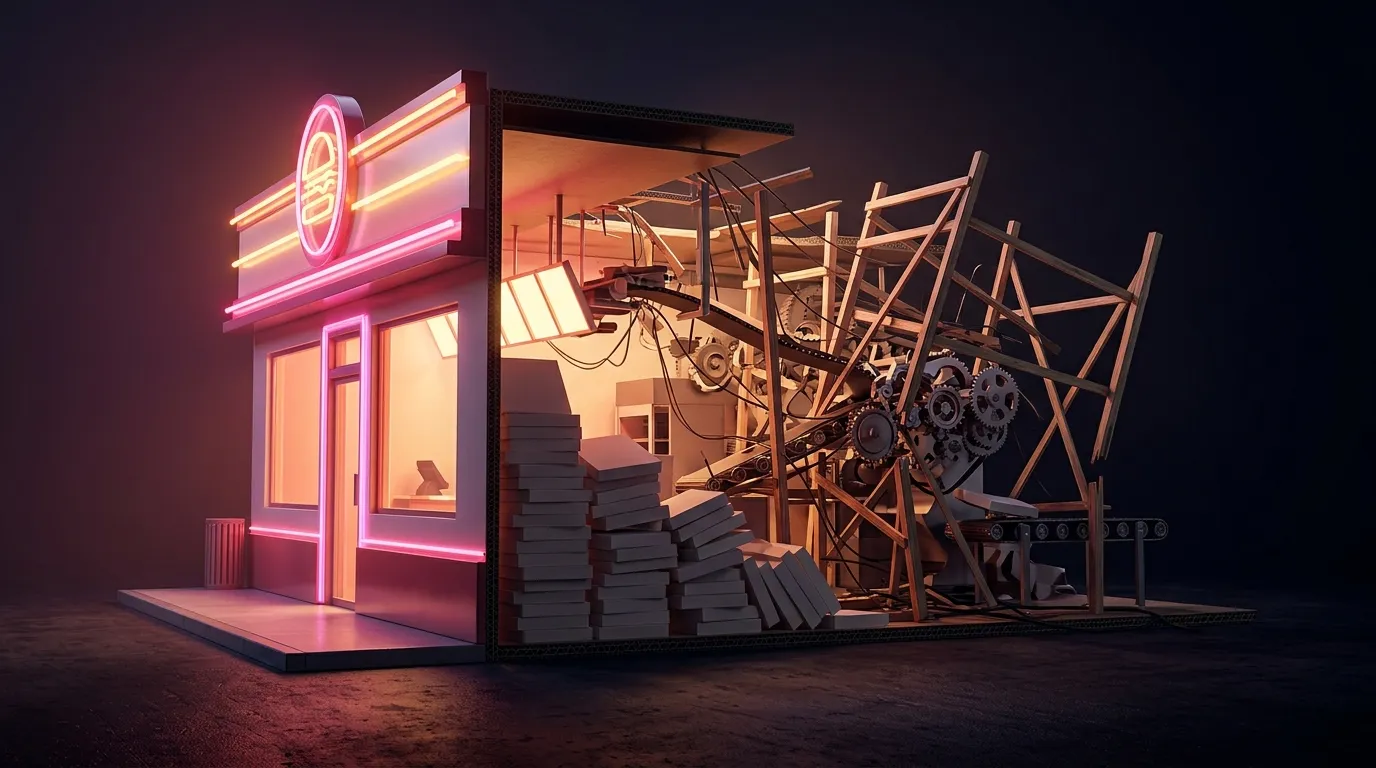
Crowds are not proof of success—behind every successful food brand lies a system of Supply Chain, Operations, and Finance. Discover what the customer doesn't see.
There is a scenario that repeats often in the restaurant world.
A new brand suddenly emerges.
A strong opening, long lines in front of branches, photos spreading across social media, influencers talking about it, and people start asking:
"Have you tried this place?"
After a short period, expansion begins.
A new branch… then another… and perhaps more.
From the outside, everything seems perfect.
But after a year or two, the picture starts to change.
The crowds diminish.
Some branches close.
Quality changes.
Prices rise.
Customers who used to talk about the brand daily move on to a new experience.
Then comes the question:
How did that happen?
How can a brand that seemed so successful disappear this fast?
The answer is not always in the food.
Sometimes the problem is that the brand succeeded in attracting customers… but failed to build the system capable of handling that success.
And here begins the story that the customer doesn't see.
Crowds Are Not Enough Proof of Success
It is very easy to link crowds to success.
A crowded restaurant = a successful restaurant.
High sales = a successful business.
A larger number of branches = successful growth.
But these equations are not that simple.
A restaurant might achieve high sales, while simultaneously suffering from high costs of food, labor, rent, energy, and other expenses.
Recent data from the National Restaurant Association shows that operating costs continue to put strong pressure on restaurant profitability; in its analysis for 2026, the association noted that total restaurant expenses have risen by about 36% since 2019, and 33% of operators surveyed said their restaurants were not profitable during the first half of 2026.
So the real question is not:
"How much did you sell?"
Rather:
"How much do you have left after paying the cost of generating those sales?"
And that is a fundamental difference.
The Problem Begins When Growth Outpaces System Capacity
Imagine a brand that started with one branch.
Demand was limited.
The number of suppliers was small.
Management was close to operations.
The founder knows the employees, knows the suppliers, and sees the problems firsthand.
Everything was under control.
Then success happened.
Demand became much larger.
And here arose the need for:
More suppliers.
Larger purchasing quantities.
Bigger inventory.
Better planning.
Transportation and distribution.
Systems.
Training.
Branch management.
Quality control.
And performance indicators.
The problem is that some brands deal with these requirements after growth occurs instead of preparing for them before it happens.
And here, growth turns from an opportunity into pressure.
From a Supply Chain Perspective
Let's take a simple example.
A certain product used to require 100 units per week.
Suddenly, demand jumped to 500 units.
Can the supplier provide this quantity?
Do they maintain the same quality?
Do they have the ability to stick to delivery schedules?
Do you have an alternative supplier?
Do you have enough storage space?
Is transportation able to handle the new quantities?
Is storage and refrigeration adequate?
Do you have the capital to fund inventory?
These questions might seem operational, but in reality, they are business questions.
Because failing to answer them can lead to something the customer sees directly:
The product is no longer what it used to be.
And here the problem begins.
The customer might think the brand "has changed."
But behind this change, there might be a new supplier, a different raw material, supply strain, reduced specifications, or a lack of planning.
That is why the Supply Chain is not just a function aimed at buying, transporting, and storing products.
It is part of the brand's ability to keep its promise to the customer.
And from an Operations Perspective
There is another, more dangerous problem.
How do you maintain the exact same experience when a single branch turns into ten, twenty, or fifty?
In the first branch, the owner or manager can oversee almost everything.
But with expansion, this is no longer possible.
You need:
Standard Recipes
SOPs
Training
Quality Control
Audits
Performance Indicators
Clear Responsibilities
Systems
And mechanisms to ensure that what was designed in the office is actually executed in the branch.
Studies related to service chain operations indicate that Standardization among units can achieve higher levels of efficiency, predictability, and control, which is one of the key reasons process standardization is essential in multi-unit models.
Here an important challenge emerges:
The customer doesn't care that the brand now has 20 branches.
They only want to get the same product and experience they loved last time.
If they get it, the brand wins.
If they don't, the question begins:
"What happened to this place?"
And from a Finance Perspective
Here is one of the most dangerous paradoxes in the restaurant sector:
Sales can grow… while profits do not grow in the same way.
In fact, business volume can increase while pressure on cash flow grows bigger.
Because every new branch requires investment.
Equipment.
Fit-outs.
Rent and deposits.
Labor.
Inventory.
Marketing.
Operations.
And ongoing expenses before the branch reaches its target performance level.
In an environment where food and labor costs are rising, controlling Prime Costs becomes fundamental to profitability. National Restaurant Association data indicates that managing food and labor costs is among the key factors linked to a restaurant's ability to turn a profit.
Therefore, the question:
"Is the new branch selling?"
Is not enough.
The better question is:
"Does the new branch achieve operational economics that allow it to continue?"
The Problem Is Not Always Expansion
It is easy to say:
"Rapid expansion is a mistake."
But that is not true in all cases.
Expansion can be an excellent decision if the system is ready for it.
The problem isn't the speed of growth alone.
The problem is the gap between the speed of growth and the speed of building the system.
If branches increase faster than the company's ability to:
Plan,
Hire and train,
Secure raw materials,
Manage inventory,
Control quality,
Manage suppliers,
And provide liquidity,
Then every new branch might not be a real addition.
It might just be a new copy of the same problem.
And Here Comes the Role of Marketing
Marketing can create demand.
But can Operations meet this demand?
This is a very crucial point.
Imagine Marketing launched a highly successful campaign.
Demand doubled.
Customers arrived.
But Supply Chain isn't ready.
One of the core ingredients is unavailable.
The kitchen is under pressure.
Wait times increased.
Quality dropped.
Customers started complaining.
The campaign succeeded from a marketing standpoint…
But it might have exposed operational weakness.
That is why Marketing, Operations, and Supply Chain should not be viewed as isolated islands.
The demand created by Marketing must be something Operations can serve, Supply Chain can support, and Finance can fund.
Only then does growth transform into a real business.
There Is Another Problem: Waste
In the food sector, a mistake doesn't always mean just extra cost.
Sometimes a mistake turns into a product that is completely discarded.
Overpurchasing.
Improper storage.
Poor inventory turnover.
Bad planning.
Preparing larger quantities than demanded.
Or product expiration.
The Food and Agriculture Organization (FAO) points out that the causes of food loss and waste in restaurants include: overpurchasing, improper storage, poor inventory turnover, bad planning, and preparing quantities greater than needed.
Meaning a dish that never even reached the customer might have already consumed:
Money + raw materials + labor + storage space + energy.
This type of cost is often invisible to the customer.
But it shows up at the end of the month.
So Why Do Some Brands Disappear?
Not because of a single reason.
Rather, because a small set of problems starts accumulating.
At first, the problem might not be obvious.
Then it recurs.
Then it grows.
Then management starts dealing with it on a daily basis.
A supply issue.
Then a quality issue.
Then a labor issue.
Then waste.
Then rising costs.
Then liquidity pressure.
Then cutting quality in an attempt to maintain margins.
Then the customer experience begins to decline.
And at this point, the customer might be the last person to know there is a problem.
Because they only see the result.
The Real Lesson
A strong brand is not one that can make people talk about it for a month.
A strong brand is one that can convert this attention into a sustainable system.
Trends can generate Traffic.
But Operations create Consistency.
And Supply Chain creates Availability.
And Planning creates Readiness.
And Finance protects Sustainability.
And Marketing creates Demand.
And strategic management aligns all of that in one direction.
Therefore, when we see a crowded restaurant, the only question shouldn't be:
"Why do people love it?"
There is another, more important question:
"What is happening behind this restaurant so it can deliver what it delivers every day?"
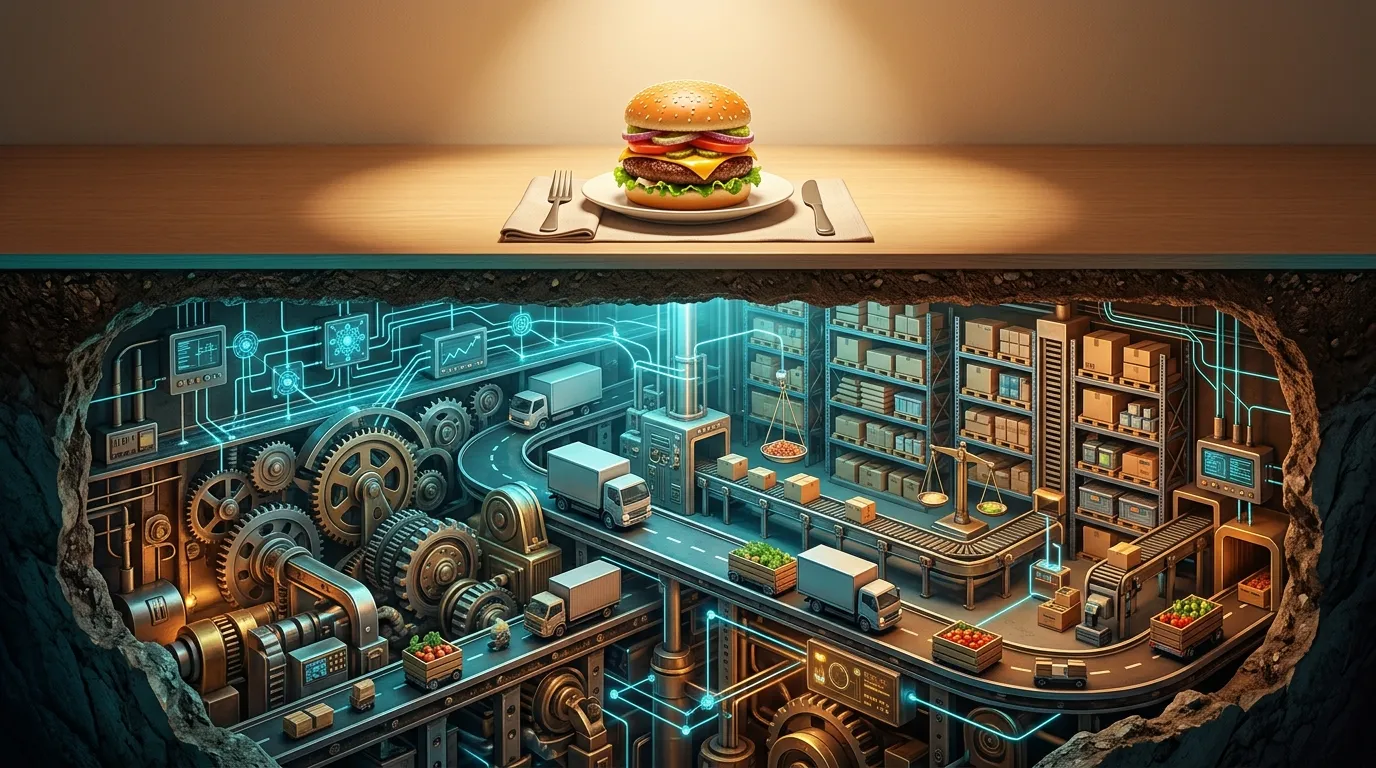
Because what the customer sees is the last step in a very long chain.
And true success doesn't start when the customer enters the restaurant.
Success starts way before that.
In the supplier.
In the warehouse.
In planning.
In the kitchen.
In the system.
In the numbers.
And in decisions no one sees.
And this is exactly the topic of this series:
What We Don't See Behind the Food Brand
Supply Chain
Supply Chain—the complete system connecting the supplier to the final product, including purchasing, transportation, storage, and distribution.
Operations
Operations—everything related to how the restaurant or project is operated daily, from food preparation to customer service.
Finance
Financial Management—managing cash flow, costs, revenue, and profitability.
Marketing
Marketing—efforts aimed at attracting customers and building brand awareness.
Standard Recipes
Standard Recipes—fixed proportions and preparation methods for each product ensuring the same taste and quality in every branch.
SOPs (Standard Operating Procedures)
Standard Operating Procedures—documented steps to perform each task inside the restaurant consistently across all branches.
Quality Control
Quality Control—ongoing monitoring processes to ensure the product adheres to defined standards at all times.
Prime Costs
Prime Costs—the combined cost of food and labor, which are the two largest expense items in the restaurant sector.
Standardization
Standardization—unifying procedures and standards across all branches to guarantee a consistent customer experience.
Multi-unit
Multi-unit—an operating model where the business owner owns more than one branch or commercial unit.
Waste
Waste—any loss in materials, time, or effort that does not add value to the final product, including food damaged before reaching the customer.
Traffic
Customer Traffic—the number of visits or orders the restaurant receives during a specific period.
Consistency
Consistency—the brand's ability to deliver the same product quality and experience every time and in every branch.
Availability
Availability—the restaurant's ability to secure the product for the customer at any time and in any branch.
What We Don't See Behind the Food Brand
Weekly Newsletter
Read between the lines before everyone else. Decode the most important economic, tech, and decision-maker movements in the region.. in 5 minutes every Saturday.