
The Egyptian Exchange is Not a Miniature Wall Street - EGX /Alpha
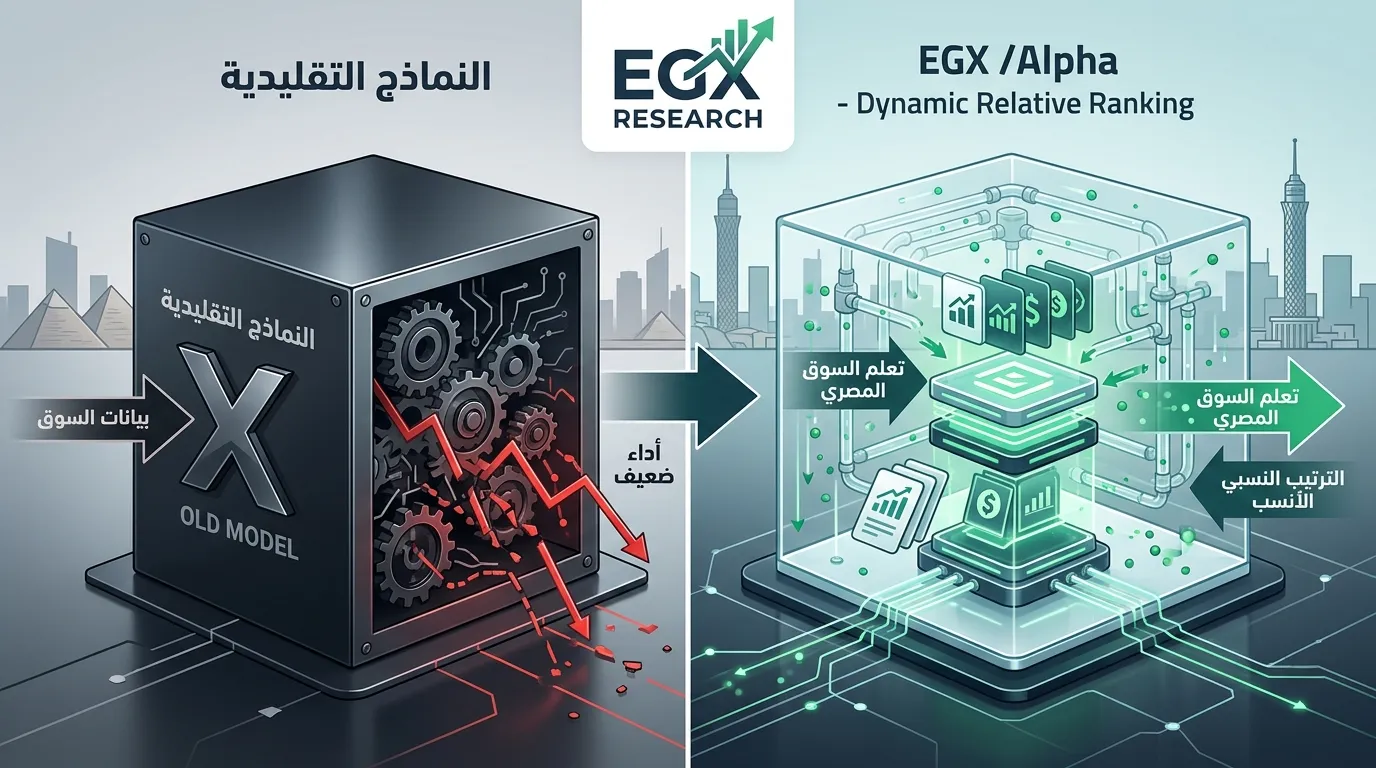
This analysis explains why EGX /Alpha was built to learn the Egyptian market from within, and the difference between traditional forecasting models and the relative ranking mechanism best suited for the structure of the Egyptian Exchange.
Why EGX /Alpha Was Built to Learn the Market from Within Rather Than Merely Guessing Stock Trends?
Inhomogeneous liquidity, sector dynamics that shift with investor behavior, and Egyptian stocks with trading windows outside Cairo. These are not minor side details in the Egyptian Exchange; they are part of the very problem that any predictive engine must learn before claiming to understand the market.
In the Egyptian Exchange, it is not enough to simply know the direction of index movement; the most crucial insight in a trading session might lie in a complete divergence between two stocks belonging to the same sector, or in the drying up of liquidity for one stock while another maintains resilient order book depth, or even in the continued pricing of news concerning a listed company on international markets following the close of local trading.
This is precisely where the true difference lies between the reality of the Egyptian market and those simplistic theoretical models that assume every security is merely a regular price series awaiting a smarter algorithm.
A recent study on trading quality in the Egyptian Exchange—based on reconstructing the order book at five-minute intervals for EGX30 index stocks—showed that liquidity possesses a dynamic signature that changes within a single session; bid-ask spreads shift over time, market depth fluctuates, and synchronized best bid and ask were present for only 84.2% of total trading time. Notably, tick size posed a binding constraint on roughly 29.2% of bid-ask spreads within the sample, a percentage that jumped to 80.3% in lower-priced stock segments; these data practically preclude treating "liquidity" as a uniform, standardized variable across all stocks. [1]
Inter-sectoral relationships lack stability; a study on dynamic correlations among Egyptian Exchange sectors revealed that correlation coefficients, although generally positive, vary sharply between sector pairs and change across time horizons and market shocks. In practice, this means that the correlation of a real estate or banking stock with market movement is not permanent; what acts as a hedge or co-moving asset in one phase may shift in the next. Investors observe this divergence directly on trading screens, and a robust quantitative model must capture it at the core of the data. [2]
Another pricing layer emerges that the local index alone fails to reflect; Commercial International Bank (CIB) has USD-denominated Global Depositary Receipts (GDRs) traded on the London Stock Exchange, in addition to GDRs for EFG Holding in the same market. Global market pricing does not pause when the Cairo session closes, making timestamping a structural component of the information. Falling into this trap does not require bad intent; it is enough for the numbers to be accurate while the timestamp is wrong. [3]
The Absence of High-Frequency Trading (HFT) is Not Reduced to a Prohibitive Legislative Text... The Obstacle Lies in Its Operational Structure
Debates surrounding High-Frequency Trading (HFT) are often reduced to a formal legal question: Is it allowed or prohibited? This is a flawed simplification that misses the essence of the matter; HFT requires, above all, execution continuity, resilient depth on both sides of the order book, spreads that enable opportunistic capturing, along with an institutional framework allowing efficient short position management, short selling mechanisms, and market making. Although the Egyptian Exchange operates an integrated electronic trading system, its execution economics differ radically from the nature of markets where this industry originated and thrived for decades.
Market microstructure data mentioned earlier reveal part of this structural constraint; when synchronized best bid and ask are absent for a fraction of trading time, and tick size restricts a significant portion of spreads, the advantage of sub-second speed loses its competitive edge. The Financial Regulatory Authority (FRA) approved new rules for securities lending in March 2026, and through July 29 was still discussing final steps for the short selling framework. The issue is not an explicit ban on HFT, but rather the difficulty of applying deep-market assumptions directly to the reality of trading in Cairo as they stand. [4]
The Trap of Replicating Foreign Models on Egyptian Data
A dilemma emerges here that is older than AI techniques themselves; today, it is easy to feed models such as LSTM, Bi-LSTM, or Random Forest with local trading data and label the outputs a "Model for the Egyptian Exchange." Despite the academic merit of such experiments, a model does not acquire local specificity simply because the stock symbol ends with the suffix (.CA).
Recent Egyptian financial and academic literature offers clear evidence of this trend; a study published in Future Business Journal in 2025 compared linear regression, Random Forest, LSTM, and Bi-LSTM algorithms across a sample of five Egyptian stocks, focusing on individual stock price prediction accuracy. Another study used an LSTM model to predict the closing price of Telecom Egypt for the next trading session. This observation does not diminish the methodological value of those studies; however, they ultimately address a different question. [5][6]
The practical question facing an investor after each session should not be confined to "What will this stock's price be tomorrow?" Rather, it is preceded by a more pressing operational question: Which stocks among dozens of available securities deserve research and analysis priority? Here, the problem shifts from mere single time-series price forecasting to relative ranking and comparison across the entire market's stocks (Ranking).
What Does EGX /Alpha Do Differently? And What Makes It the Most Effective Search Engine for the Egyptian Exchange?
The EGX /Alpha engine stems precisely from this question; the project's published technical methodology defines it as a Ranking-First system. Once the trading session ends, the system evaluates eligible Egyptian stocks within the market and estimates their relative positioning across defined future time horizons. The goal centers on measuring the "relative opportunity compared to overall market movement," so that a broad market rally is not mistaken for a stock-specific predictive achievement simply because all stocks rose collectively. [7]
Asking a different question required a corresponding shift in market data representation; the model does not merely read spot closing prices and trading volumes, but temporal memory tracks stock behavior across a rolling historical window, while structural context embeds the security within its sector relationships, liquidity levels, market movement, and benchmark bellwether stocks. The current version of the engine underwent training covering 91 local stocks over 25 years across four horizons: 1 session, 3, 5, and 10 sessions; utilizing 909,712 raw data rows yielding 435,954 final modeling samples. [8]
This framework embodies how EGX /Alpha captures the DNA of the Egyptian market; there is no secret magic formula, but rather a design that forces the model to accurately locate a stock within broader market movement, sector context, and liquidity levels, alongside complete temporal separation between local and international information. [9]
Another fundamental distinction arises: the production model does not retrain itself every night; predictions issued today await horizon maturity to transform into measurable, verifiable numerical evidence. When the need for a new training generation arises, a challenger model enters rigorous testing before adoption. This conservative methodology proves to be a decisive advantage in financial markets, where no one favors a model that shifts its rules overnight and claims increased accuracy by morning. [10]
How Can an Investor Use the Free Interface? A Direct Practical Example
The public interface on EGXResearch.com is designed so investors do not need to process technical complexities; following each trading session, the platform displays stock rankings across four distinct future horizons: 1 session (1D), 3 sessions (3D), 5 sessions (5D)—the primary reference analytical window—in addition to a 10-session horizon (10D). [11]
To illustrate with a practical example, assume a stock appears after today's session at rank (#4/91) on the weekly horizon screen (5D). This ranking does not imply that the stock's probability of generating profit ranks fourth, nor does it constitute a buy signal; its meaning is strictly limited to the model placing only three stocks in a higher rank out of 91 stocks compared relatively.
The "Model Direction" field is read separately; if it indicates "Positive", this is considered a supporting classification, but if it shows neutral or negative, it does not invalidate an advanced position in relative ranking. Next comes the "Rank Move" indicator; if the field shows (+7), it means the relative ranking improved by seven positions compared to the last completed evaluation, not a 7% price increase.
The next step is conducting fundamental financial analysis of the company—a role where EGX /Alpha does not replace the investor—starting with reviewing disclosures, material events, news announced after data cutoff times, monitoring current prices, liquidity levels, and valuation multiples. The sole function of EGX /Alpha is organizing priorities on the research and analysis table before the session starts.
This methodological vision appears far more consistent with the nature of the Egyptian Exchange than chasing the illusion of predicting "the stock that will rise tomorrow"; the local market does not suffer from a shortage of opinions or technical indicators, but generally lacks a disciplined mechanism to prioritize attention. As long as the structure of the Egyptian Exchange consists of a network with uneven liquidity, shifting sectoral ties, and stocks receiving cross-border pricing signals, the true advantage of an engine like EGX /Alpha does not stem merely from utilizing deep learning techniques, but manifests in the core methodological question that Deep Learning was asked to learn to answer.
Disclaimer: The EGX /Alpha engine is a research and market-tracking tool; it does not constitute a buy or sell recommendation, nor does it provide a target price or any guarantee of investment return.
References
[1] Rushdy & Samak (2025), "Examining Market Quality on the Egyptian Exchange (EGX): An Intraday Liquidity Analysis," Journal of Risk and Financial Management 18(1). DOI: 10.3390/jrfm18010032.
[2] Ahmed & Naguib (2018), "DCCs among Sector Indexes and Dynamic Causality between Foreign Exchange and Equity Sector Volatility: Evidence from Egypt," Applied Economics and Finance 5(1), 14–28. DOI: 10.11114/aef.v5i1.2842.
[3] London Stock Exchange, official GDR instrument pages for Commercial International Bank (Egypt) S.A.E. (CBKD) and EFG Holding S.A.E. (EFGD/BG79), accessed August 2026.
[4] Financial Regulatory Authority (Egypt), official releases on securities lending/short selling (9 March and 29 July 2026) and market-maker activation (8 June 2026), fra.gov.eg.
[5] Abd-Elwahab et al. (2026), Future Business Journal 12, 191, DOI: 10.1186/s43093-026-00897-4; Ezzat (2024), "Recurrent Neural Networks with LSTM for Stock Market Index Prediction," IJIMCT 6(2), DOI: 10.21608/ijimct.2024.220153.1048.
[6] Fattoh, El Maghawry Ibrahim & Mousa (2025), "Unveiling market dynamics: a machine and deep learning approach to Egyptian stock prediction," Future Business Journal 11, 18. DOI: 10.1186/s43093-025-00421-0.
[7] EGX Research, "EGX /Alpha Methodology," Public Technical White Paper, July 2026, §§1–4.
[8] EGX /Alpha v1.2 technical package, training_summary.json and manifest.json, 8 July 2026: 909,712 raw rows; 435,954 model samples; 4,129 training dates; 91-symbol training universe; 32-session lookback; horizons 1/3/5/10.
[9] EGX /Alpha Market Structure Memory, README.md, offshore_bridge_map.json and structural_feature_schema.json.
[10] EGX Research, "EGX /Alpha Methodology," §7, "Matured-outcome follow-up, evidence state and drift."
[11] EGXAlphaWeb public repository, src/home.mjs and src/investor-guide.mjs, August 2026; EGXResearch.com.
Weekly Newsletter
Read between the lines before everyone else. Decode the most important economic, tech, and decision-maker movements in the region.. in 5 minutes every Saturday.