

North African Countries Train Their Youth for Jobs AI Might Erase

Summary
Digital exports may rise and the need for employees may decline, while profits leak abroad and North African countries race to increase output in an economic climate where young people have fewer employment prospects.
Morocco aims to increase the number of workers in outsourcing services—work performed by local companies for foreign institutions—from 130,000 in 2022 to 270,000 by 2030. In September 2026, the government announced its ambition to add 100 billion dirhams to economic output thanks to artificial intelligence, and to create 50,000 direct and indirect jobs linked to it. The two plans reveal a paradox that North African economies may face over the next four years: the technology that governments aim to use to boost production can simultaneously reduce the number of employees needed to achieve it.
The appeal of outsourcing companies has long relied on providing skilled workers at competitive wages. However, artificial intelligence is gradually changing the foundation of competition.
Software now handles parts of conversations, coding, and document preparation—tasks that once required long hours of human labor. As the time needed to complete tasks decreases, the distribution of profits shifts. Foreign clients may get lower prices, tech platforms may capture a portion of savings through usage fees, or local companies may retain the gains. The ownership of tools, contract terms, and workforce skills determine how much value remains within the domestic economy.
The potential outcome is more complex than growth indicators suggest. Digital exports may rise while graduate hiring slows, as companies can execute larger contracts with smaller teams. Nevertheless, the International Labour Organization concluded in June 2026 that productivity gains were beginning to appear unevenly, while widespread job cuts remained limited. The World Bank estimates that less than 10% of jobs in its broader economic region face near-term risks of automation, while productivity could improve in 13% to 20% of them. These percentages measure the susceptibility of tasks to change and do not represent direct forecasts of layoffs in North Africa.
Morocco is approaching a practical test of this paradox, as the number of outsourcing workers exceeded 148,000 in 2024, and sector exports reached over 27 billion dirhams in 2025. The government launched the 'AI Made in Morocco' program alongside research, application, and cloud service projects. These steps represent an attempt to shift from competing on wages to competing on technical capability. However, achieving the 2030 targets will depend on companies successfully offering higher-value services, such as systems management and reviewing AI outputs, so that new demand offsets the reduced need for certain routine tasks.
Tunisia, meanwhile, possesses a scientific advantage that clashes with economic constraints. The 2026 Global Innovation Index ranked it first worldwide in the proportion of science and engineering graduates, who make up 37.93% of total higher education graduates, but placed its business environment at 124th. Information and communications technology accounts for about 11% of GDP according to published 2025 data. This gap highlights the possibility that Tunisian engineers' productivity could rise without a corresponding increase in returns retained by local firms.
AI grants Tunisian programmers a greater ability to develop products at lower costs, but it gives foreign competitors the exact same advantage. Therefore, gains during 2027–2030 will be determined by companies' ability to own software sold to multiple clients, secure funding, and access markets. As long as companies continue to execute tasks for external institutions, their ability to retain value will remain constrained by contractual terms and international competition.
In Algeria, another economic impact of technology emerges regarding state efficiency. In September 2026, authorities announced a plan to train 50,000 AI specialists by 2030, placing tax administration among the primary application areas. Smart systems can detect discrepancies in returns and unusual transactions, helping improve collection and cut procedural costs. However, their success requires interconnected records, reliable information, and safeguards for reviewing automated decisions. With the IMF predicting government debt to rise to 75.4% of GDP by 2030, fiscal savings from these applications become far more important than the number of systems institutions purchase.
Libya differs from Algeria in the nature of available opportunities, as hydrocarbons accounted for 93% of its exports in 2024, whereas the AI strategy launched by the Government of National Unity in June 2026 aims to enable 80% of government entities to use its tools by 2030. Analyzing oil equipment data can predict certain failures before production stops—an application that could yield significant returns in an economy whose foreign revenues rely on a single sector. However, predictive accuracy hinges on the presence of measuring instruments and regular maintenance logs.
Libyan administration faces a similar constraint when digitizing public services, as secure and regular information sharing between institutions is a prerequisite for leveraging advanced systems. If institutional coordination improves, it could reflect positively on production stability and spending efficiency. Potential gains will remain limited whenever data collection or the implementation of model-suggested decisions proves difficult.
Mauritania is betting on applications closer to its productive economy's needs. Its AI strategy through 2029 encompasses agriculture, fishing, and healthcare. Satellite imagery and vessel movement data allow for improved monitoring of fishing grounds and detection of violations, provided authorities have the capability to verify and intervene. However, the World Bank found that only 20% of adults used digital payments in 2022, alongside limited technology adoption within companies. These figures suggest that expanding digital services and connecting markets might yield faster economic returns than spending heavily on developing advanced AI models.
In Sudan, war imposes a different order of priorities. In March 2026, the Sudanese Telecommunications Authority announced offline mobile banking transactions to address payment difficulties during network outages. The importance of this step lies in restoring the ability of residents and businesses to conduct essential transactions. Meanwhile, using AI for crop monitoring, aid distribution, and rebuilding services depends on stable electricity, telecommunications, and reliable data availability. Security developments and the speed of institutional recovery will determine the potential economic impact up to 2030.
These experiences share a problem that transcends national borders: importing AI tools means purchasing computing services and software usually paid for in foreign currency. The International Energy Agency projects global data center electricity consumption to rise from around 485 TWh in 2025 to 950 TWh in 2030. Foreign cloud services may save governments and companies the cost of building local centers, but they create ongoing operational obligations toward tech providers. This equation is especially delicate for economies facing pressure on foreign exchange reserves or constraints on electricity and water.
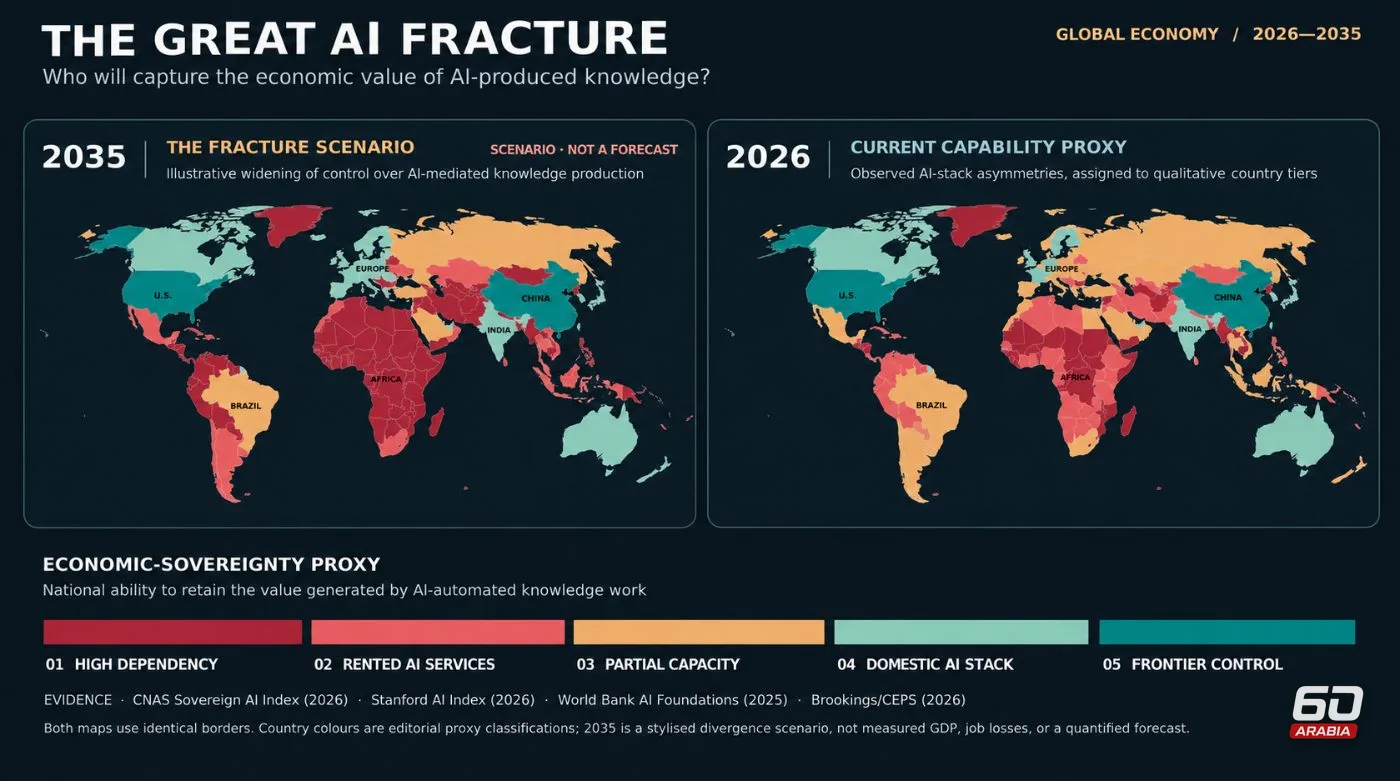
This reveals a relationship that could change how the success of digital transformation is evaluated. Increasing local worker productivity elevates the potential economic value of their labor, but the portion retained by the economy depends on who owns the software, sets prices, and maintains the customer relationship. As imported technology fees rise or competition for service contracts intensifies, local firms' share of gains shrinks, even when their technical performance improves.
Over the next few years, it will become essential to measure the net value of digital exports from North African countries after deducting the costs of foreign software and computing, and compare it against trends in employment and wages. Early signs may appear in new outsourcing contracts and job opportunities for university graduates. If companies begin delivering more work with fewer employees, measured productivity will rise, but its social impact will depend on the emergence of new activities to absorb labor. As competition shifts from selling billable hours to selling outcomes, North Africa's share of AI wealth will be determined by its capacity to own products and client relationships, while the labor market will reveal who bore the cost of this transition.

Dr. Khaled Saqr is a complex-systems scientist recognized among Stanford University’s top 2% of global scientists (2023–2026) for discovering a previously unknown state of turbulence in human blood flow that reshaped the understanding of vascular disease. The co-founder of Bio-CFD and founder of KNOWDYN, he helps researchers translate intellectual assets into economic value. He is the author of Adjoint Thinking, on preserving human agency alongside AI, and Kinetic Markets, which introduces a quantitative theory of financial markets. Additionally, he advises the board of the U.S.-based ScienceWerx Foundation, applying quantitative foresight to the intersection of emerging science, technology, and global governance.
Profile and all their articlesBefore it happens
الصدع الكبير في عصر الذكاء الاصطناعي

One Update Could Wipe Out Your Company in 2027

حين يصبح الاكتشاف العلمي أرخص من هاتفك... مَن سيشتري مستقبل العالم؟

Debt-Ridden Countries May Be Wealthier Than They Appear
Weekly Newsletter
Read between the lines before everyone else. Decode the most important economic, tech, and decision-maker movements in the region.. in 5 minutes every Saturday.