The First Phone Call in the Gulf Isn't a Venture Fund!
Summary
In the US, government validates — then venture scales. The Gulf runs that sequence in reverse. And the implications for every deep-tech founder are enormous.
Listen to this article
It's a sovereign balance sheet, and it reverses the way deep tech gets funded
A founder raising a Series A in Denver and a founder raising "the same round" in Abu Dhabi are not doing the same thing. They are using one word for two different instruments.
In the United States, the sequence is almost liturgical. You de-risk the technology with non-dilutive government money — an SBIR Phase I, an STTR, a BAA award — and then you raise venture capital to scale what the state has already validated. Government funding before venture funding is more than a slogan: we have tested it repeatedly, and it is the sequence behind many of the most credible deep-tech companies of the last two decades.
The Gulf runs that sequence in reverse. The first call is not to a venture fund. It is to a national strategy that has already decided the sector matters, attached to a sovereign balance sheet that can act as first customer, anchor investor, and patient buyer at the same time.
That inversion is the most under-discussed fact about the region's space build-out, and it changes what "raising money" actually means.
A strategy with a checkbook attached
Start with the United Arab Emirates. In late March 2026, the UAE Cabinet approved the National Space Strategy 2031, an update to the 2030 framework the country adopted in 2019. The stated aim is not exploration for its own sake. It is, in the government's own framing, a "flexible and reliable investment environment" — infrastructure, manufacturing, data, artificial intelligence, research, and talent, with the economy at the center.
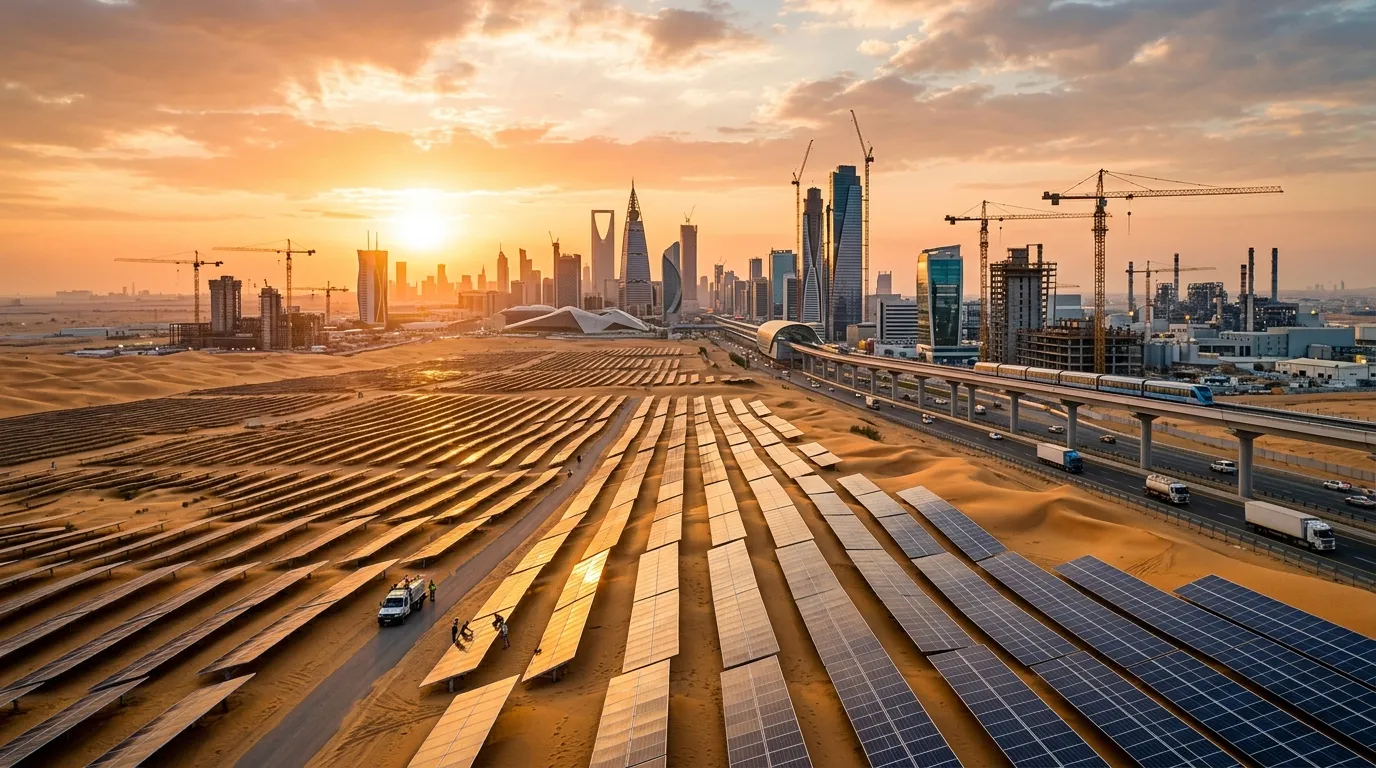
Saudi Arabia has done the same thing on the civil side. The Communications, Space and Technology Commission (CST) put the Kingdom's space economy at $8.7 billion as of 2024, and has since projected that Saudi space investments will nearly quadruple, to $31.6 billion by 2035. In May 2024, the Public Investment Fund stood up the Neo Space Group, a wholly owned company spanning satellite communications, geospatial services, and positioning, navigation and timing — PIF's first dedicated bet on space, and explicitly mandated to develop local capability.
The pattern repeats across the region: a strategy document, then a state-owned vehicle, then a localization mandate. Capital is a tool of policy, not the other way around.
Why this is a capital-stack story
For a founder, the Gulf proposition is not "more money." It is a different cost of capital, with different terms.
Venture capital prices risk and demands an exit on a clock. It wants a clean cap table, a defined use of proceeds, and a multiple. Sovereign capital prices strategic alignment. It is patient and large, and it frequently does not need the classic exit, because the return it optimizes for also includes industrial capability, skilled jobs, and geopolitical positioning.
That sounds like free money. It is not. The price is paid in three currencies:
-Anchoring. The capital usually arrives with an expectation that capabilities, and often facilities, land in-country.
-Alignment. You are being funded to advance a national strategy, not a neutral market. The investor is also, frequently, your customer.
-Concentration. Gulf checks are big enough to make your cap table look easy, right up until a single sovereign LP dominates your register and shapes your governance.
None of that is a reason to stay out. It is a reason to sequence deliberately — and to know which of the three you can live with.
A customer before a cap table
The most important line item in a Gulf raise is not the valuation. It is the contract.
In the American model, a grant or an SBIR award is proof of technical legitimacy that unlocks equity. In the Gulf model, the first contract — a satellite services agreement, a data-as-a-service purchase, a defense offset — is the proof that unlocks the balance sheet. The state is simultaneously regulator, first customer, and anchor investor. That circularity is not a bug. It is the design.
For deep-tech founders, the practical implication is that the smart entry is not a pitch deck. It is a procurement relationship that produces revenue first and equity second.
What it costs, and what it buys
The blunt economics: Gulf capital lowers your cost of equity but raises the cost of optionality. You trade some freedom — where you build, who holds the IP, where value accrues — for capital that will not wash out in a down round and a customer who can scale with you.
That trade is rational for a specific kind of company: one with dual-use demand, whose product is infrastructure rather than a consumer app, and whose growth story is inseparable from a national build-out. It is a poor trade for a company that needs to stay footloose.
It is also personal. The alignment price is often paid in geography: you may be asked to build where you did not plan to live, and to put down roots you did not plan to put down. Founders should price that honestly before they sign.
The part the West keeps misreading
Western observers still read Gulf space spending as either vanity or an oil hedge. The last few years say otherwise. In January 2024, NASA and the Mohammed Bin Rashid Space Centre announced that the UAE would provide the Crew and Science Airlock module for the lunar Gateway station, and that NASA would fly a UAE astronaut to Gateway on a future Artemis mission. Saudi Arabia signed the Artemis Accords in July 2022, and now runs research, workforce, and industrial programs through a single space agency.
These are industrial policy, financed like infrastructure: strategic capital, long horizons, a mandate for local content.
The takeaway
"Government funding before venture capital" describes the American playbook. The Gulf has written its own version, one in which the government *is* the venture capitalist — and often the first customer too.
Founders should stop treating the region as an ATM at the end of the road and start treating it as a co-investor at the beginning: one that pays in contracts, patience, and proximity to one of the largest concentrations of long-duration capital on earth.
The scarce good in the Gulf was never capital. It is alignment. Bring something the strategy needs, and the balance sheet follows.
*Samson Williams is a Senior Partner at MilkyWayEconomy and an author on blockchain, space, and crowdfunding. Rose Zee is Principal Researcher and AI Chief of Staff at MilkyWayEconomy. Views are the authors' own.*
Space Economy Arabia

Weekly Newsletter
Read between the lines before everyone else. Decode the most important economic, tech, and decision-maker movements in the region.. in 5 minutes every Saturday.