Halan's IPO Subscription Covered 43.6 Times... Can the Egyptian Exchange Absorb State Offerings Up to EGP 59 Billion?
Summary
MNT-Halan's 43.6x oversubscription reveals supply scarcity rather than proving sustainable liquidity abundance on the Egyptian Exchange.
I have covered initial public offerings on the Egyptian Exchange for over twenty years, and I have learned to distinguish between three things: registered demand, the liquidity backing it, and the market's capacity to absorb what comes next. MNT-Halan's 43.6x subscription coverage answers only the first. The value of buy orders at the offering price stands at EGP 51.3 billion—a nominal figure, not an amount paid in full—against shares worth EGP 1.18 billion. A subscriber will receive approximately 2.3 piasters for every pound requested, assuming proportional allocation.
EGP 51.3 Billion in Orders vs. EGP 1.18 Billion Available
Initial buy orders in the retail tranche reached 2.093 billion shares against 48 million offered at EGP 24.5 per share. The timing of the demand is noteworthy. On Wednesday evening, a day before closing, coverage stood at 13.9 times with orders for 669 million shares. It then reached 27 times midway through Thursday's session and 36 times shortly before the close, ending at 43.6. This means nearly 1.42 billion shares, worth approximately EGP 35 billion, entered on the final day alone.
This surge opens the possibility that herd behavior inflated demand along with conviction in the company's valuation, but numbers alone do not reveal subscribers' motives; delayed registration or anticipation of allocation scaled back might also explain it. Registration rules allow inflation: brokerage firms deposit at least 25% of each order's value, enabling subscribers to request four times their actual liquidity. This does not make orders phantom, as anyone allocated more than their deposit covers pays the remainder. However, it means registration funds totaled at least EGP 12.8 billion, of which at least EGP 11.6 billion will be returned following allocation.
Private Tranche Quieter, Prospectus Raises Questions
The private tranche was covered 11.2 times, rising to 19.4 times after excluding 121.2 million shares subscribed to by strategic investors through prior agreements. The disparity with the 43.6x in the retail tranche raises questions about differing demand motivations between the two tranches without settling them. The offering price represents a ~5.5% discount to the fair value determined by independent financial advisor BDO at EGP 25.92.
Conversely, the prospectus discloses approximately 124,800 lawsuits against defaulting clients involving claims totaling EGP 6.47 billion. The company states that this figure represents the total value of disputed financing contracts rather than actual outstanding balances, representing no more than 3.5% of its total issuances since inception. Its impact on portfolio quality cannot be assessed before the outstanding balance is disclosed. Offsetting this is outstanding securitization of around EGP 39.54 billion. Furthermore, the IPO is a complete sale of secondary shares owned by the principal shareholder, meaning proceeds go to the seller rather than the company.
A Declining Market and Local Depth
The subscription came after a tough month. According to the monthly exchange report, market capitalization fell 5.39% in September, losing EGP 230.9 billion, while the EGX30 dropped 5.42% to 51,894.83 points following nine consecutive sessions of decline. By my calculations, 62% of the losses occurred outside EGX30 components—i.e., in retail-heavy stocks—as main index constituent stocks lost only EGP 87.5 billion.
During the final subscription week, the market lost nearly EGP 204 billion across three sessions, dropping from EGP 4.203 trillion at the close of Thursday, October 8, to EGP 3.999 trillion on Tuesday (EGP 4.122 trillion on Sunday after an EGP 81 billion loss, then EGP 4.052 trillion on Monday, reaching EGP 3.999 trillion). It subsequently rebounded, closing Thursday at EGP 4.051 trillion with a gain of EGP 25.6 billion, while the EGX30 closed at 52,273.34 points—near its end-of-September level. Market cap loss reflects price adjustments and does not equal an equivalent outflow of cash.
Was liquidity pulled from the secondary market to fund subscriptions? The decline occurred during the subscription period, but concurrence does not prove causality; funds may have come from off-market savings, cash positions prepared for the IPO, or sales of existing equities. The late two-session rebound weakens the thesis. Moreover, the returned EGP 11.6 billion is not necessarily new liquidity; it might flow back into existing shares, remain in cash, or shift to Banque du Caire's upcoming IPO.
Market depth remains domestic. Through the end of September, Egyptians accounted for 88.3% of year-to-date trading value, compared to 7.6% for foreign investors and 4.2% for Arab investors. Net foreign sales reached EGP 11.2 billion and net Arab sales EGP 10 billion. However, both groups were net buyers in September itself, purchasing a combined ~EGP 3.57 billion, meaning local investors were the counterpart in net monthly flows.
Banque du Caire and Misr Life Insurance: Larger Stakes
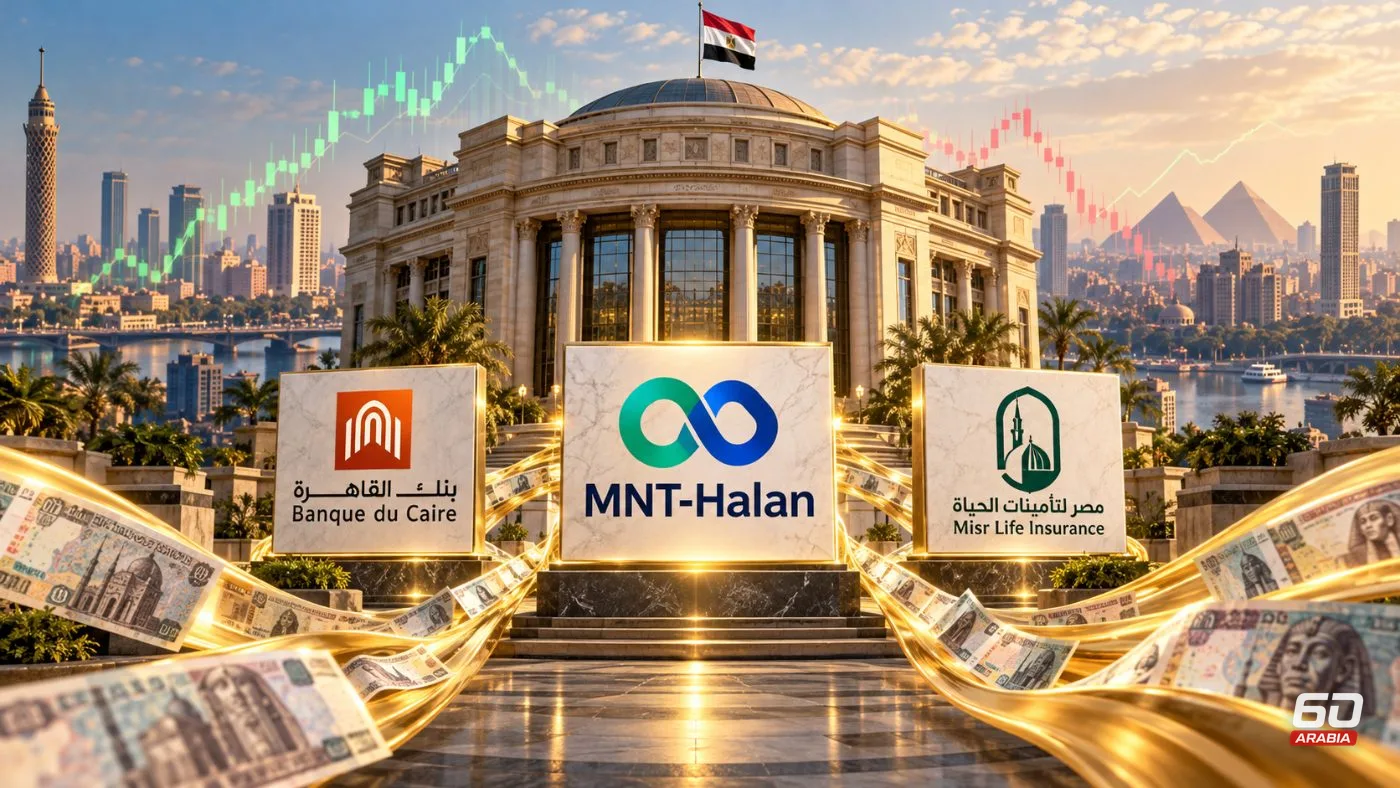
Banque Misr is offering 4.575 billion shares in Banque du Caire, representing a 30% stake, with subscription expected in late October and trading in November. With an indicative price range between EGP 4.3 and EGP 4.82, sources cited by Asharq Bloomberg say it could raise up to EGP 22 billion. The news agency reported an official source saying the stake was increased to 45% (about 6.862 billion shares), yielding proceeds between EGP 29.5 and EGP 33.1 billion, though no official announcement has been made. For Misr Life Insurance, Investment Minister Mohamed Farid estimated proceeds from selling 20% at EGP 14 to EGP 18 billion, with an IPO planned before year-end after the April target of late June was missed.
Adding Halan's EGP 7.84 billion, new supply ranges between ~EGP 42 billion and EGP 59 billion over roughly ten weeks—or EGP 51 billion to EGP 59 billion if the stake increase to 45% is confirmed. This represents 1% to 1.5% of total market cap, but equals six to over eight times Thursday's equity trading value of EGP 7.04 billion. This comparison highlights the scale of the challenge without measuring ultimate absorption capacity. The verdict depends on funding sources: fresh savings, portfolio reallocations, or foreign funds and strategic investors—and current data remains inconclusive.
The valuation discount speaks louder than oversubscription rates. The indicative range represents a 9% to 19% discount to the estimated fair value of EGP 5.3 per share (valuing the bank at ~EGP 80.8 billion), compared to 5.5% for Halan. This discount puts investor appetite to the ultimate test, yet does not fully explain seller motives, which are shaped by stake size, market conditions, and pricing mechanics.
What to Watch
First, the retail allocation in Banque du Caire, which accounted for 15% in Halan's offering. Second, Halan's listing on October 20, as announced by the company's chairman. Unmet demand approaches EGP 50 billion, while fair value exceeds the IPO price by only 5.8%. If the stock clearly surpasses this level, should it be read as attractiveness or scarcity? Finally, who will support the new shares post-listing, and when will market makers begin operations?
A 43.6x oversubscription measures momentum at the moment of offering. Banque du Caire and Misr Life Insurance will measure who remains once that moment passes.

Ibrahim Gamal Ibrahim is an Egyptian journalist and expert in digital media, economic and financial journalism, with more than 20 years of experience across the Middle East and North Africa (MENA) markets. He specializes in leading editorial teams, developing content and digital growth strategies, and integrating artificial intelligence into newsrooms, with extensive experience covering financial markets, monetary policy, and the banking sector. He has held editorial positions at Argaam, Veto, Besraha, Al Mal, and Mubasher.
Profile and all their articlesBeyond The Number

"Tabadul" Expands on Paper... But Will Liquidity Follow?

The IMF Puts Poison in the Honey: $126 Oil, Gulf Contracts, and Egypt Is 'Out of the Hole'

Between the Dollar and the Dirham: First Abu Dhabi Bank and Emirates Islamic Tap the Debt Market from Two Different Doors
From the 2004 Settlement to the Hyde Park Deal: What Happened to the Dreamland Land in 22 Years?
Weekly Newsletter
Read between the lines before everyone else. Decode the most important economic, tech, and decision-maker movements in the region.. in 5 minutes every Saturday.