"Tabadul" Expands on Paper... But Will Liquidity Follow?
Summary
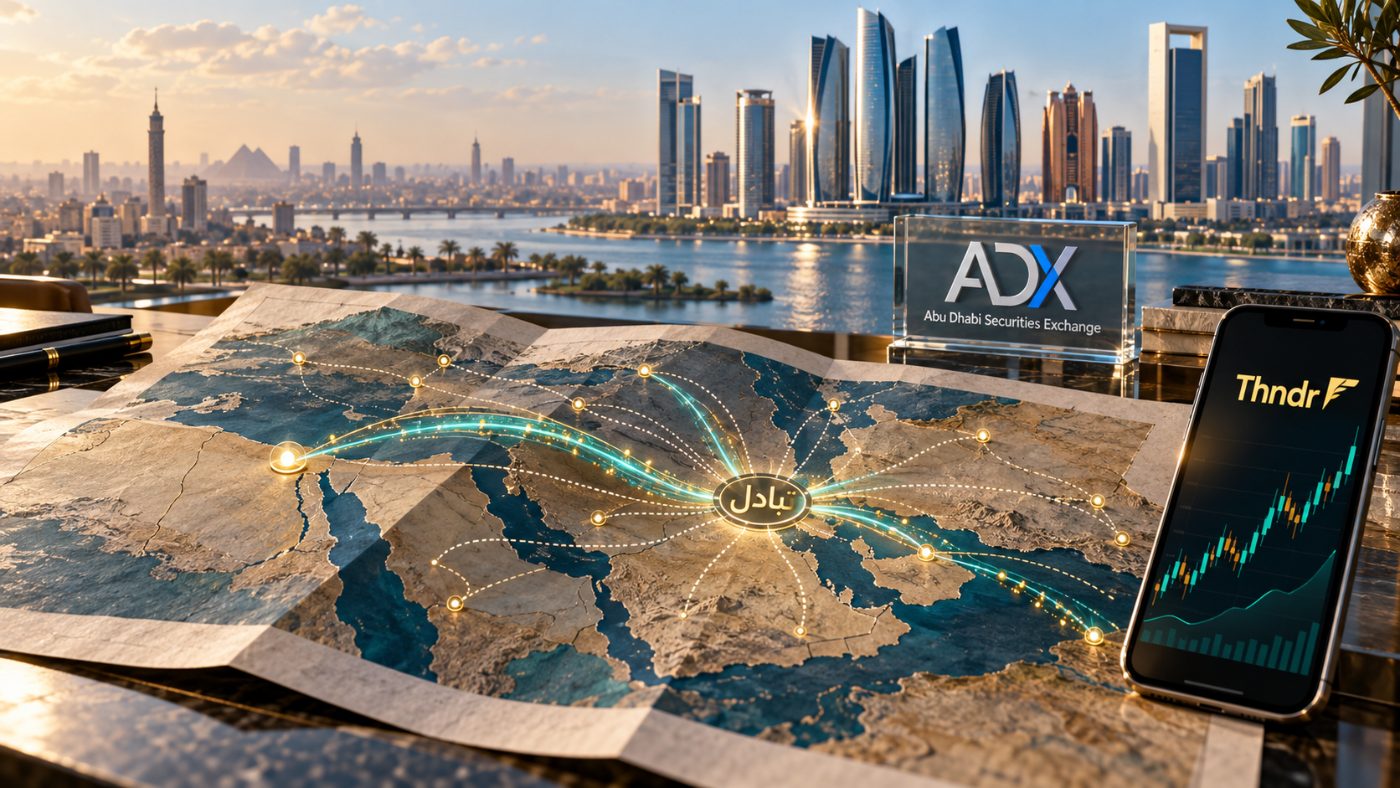
The "Tabadul" platform, owned by the Abu Dhabi Securities Exchange (ADX), is expanding through memorandums of understanding with the Egyptian Exchange and the Damascus Securities Exchange. However, will this expansion translate into actual liquidity? The article discusses the gap between signing agreements and the start of trading, as well as the role of the "Thndr" app in attracting retail invest
How many memorandums of understanding does a financial market need to turn into a trading network? A question worth asking after statements by Abdulla Salem Al Nuaimi, CEO of Abu Dhabi Securities Exchange Group, to CNBC Arabia. He spoke of two agreements with Egypt and Syria, around 20 or 21 markets connected to the "Tabadul" platform, and the Egyptian Exchange joining in the first half of 2027. The numbers are shiny, but it is more accurate to read them a second time.
Two Agreements, or Two Memorandums of Understanding?
What was signed in Abu Dhabi, on the sidelines of the annual conference of the Arab Federation of Capital Markets, were two memorandums of understanding with the Egyptian Exchange and the Damascus Securities Exchange. Their announced wording speaks of "exploring" opportunities to join the platform and initiatives to expand cross-border trading. A memorandum does not mean the completion of joining and linking requirements, and its legal effect depends on its text, which is unpublished. The Egyptian Exchange includes 277 listed companies with a market capitalization of $77 billion in August 2026; it is not a small market to be hastily attached to the network.
From Signing to Operation: How Long Is the Road?
"Tabadul" was launched in July 2022. According to market data, the Astana International Exchange joined in 2024 following a strategic partnership described in an MoU signed in June 2023—about a year later—and direct connection between the central depositories of both markets was delayed until September 2025. Then there was the Tashkent MoU in April 2024, which mentioned joining as a fifth member, but its name did not appear on the member list announced in January 2025. Then came the Budapest MoU in 2025 with the same wording, i.e., evaluating ways to join.
The paradox is that the timeline Al Nuaimi proposes for Egypt—between six and nine months from signing the MoU—is shorter than what Astana took. This is possible, as Cairo might be technically and managerially closer. However, joining is one thing, and the depth of interconnectivity is another. What will shorten the distance this time, and what level of connection does the market consider a completed accession? The published statements did not include an answer to that.
From 12 to 21
Al Nuaimi says the number of connected markets reached 12 after activating the connection with Iraq, and that it will rise to 20 or 21. That means eight or nine new markets, of which only Egypt and Syria were named. Here, the number needs a definition: Does it mean markets that signed MoUs, those that completed technical connectivity, or those where trading has actually begun through the platform? These are three different stages, and combining them into a single counter is inappropriate. As long as the number ranges between 20 and 21, the list is likely not finalized yet, and the legitimate question is where each market stands today.
A Model That Reduces Costs But Does Not Eliminate Obstacles
"Tabadul" is based on mutual access through local brokers, which reduces the need for dual listing or an additional custodian. The two Abu Dhabi MoUs mentioned dual listing among the options being studied, but it is not a prerequisite for the platform's operation. While this model lowers the cost of access, it does not automatically eliminate capital transfer barriers, taxes, and compliance issues—which ultimately determine whether an investor sends funds to another market.
Regarding volume, the market announced that trading among "Tabadul" members doubled in 2024 compared to 2023. This is rapid growth, but doubling a small baseline may still yield a small number. What was the baseline that doubled? For comparison, trading value on the Abu Dhabi Securities Exchange alone reached 342 billion AED in 2024, about $93 billion. Without the absolute number, it is impossible to know whether we are talking about a main artery or a small tributary.
Thndr: The Door That Actually Works
"Thndr", an Egyptian-born application, was approved as the first remote trading member for retail investors on the Abu Dhabi Securities Exchange. According to the exchange's statement, it has over 4 million users, and trading value through it exceeded $13 billion in 2024 across 12 million transactions. However, these are the total platform figures, offering access to the UAE, Egypt, and the US combined. How many of these billions went into shares listed in Abu Dhabi, and what percentage of daily trading there does that represent?
A distinction must be made between two roles. "Thndr" handles the retail investor interface and increases accounts and transactions, while "Tabadul" handles the access infrastructure between markets. Neither alone is sufficient to generate deep liquidity. That requires market makers, research coverage, free movement of capital, and clearing and settlement efficiency. Increased activity does not necessarily mean additional liquidity; trading might simply shift from one broker to another without new capital entering.
The 12%: In What Exactly?
Al Nuaimi stated that foreign investment in the market rose by about 12%. An important figure, but hanging in the air. The market's own data for 2025 speaks of a 13.8% increase in foreign trading value, so is that what was meant, or another index? Net flows, trading value, or ownership percentage? And what is the comparison period? Is there evidence linking it to "Tabadul" or "Thndr", or did it come from institutions entering the market through customary channels? Without these answers, the figure serves neither as proof of the platform's success nor as an argument against it.
The Price Limit: A Regulatory Trade-off
Al Nuaimi confirmed maintaining the maximum decline limit at 5% as investor protection. The market originally announced this measure as a temporary amendment upon resuming trading on March 4, 2026, lowering the limit from 10% to 5%, subject to continuous review. This means it remained in effect for about seven months up to the date of the statement. Its continuation, according to Al Nuaimi, does not necessarily mean a formal shift into permanent policy.
The issue is a clear trade-off. The limit tempers panic selling in a market with new retail investors, but it may hamper price discovery during shocks and leave sell orders pending on difficult days. The institutional investor we wish to attract asks first about exit conditions. This trade-off is measured by numbers held by the exchange alone, such as the volume of unexecuted orders during limit sessions and the speed at which prices recover afterward. Why are these not published?
What Should We Watch?
The success of "Tabadul" is not measured by the number of markets on its map, but by its ability to convert technical access into actual liquidity, and "Thndr" is the most measurable test so far. If a substantial portion of its digital user base turns into sustained investment in Abu Dhabi-listed stocks, it will have delivered what MoUs alone cannot: new, recurring demand. If connected to the "Tabadul" network, a retail investor buying stocks from a phone might find a path to opportunities in Egypt or Iraq without traditional brokerage complexities. This scenario depends on lower transfer and settlement costs, clear tax and capital exit rules, and attractive companies and products sufficient to convince them to venture beyond their local market.
Therefore, the key indicators to watch in 2027 are the percentage of trades executed via the platform in locally listed shares, net retail investor flows, market depth compared to pre-expansion levels, and the names of companies that actually benefit from broader access alongside their daily trading volume on the secondary market. If these numbers materialize, Al Nuaimi can truly speak of a network. Until then, "Tabadul" remains a promising project with a map wider than its actual activity so far.

Ibrahim Gamal Ibrahim is an Egyptian journalist and expert in digital media, economic and financial journalism, with more than 20 years of experience across the Middle East and North Africa (MENA) markets. He specializes in leading editorial teams, developing content and digital growth strategies, and integrating artificial intelligence into newsrooms, with extensive experience covering financial markets, monetary policy, and the banking sector. He has held editorial positions at Argaam, Veto, Besraha, Al Mal, and Mubasher.
Profile and all their articlesBeyond The Number
Halan's IPO Subscription Covered 43.6 Times... Can the Egyptian Exchange Absorb State Offerings Up to EGP 59 Billion?

The IMF Puts Poison in the Honey: $126 Oil, Gulf Contracts, and Egypt Is 'Out of the Hole'

Between the Dollar and the Dirham: First Abu Dhabi Bank and Emirates Islamic Tap the Debt Market from Two Different Doors
From the 2004 Settlement to the Hyde Park Deal: What Happened to the Dreamland Land in 22 Years?
Weekly Newsletter
Read between the lines before everyone else. Decode the most important economic, tech, and decision-maker movements in the region.. in 5 minutes every Saturday.