

Profits of 8 Saudi Banks Grow 5.4% in Q3, Al Rajhi Adds Two-Thirds of the Increase
Summary
Eight Saudi banks achieved profits of 22.1 billion riyals in the third quarter of 2026, an increase of 5.4%. Al Rajhi Bank accounted for about two-thirds of the total increase amid pressures from expenses and provisions.
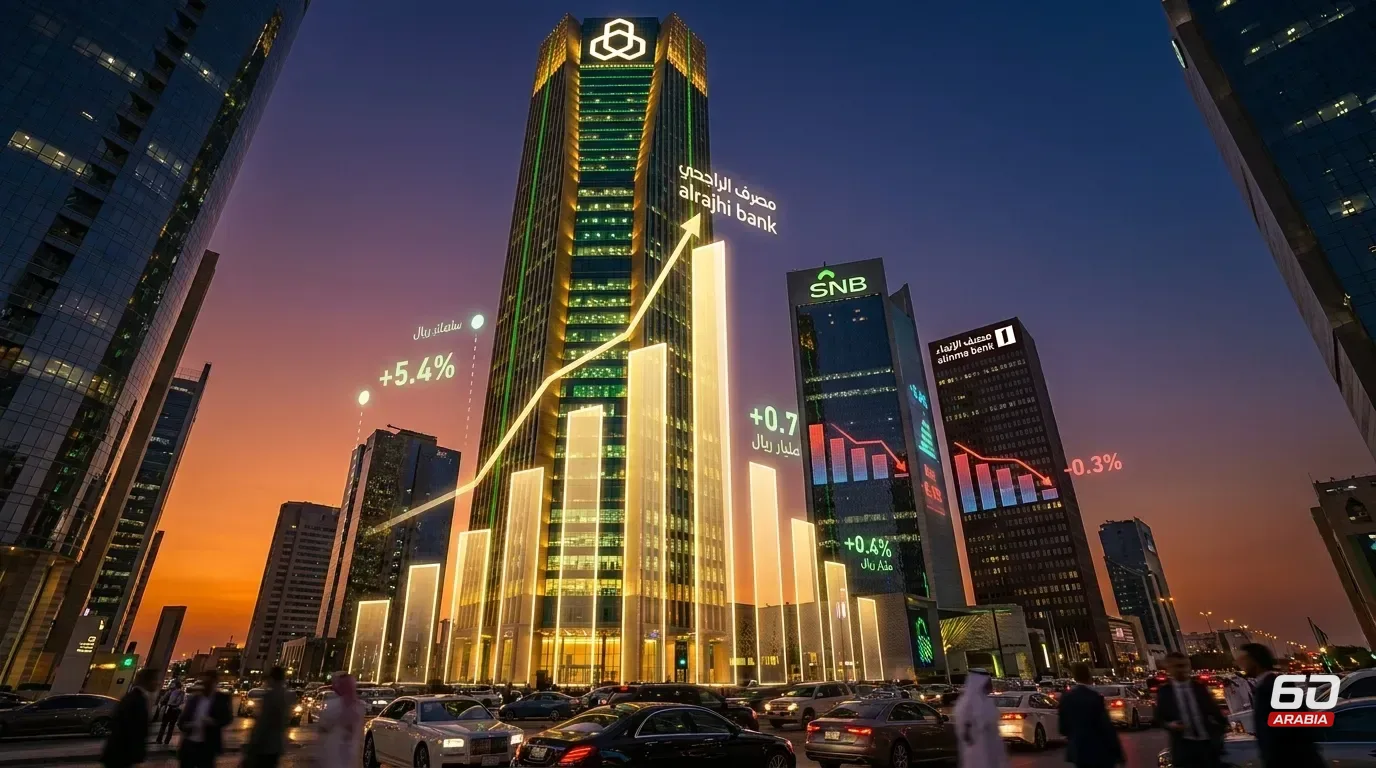
Eight listed Saudi banks in the Saudi market earned about 22.1 billion riyals in the third quarter of 2026, compared to about 21 billion a year earlier, an increase of 5.4%. The number is comfortable on the surface, but breaking it down changes the picture. Al Rajhi Bank alone added about 0.7 billion riyals out of a total increase of nearly 1.1 billion, or almost two-thirds, while the profits of Saudi National Bank, Alinma Bank, and Bank Albilad declined.
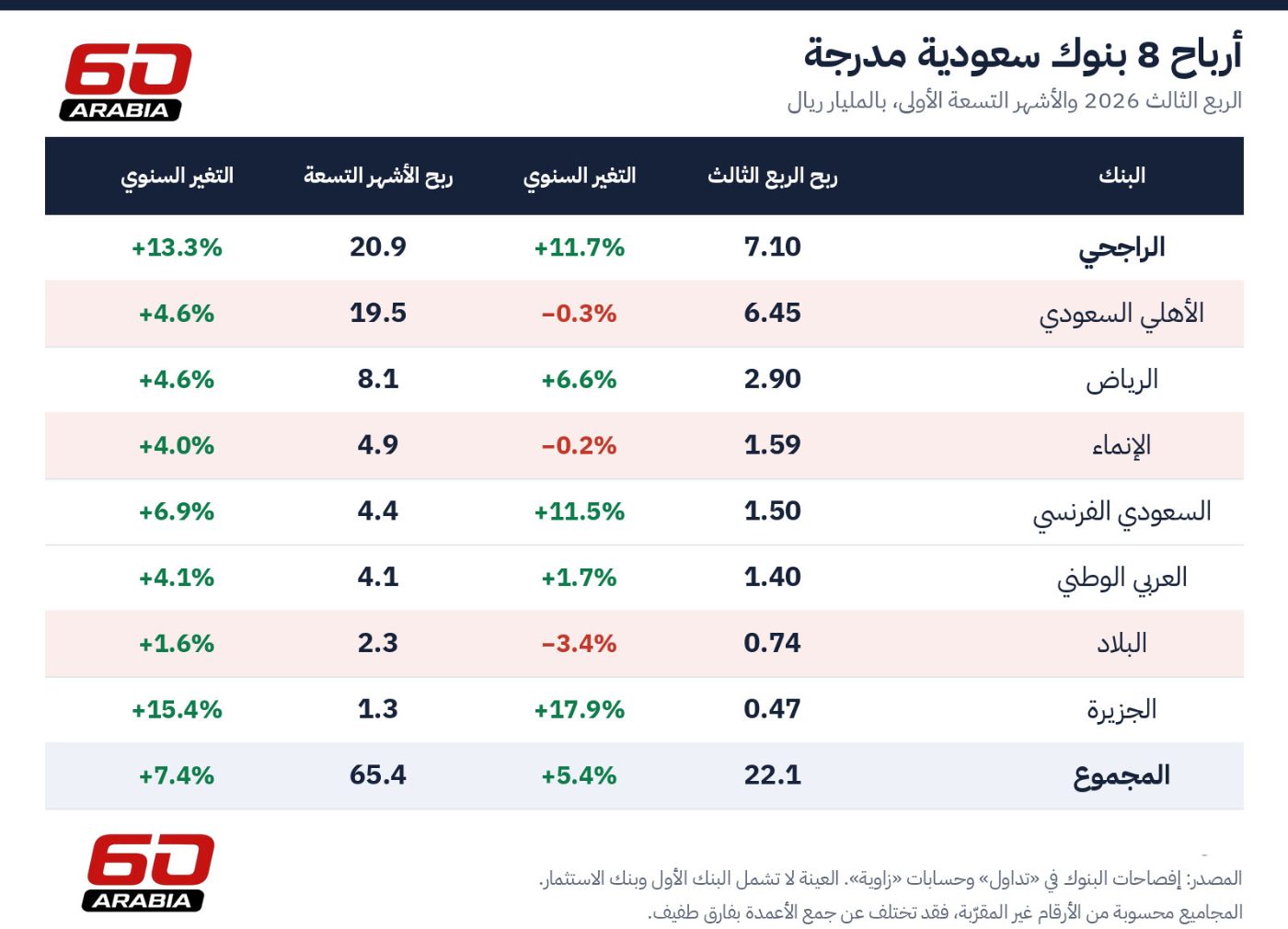
The material relies on bank disclosures on "Tadawul" and covers Al Rajhi Bank, Saudi National Bank, Riyad Bank, Alinma Bank, Banque Saudi Fransi, Arab National Bank, Bank Albilad, and Bank AlJazira, excluding Saudi Awwal Bank and The Saudi Investment Bank, so it does not represent the entire listed sector. All figures pertain to net profit attributable to shareholders.
Q3 Growth Below First-Half Rate
When subtracting Q3 profits from the nine-month total, the eight banks' profits in the first half were about 43.3 billion riyals compared to 39.9 billion, representing a growth of nearly 8.5%. Thus, Q3 growth was below the combined rate of the first half. This comparison is between a single quarter and a six-month period, so it does not conclusively determine the trend between Q2 and Q3 on its own, but it points to it.
In the background, "Alkhair Capital" observed in Q2 that none of the ten listed banks experienced a decline, whereas in Q3, profits declined at three out of eight. The two samples differ, making this contextual background rather than a direct comparison.
Who Declined and Why?
Saudi National Bank recorded 6,450 million riyals compared to 6,469 million, a drop of 0.3%. Operating income increased by only 2.2%, while operating expenses before provisions rose 9% and credit loss provisions surged 39.8%. The comparison base played a role, as its profits in Q3 2025 had risen 20.6%. ANB Capital had expected growth of around 3.5% to nearly 6.7 billion riyals, making the result below estimates by about 250 million.
Alinma recorded 1,588.3 million riyals compared to 1,592 million. The bank attributed the slight decrease to lower banking service fees and fair value investment evaluation income, along with increased expected credit loss provisions, despite growth in net financing and investment income. Published broker forecasts had anticipated growth between 6.5% and 8%.
Bank Albilad recorded about 740.2 million riyals compared to 766.5 million, a decline of 3.4%, the largest among the eight. Operating income rose 5.3%, but expenses including provisions increased by about 16%, and credit loss provisions climbed 149.7% to 82.4 million riyals. By derived calculation, provisions a year ago were around 33 million, making the increase nearly 49 million. Assuming other items remain constant, this increase exceeds the 26 million drop in profit, though it alone does not prove the cause of the decline, as net profit is affected by Zakat, tax, and other items.
Bank AlJazira was the exception. Its operating income rose 10.4% against expense growth of 8%, aided by a lower Zakat provision, yielding the highest growth in the quarter: 17.9% to 471.6 million riyals.
Al Rajhi: Expanding Lead and Narrowing Base
Al Rajhi Bank achieved about 7.1 billion riyals, a growth of 11.7%, even though its operating expenses including provisions increased by 15.2%, faster than its income growth of 12.5%. This growth comes off a high base, as its profits in the corresponding quarter of 2025 jumped nearly 24.6% according to press reports. The result fell in the upper end of published broker estimate ranges (8% to 12.1%).
Al Rajhi accounts for about 32% of the combined profits of the eight banks in Q3, and Saudi National Bank accounts for about 29%, bringing the two close to 61%. Adding Riyad Bank, whose profits rose 6.6% to about 2.9 billion riyals, reaches nearly 74%. Three banks account for three-quarters of the profits.
Over the nine months, profits rose across all eight banks, including the three that declined in Q3, reaching about 65.4 billion riyals compared to 60.9 billion, a 7.4% growth. The most significant shift at the top: a year ago, Saudi National Bank led over the nine months (18.6 billion versus 18.4 billion), while today Al Rajhi leads with about 20.9 billion compared to 19.5 billion. It alone added about 2.5 billion of the total 4.5 billion increase, or more than half.
Behind the Number
Disclosures tell what happened, but little about why. The following external sources, mostly Q2 data, serve as explanatory background rather than a complete description of Q3 events.
Interest Rates. The Saudi Central Bank lowered the repo rate three times in the final months of 2025 to 4.25%, following the US Federal Reserve due to the riyal's peg to the dollar. A report by "Edge" Economic Consulting highlighted its impact on lending margins. SAMA then raised it on September 16, 2026, to 4.50% after the Fed's first hike since 2023. The decision came near the end of the quarter, so Q3 results alone are insufficient to measure its impact, which in coming quarters will depend on the speed of asset and liability repricing and the funding mix.
Financing and Lending
According to available data for the top ten banks in Q2, term deposits jumped 9.1% while cheaper current and savings deposits dropped 2.2%, raising the share of term deposits to 45% and cost of funds to 3.2%. Net loans grew 7% to 3.25 trillion riyals, with the loan-to-deposit ratio at around 103%.
A report by "Al Rajhi Capital" noted that Al Rajhi, SNB, and Riyad Bank lowered their loan growth forecasts for 2026, interpreted as a shift toward yield over expansion. This may protect margins but limits income growth.
Cost of Risk.
The cost of risk for the ten banks more than doubled in Q2 to 0.32% from 0.15%, and loan provisions surged 111.7% to 2.6 billion riyals. Q3 disclosures showed that provisions rose across all eight banks. However, an increase in provisions may reflect accounting conservatism and risk anticipation, or actual deterioration in portfolio quality. Available disclosures do not differentiate between the two, and Q3 cost of risk data for the sector is not yet available, making any definitive judgment premature.
What Q4 Will Tell
The eight banks are earning more, but profits are concentrating in fewer balance sheets. Three indicators will reveal if the slowdown is temporary: the direction of provisions at the three declining banks, cheap deposit movements and funding costs, and the impact of the recent rate hike on margins. If expenses continue outstripping income at the rest, the group's growth will remain reliant on a single bank.

Ibrahim Gamal Ibrahim is an Egyptian journalist and expert in digital media, economic and financial journalism, with more than 20 years of experience across the Middle East and North Africa (MENA) markets. He specializes in leading editorial teams, developing content and digital growth strategies, and integrating artificial intelligence into newsrooms, with extensive experience covering financial markets, monetary policy, and the banking sector. He has held editorial positions at Argaam, Veto, Besraha, Al Mal, and Mubasher.
Profile and all their articlesBeyond The Number

A White Penny for a Black Day... Why Didn't Gulf Currencies Collapse Despite the Iran War?
Banque du Caire on the Stock Exchange: Capped Pricing in the Final Weeks of the IMF Program

"Moody's" Returns Egypt to B3: An Upgrade After a Crisis and Its Real Test After December

"One Hand Alone Cannot Clap"... Why Is Africa's Richest Man Knocking on the Door of the Egyptian Stock Exchange?
Weekly Newsletter
Read between the lines before everyone else. Decode the most important economic, tech, and decision-maker movements in the region.. in 5 minutes every Saturday.