A White Penny for a Black Day... Why Didn't Gulf Currencies Collapse Despite the Iran War?
Summary
A white penny is useful for a black day, provided that the black day is short. The stability of Gulf currencies despite the Iran war does not negate the existence of a cost to defend them, with GCC economies expected to contract by 4.8%.
"A white penny is useful for a black day" is a famous Egyptian proverb calling for saving and setting aside a portion of money for hard times. That is how we were raised. After 23 years of covering the economy, I add a condition to the proverb that people usually do not say: provided that the black day is short.
This is not an introduction, but the main idea around which this article revolves. The black day came to the Gulf on February 28 with the start of the war on Iran, followed by a widespread disruption of navigation in the Strait of Hormuz. After about eight months, the International Monetary Fund (IMF) said on Thursday, October 22, that the economies of the Gulf Cooperation Council (GCC) will contract by 4.8% this year, after having expected a growth of about 2% in April. Nevertheless, currencies remain pegged to the US dollar, and the Fund's Managing Director described the peg on October 1, according to "The Asian Banker," as anchoring stability and confidence.
The answer I see to the headline's question begins with this sentence: the stability of the announced exchange rate does not mean that the cost of defending it is zero, nor that pressures are equal across countries. It means that central banks are still able to fulfill their commitment at the official rate, while the impact of the shock is distributed across reserves, financing, and economic activity.
The fixed rate of Gulf currencies despite the war with Iran is not a complete test of the health of the economy, nor of the strength of all aspects of the peg. The figure on the screen may remain unchanged while reserves decline, borrowing costs rise, or banks require liquidity. Therefore, the question worth asking in the Gulf is: how many pennies does each country possess, and how many days can those pennies buy?
What Protected the Currency?
The first answer is administrative before it is economic. Five of the six GCC countries peg their currencies to the US dollar, and Kuwait to an undisclosed basket that practically moves close to the dollar. That means the exchange rate is not market opinion, but an announced commitment by the central bank to sell dollars and buy local currency. The peg provides a return that explains governments' adherence to it: it limits exchange rate volatility in economies that import heavily and price their trade and financing in dollars, providing investors with a stable benchmark. However, it protects the exchange rate, not the output, and its price is less autonomy over interest rates.
On September 16, the Federal Reserve raised interest rates by a quarter point to 3.75%-4.00%, followed by the central banks of Saudi Arabia, the UAE, Qatar, Bahrain, and Oman, while the Central Bank of Kuwait kept interest rates unchanged. I am not saying that interest rates caused the contraction, as the IMF figures are primarily due to disruptions in oil and gas production and exports. However, an announced commitment requires backing.
How Many Pennies Does Each Country Own?
A column by Mike Dolan in Reuters last March estimated the reserves supporting the peg of five currencies at around $800 billion. I am reserved about this figure, as it is a journalistic estimate that does not distinguish between official reserves held by central banks and sovereign wealth fund assets, which have different owners, purposes, and liquidity profiles. It is more accurate to examine the official figures for each country. The Saudi Central Bank's net foreign assets reached $437 billion at the end of 2025, and the IMF review estimates the Kingdom's reserves at about 13.9 months of imports in 2026. As for Bahrain, the IMF stated in January that its reserves barely exceed slightly more than two months of its projected non-hydrocarbon imports, and that its total government debt exceeded 133% of GDP in 2024. The two metrics are not identical, so I am not comparing them figure for figure, but the trend needs no explanation: pennies are not equal.
And How Many Days Did They Buy?
Countries bought time from three sources. The first is oil. Brent is 47% higher than its pre-war level, according to Jihad Azour, Director of the IMF's Middle East and Central Asia Department, on October 15; however, revenue depends on volume, not just price. The Fund stated that oil and gas production among directly affected exporters dropped from 33 million barrels per day in February to about 19 million in May, with Qatar's production falling by up to 86%. Gulf crude exports recovered in September to over 75% of pre-war levels, according to the International Energy Agency (IEA). The capacity of the Saudi East-West Pipeline is about 7 million barrels per day, and the Energy Minister announced on October 6 that throughput returned to 5.8 million following a shutdown since September 11 due to drone attacks. This figure reflects throughput, not the quantity available for export, as part of it feeds Saudi refineries according to a previous Bloomberg estimate.
The second source is borrowing. Regional bond sales reached $112 billion through late July, a record figure according to Bloomberg. On July 23, Kuwait sold $6 billion in bonds at spreads of 70, 75, and 85 basis points over US Treasuries for three-, five-, and ten-year maturities, with the Ministry of Finance stating that orders exceeded three times the offering size. By comparison, the October 2025 issuance tranches were priced at 40, 40, and 50, widening the spread by 30, 35, and 35 points depending on maturity—a calculation based on public figures. Investors did not leave, but borrowing costs increased.
The third source is the liquidity network. On April 8, the UAE and Bahrain central banks signed a currency swap agreement between the dirham and the dinar with a nominal value of 20 billion dirhams (2 billion dinars) for a five-year term. This is a liquidity facility, not a fully injected sum nor an open-ended UAE guarantee for the dinar. Analysts told Bloomberg that investors expect additional support from neighbors, though this reflects analyst expectations rather than an announced commitment.
Who Pays the Bill?
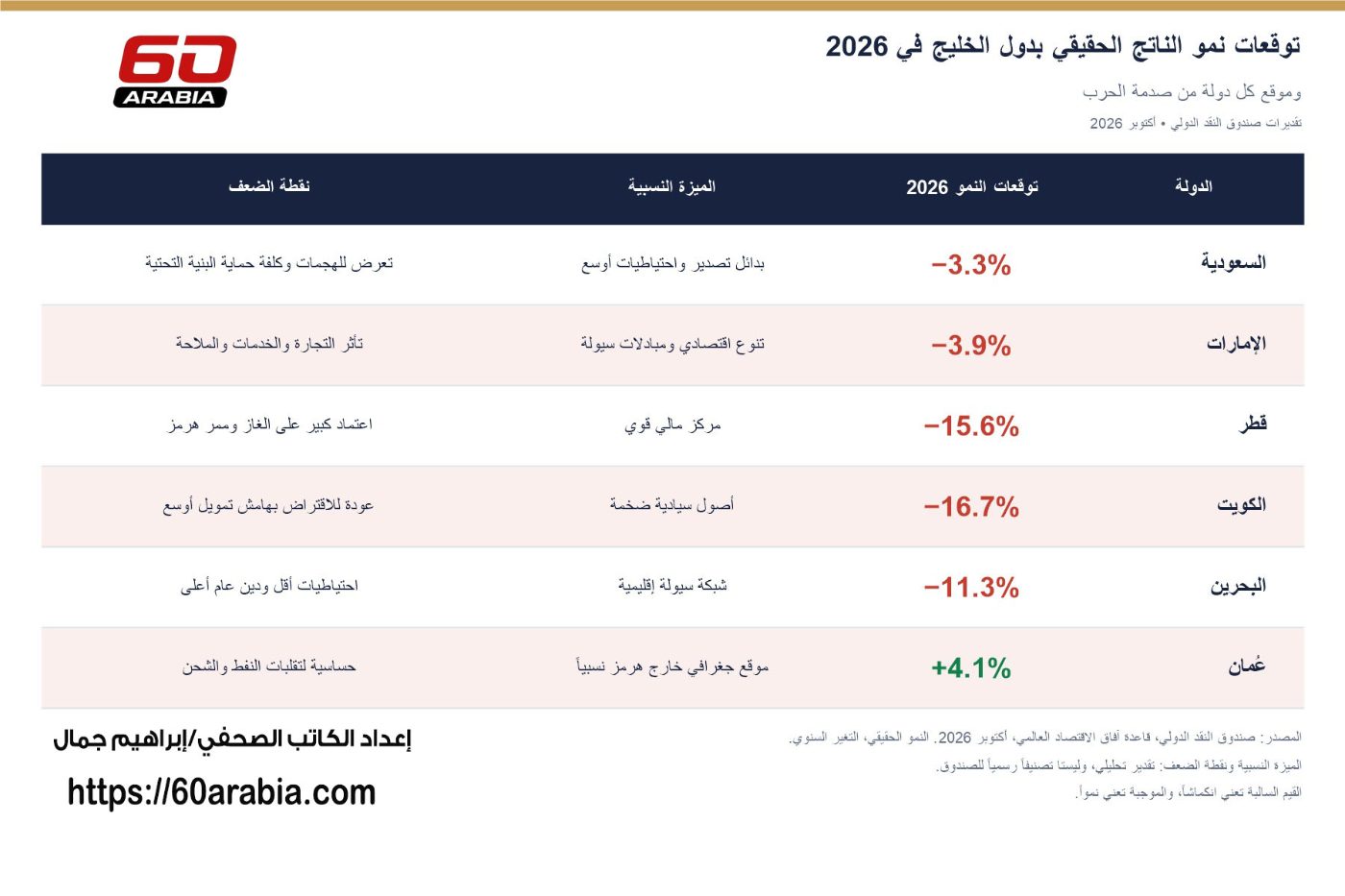
Here lies the cost, which is in the economy rather than the exchange rate. The IMF's forecasts for real GDP growth in
2026, according to The National citing the October report, ranged between a contraction of 3.3% in Saudi Arabia, 3.9% in the UAE, 11.3% in Bahrain, 15.6% in Qatar, and 16.7% in Kuwait. Oman alone showed positive growth, with reports differing on its figure between 2.4% and 4.1%. The Fund expects the GCC's current account surplus to shrink to 1.3% of GDP from 5% in 2025, its combined fiscal deficit to widen to 2.3% of GDP from 0.8%, and its non-oil economy to contract by 0.8%. At the corporate and household level, less is documented, and my view is a deduction rather than a published figure: borrowers, real estate, and construction sectors bear the brunt, as interest rates rose in September while AGBI reported in August that developers had virtually halted launching new projects. There is no free lunch in the Gulf either.
When Should I Worry?
I distinguish between pressure on a currency and an attack on a peg. Pressure is what we see now: higher demand for dollars, wider credit spreads, and the use of liquidity facilities and swap arrangements. An attack, however, involves sustained and broad selling of local currency, rapid depletion of reserves, and a surge in forward exchange rates. This pattern did not appear in the reports I reviewed, though I found no recent forward exchange data for each country. For each country individually, I monitor official reserve trends, bond spreads compared to pre-war levels, the extent of liquidity facility usage, deposit growth, and interbank funding costs. I worry when these indicators converge in a single country, and Bahrain is the primary one to watch given its numbers.
The Fund's projections are conditional. It assumes that the reopening of Hormuz will begin in March 2027 and that conditions will return nearly to pre-war status by October 2027—an assumption, not a guaranteed date. Nor does output contraction translate into a fiscal deficit to the same degree. Azour stated that the region will not return to its pre-war trajectory in the medium term, and that the reserves that bought time are finite. If the Strait of Hormuz reopens on schedule, the Gulf will have spent what pennies it can recover. If it does not reopen, our question will not be why currencies did not collapse, but rather how much is left in the pockets.
Finally... A white penny is useful for a black day, provided that the black day is short. If the war does not end and the Strait of Hormuz does not reopen, the question will not be why Gulf currencies didn't collapse, but rather how much is left in the pockets.
Ibrahim Gamal Ibrahim is an Egyptian journalist and expert in digital media, economic and financial journalism, with more than 20 years of experience across the Middle East and North Africa (MENA) markets. He specializes in leading editorial teams, developing content and digital growth strategies, and integrating artificial intelligence into newsrooms, with extensive experience covering financial markets, monetary policy, and the banking sector. He has held editorial positions at Argaam, Veto, Besraha, Al Mal, and Mubasher.
Profile and all their articlesBeyond The Number
Banque du Caire on the Stock Exchange: Capped Pricing in the Final Weeks of the IMF Program
"Moody's" Returns Egypt to B3: An Upgrade After a Crisis and Its Real Test After December
"One Hand Alone Cannot Clap"... Why Is Africa's Richest Man Knocking on the Door of the Egyptian Stock Exchange?
"Tabadul" Expands on Paper... But Will Liquidity Follow?
Weekly Newsletter
Read between the lines before everyone else. Decode the most important economic, tech, and decision-maker movements in the region.. in 5 minutes every Saturday.