"One Hand Alone Cannot Clap"... Why Is Africa's Richest Man Knocking on the Door of the Egyptian Stock Exchange?
Summary
One hand indeed cannot clap. Perhaps Dangote does not merely want shareholders who buy the stock, but a base that trusts the project and holds onto its investments when market conditions change. Money alone does not explain the offering, and Cairo does not yet know what it will get.
Africa's richest man owns about 87% of a refinery valued at nearly $50 billion, and approximately 84% will remain in his hands after the offering, according to a published analysis of the prospectus.
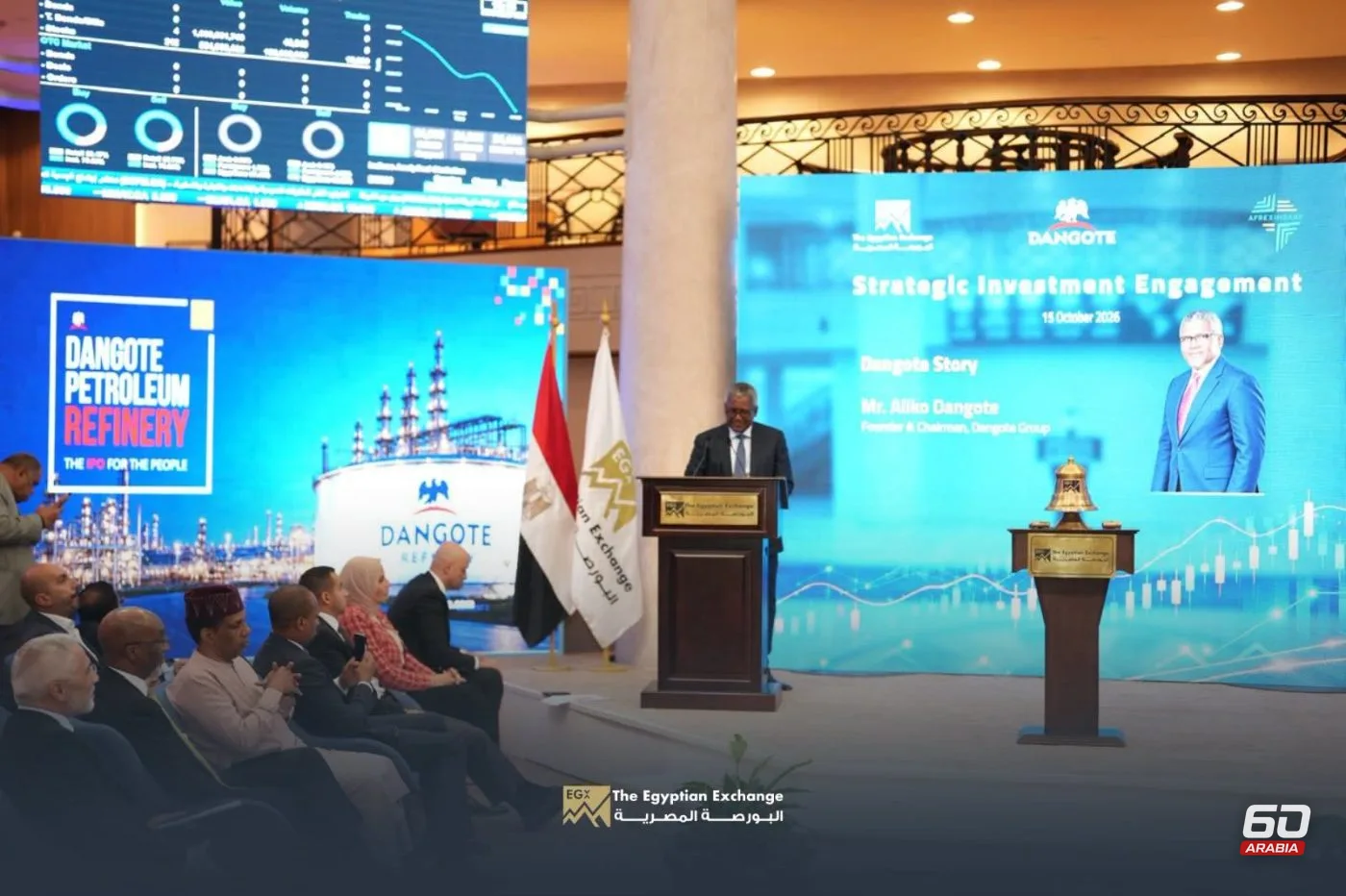
Yet he is touring African financial markets in search of shareholders. The minimum subscription is 5,250 Naira, about four dollars, and the target is ten million retail investors. This roadshow campaign reached Cairo on Thursday, October 15.
The offering itself is known: 4.1 billion new shares at a price of 525 Naira, to raise about $1.6 billion, with proceeds reaching $2.1 billion if the 30% over-allotment option is exercised. The subscription period was extended from October 13 to October 27 with approval from the Nigerian authority.
Money is not the full explanation
Dangote said that subscriptions reached three or four times the target amount, and that it is a matter of the number of participants, not the amount collected. However, no subscription figures have been published to prove this. Yet published numbers have their own story to tell. According to the company's results announced on October 13, its operating cash flows reached $3.68 billion in nine months, and September ended with a cash balance of $6.69 billion.
However, net cash after deducting debt is only $650.8 million, meaning its declared debt is close to $6 billion. The cost of the planned expansion is $14.3 billion to double capacity to 1.4 million barrels per day by 2029, and the offering proceeds cover about 11% of it.
So the offering covers part of the bill, and it cannot be said that the company does not need it financially. But it is a small part, and strong cash flows make the question legitimate: Is Dangote seeking something beyond the proceeds?
Three readings of what he is looking for in Cairo
The following are analytical readings of the offering structure and the visit, not objectives declared by Dangote. What is officially announced is expanding African participation in the refinery's ownership; anything beyond that is an inference.
First: Expanding the circle of interests. In 2024, Dangote faced allegations of monopoly and responded by offering to sell the refinery to the Nigerian National Petroleum Corporation.
There is no proof that the current offering is aimed at addressing that image. However, it opens a question about the impact of expanding ownership: If he succeeds in attracting millions of investors—a target not yet achieved—shares alone will not be distributed; the circle of interests tied to the project's success may expand alongside them.
Second: Expanding the demand base post-listing. The expected public share is about 3.3% of the capital, with listing expected around December 8. Such a percentage makes the float of available shares an important factor in tracking liquidity.
Participation by investors from multiple African markets may help expand the demand base, though this depends on the volume of actual participation, the terms of the instrument, and investors' willingness to hold the stock.
Third: Building mutual economic interests. Dangote is looking for industrial opportunities in Egypt, and the stock exchange is considering enabling investment in his group's companies through a local instrument. Financial and industrial tracks could create shared interests encouraging continued cooperation. However, there is no announced evidence that either track is a condition for the other, or that financial investment will lead to concessions or projects. What has been announced is less than these readings suggest, but they serve as keys to monitor what lies ahead.
7.6 times earnings: Cheap or misleading?
The post-offering valuation is 65.2 trillion Naira, between $47 billion and $49 billion depending on the exchange rate. The refinery announced, in unaudited results, a net profit of $4.73 billion in the first nine months of 2026 compared to a loss of $117.2 million a year earlier, with revenues reaching $22.48 billion. By annualizing the nine-month profit—our own calculation, not an officially declared figure from the company—the price equals about 7.6 times earnings, an apparently attractive ratio on the surface.
However, the same calculation based on first-half profits alone—which stood at $1.82 billion according to the prospectus—raises the multiple to about 13 times. This difference tells the story, as the third quarter alone generated nearly $2.9 billion, more than the entire first half.
The surge came amidst energy supply disruptions due to the war with Iran and shipping blockages in the Strait of Hormuz. According to Reuters citing Kpler data, Europe lost nearly a quarter of its diesel and jet fuel supplies following the strait's closure, and the refinery shipped about 80,000 barrels per day of jet fuel to Europe in the second quarter, equivalent to 13% of the deficit. In June and July, it became the largest single supplier of jet fuel to the continent, according to Kpler. Subscribers are therefore also buying profits for years when markets calm down, betting that the expansion will compensate for what is lost. The professional question is: What profits can be sustained when supplies return to normal?
Two tracks that do not meet
The first is financial: an Egyptian investor base reached through an instrument traded in Cairo. The second is industrial: Dangote met President El-Sisi in New Alamein on October 3, discussing energy, fertilizers, chemicals, and cement, with the President promising facilities and reminding him that he is an Al-Azhar graduate—a nice human touch, but no substitute for a feasibility study.
Here, a distinction must be made between declared ambition and specific investment. In his Cairo conference, Dangote said that Egypt is part of a $50 billion program to industrialize Africa, without naming a project or specifying Egypt's share.
Reports speak of investments in Egypt between $10 billion and $15 billion with no projects or schedules. In cement, there is no project, no acquisition deal, and no production capacity. A big number without an address—typical of large numbers in the early stages of courtship. As for an Egyptian buying a certificate linked to shares of a Nigerian company, they are not thereby directing funding to a factory inside Egypt.
What Cairo actually walked away with
According to Nigeria's Business Day, Kenya approved a route via Global Depositary Receipts, Uganda and Ethiopia permitted participation under eligibility conditions, Zimbabwe facilitated subscription via Botswana's framework, while Egypt and Rwanda are still exploring.
The head of the stock exchange, Omar Radwan, said that the stock exchange is studying Egyptian depositary receipts linked to the shares of the group's companies, enabling institutions and family offices to invest through a local instrument.
The two sides agreed on intensive technical meetings. This is the announced outcome: a study and meetings. No license, no prospectus, no date, and it has not been settled whether the instrument will enable the current subscription.
Since the subscription ends on October 27, it is difficult for an as-yet-undesigned instrument to catch up with it. The published timeline suggests allotment approval around November 11 and listing around December 8, so the likeliest path is a certificate issued against listed shares afterwards. This is my assessment, to be settled in upcoming meetings.
What this means for whoever buys the certificate
A depositary receipt is not a share, and its holder relies on intermediary links, each carrying its own risks, even if the details of the Egyptian instrument have not yet been settled. The underlying asset is priced in Naira while the certificate will trade in Pounds; a local-currency instrument relieves the complexities of conversion but does not eliminate the impact of a declining Naira, as the certificate's price could fall while the stock remains unchanged.
Usually, the custodian holds the underlying shares, and dividends and rights reach the holder through them after deducting fees, so their reputation and authorities are part of the investment. If trading in the certificate is thin, the holder may sell at a discount to the original price. As for the conversion ratio to the share and the fees, they determine how much an Egyptian pays per actual share, and both remain unannounced.
The instrument has not been licensed yet, so any offer to sell a "stake in Dangote" through unlicensed channels before the prospectus is issued warrants suspicion.
What the stock exchange gains if the instrument succeeds
If the certificate is issued and trades with real liquidity, the stock exchange stands to gain fees, new institutional inflows, and a precedent demonstrating that Cairo can host securities of major African companies, becoming a link between continental markets. But if it remains a rarely traded paper, the photograph taken on the day of the visit is all that will remain. A photograph does not list a security.
The stock exchange and the regulator must clarify whether the certificates cover the refinery alone or other companies in the group, whether an Egyptian can participate in the current subscription or buy after issuance, and who is responsible for each step and when.
And one hand indeed cannot clap. Perhaps Dangote does not merely want shareholders who buy the stock, but a base that trusts the project and holds onto its investments when market conditions change. This is an economic hypothesis explaining the offering, though he has not confirmed it. And ten million hands—which is the target—do not create applause if each hand does not know where it is putting its money and what it is getting in return.
Ibrahim Gamal Ibrahim is an Egyptian journalist and expert in digital media, economic and financial journalism, with more than 20 years of experience across the Middle East and North Africa (MENA) markets. He specializes in leading editorial teams, developing content and digital growth strategies, and integrating artificial intelligence into newsrooms, with extensive experience covering financial markets, monetary policy, and the banking sector. He has held editorial positions at Argaam, Veto, Besraha, Al Mal, and Mubasher.
Profile and all their articlesBeyond The Number
"Moody's" Returns Egypt to B3: An Upgrade After a Crisis and Its Real Test After December
"Tabadul" Expands on Paper... But Will Liquidity Follow?
Halan's IPO Subscription Covered 43.6 Times... Can the Egyptian Exchange Absorb State Offerings Up to EGP 59 Billion?

The IMF Puts Poison in the Honey: $126 Oil, Gulf Contracts, and Egypt Is 'Out of the Hole'
Weekly Newsletter
Read between the lines before everyone else. Decode the most important economic, tech, and decision-maker movements in the region.. in 5 minutes every Saturday.