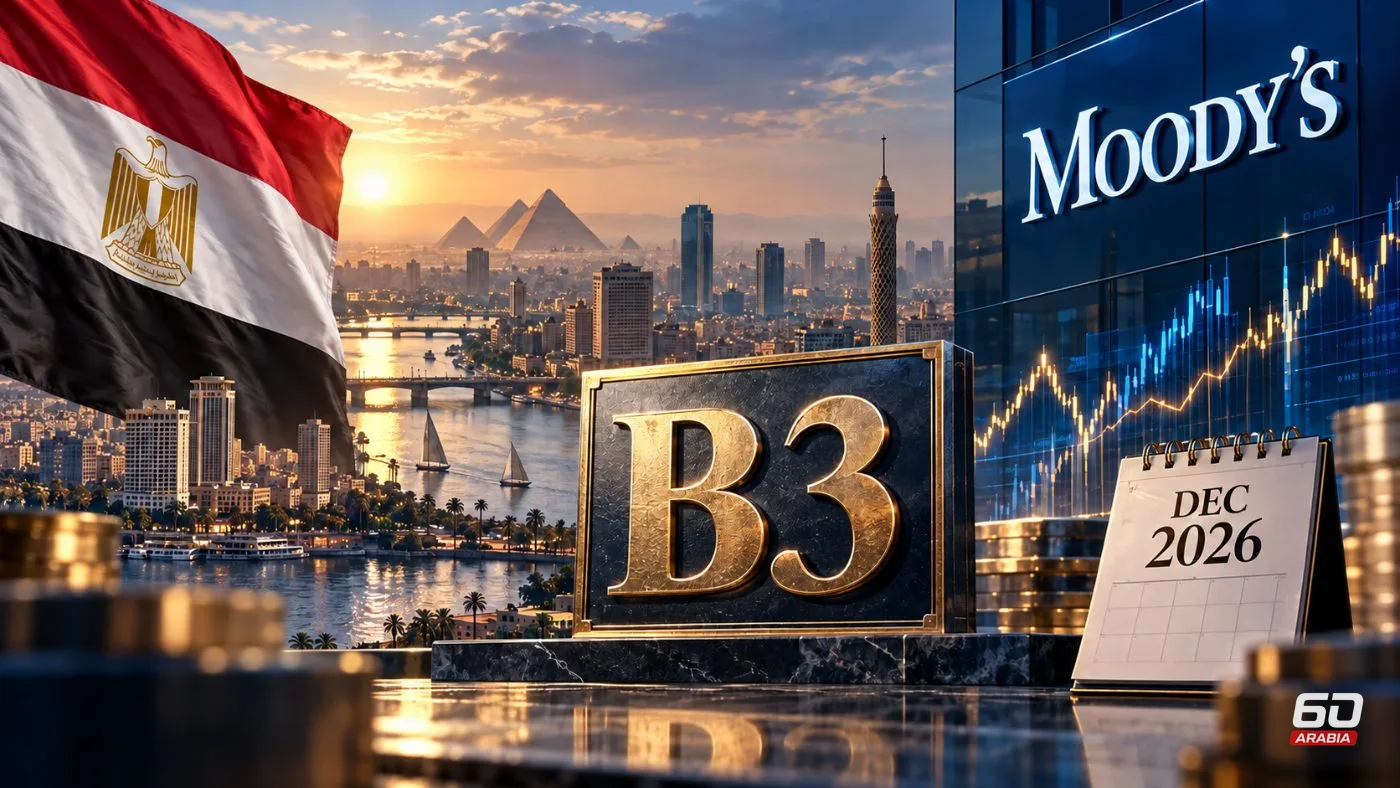
"Moody's" Returns Egypt to B3: An Upgrade After a Crisis and Its Real Test After December
Summary
The upgrade of Egypt's credit rating reflects improving indicators, but the real test lies in maintaining fiscal discipline after the expiration of the IMF program.
The upgrade comes with the arrival of the test. Moody's raised Egypt's rating to B3 just a few months before the expiration of the International Monetary Fund program in December 2026. This timing makes the question more important than the rating itself: Will discipline remain when the framework that imposed it is gone?
The Decision in Brief
The agency raised Egypt's sovereign rating from Caa1 to B3, a one-notch upgrade, while maintaining a positive outlook. B3 remains in speculative grade, meaning investors bear relatively high credit risk. The positive outlook signals the possibility of an additional step, not a promise of one.
What the Agency Said and What I Read Into It
Moody's attributes its decision to fiscal consolidation, progress in structural reforms, a transition toward a flexible exchange rate and a tighter monetary policy, alongside improved foreign reserves and the economy's capacity to absorb external shocks. This is what the agency said. What follows is my own reading of these reasons and should not be attributed to Moody's.
Debt and Interest: The Hardest Test for the Positive Outlook
Moody's is betting that the burden of public debt and interest costs will decline faster than assumed in its baseline scenario. Here lies the hardest test for any subsequent upgrade.
The debt-to-GDP ratio alone is insufficient for judgment. This ratio might drop while interest payments consume a large share of revenue, and the primary budget balance might improve while maturity obligations requiring refinancing remain heavy. Therefore, I start with the interest-to-revenue ratio, as it clarifies the proportion of tax revenues absorbed by interest payments and the pressure this exerts on the fiscal space available for other spending. I then move to gross financing needs, meaning the budget deficit plus maturing debt installments.
International Monetary Fund estimates reveal the extent of this pressure. Interest payments absorb about 83% of tax revenues according to the IMF's 2026 report, and gross financing needs are expected to remain close to 40% of GDP over the next three years. These are estimates from an international institution, not final results for the current fiscal year. The Ministry of Finance estimates in its annual borrowing plan that financing needs for the period from January to June 2026 will be about 30.4% of GDP, with 91% allocated to debt maturities. These figures are not suitable for direct comparison, as the two periods differ, but each highlights, within its scope, the magnitude of pressure imposed by debt service and maturities on financing requirements.
An improvement in both indicators supports the chances of another upgrade, but does not guarantee it. The agency does not decide based on two isolated indicators; it looks at the overall debt trajectory, fiscal discipline, and the continuation of reforms. Caution is needed when reading the ratio alone, as it may improve because its denominator grew—due to revenues or nominal GDP inflated by inflation—without the underlying liabilities actually declining. If improvement in both indicators lags, the positive outlook loses its strongest support.
Reserve Quality Is More Important Than Its Size
Net international reserves reached about $57.35 billion at the end of September 2026, according to preliminary data from the Central Bank of Egypt. This is good news, but the figure alone does not reveal the source of the increase. Dollars originating from exports, tourism, remittances, and foreign direct investment build a lasting capacity to generate currency. Dollars stemming from borrowing or hot money buy time—which is useful—but do not resolve the imbalance in itself.
However, this distinction is not absolute; direct investment may include profits repatriated abroad, and borrowing may finance a productive project. Judgment depends on the nature of the inflow, its utilization, and the corresponding liabilities. To evaluate the quality of the increase, one must read the balance of payments, investment flows, and external financing, rather than relying solely on the end-of-month balance.
A Flexible Exchange Rate: Its Success Is Measured by the Source of Dollars
A flexible exchange rate means that the pound no longer solely bears the cost of delayed decisions, and that the market prices risk rather than the state hiding it. This is a real advantage, and it comes at a price: currency depreciation, higher import costs, and an increased burden of dollar-denominated liabilities when measured in pounds. The true benchmark of its success is the economy's ability to supply foreign currency from sustainable sources without the return of shortages, reserve depletion, or runaway inflation. Allowing the exchange rate to move alone is not enough.
What Actually Changes in Financing Costs
The upgrade may reduce the sovereign risk premium and improve Egypt's image in international debt markets, which could gradually reflect on future issuances. However, it does not guarantee a similar drop in the required yield, as the final yield is influenced by global interest rates, investor appetite for emerging markets, bond maturity, issuance size, and currency risk. Domestically,
interest rates may remain high due to inflation, monetary policy, and the government's financing needs.
Therefore, I track borrowing costs, maturities, and refinancing risks as indicators showing whether credit improvement has actually translated into financing. Maturities may improve through active debt management despite yields remaining high, and yields may fall due to
the global market without a corresponding improvement in fundamental risks.
Foreign investors see a relative reduction in risk, but they also weigh expected returns, ease of profit repatriation, liquidity, and exit options. As for citizens, they will not feel the impact unless stability translates into sustainably lower inflation, along with better investment, employment, and incomes. An upgrade does not lower prices tomorrow.
From 2019 to Today: What Was Not Enough Back Then
Egypt reached B2 in April 2019. In February 2023, Moody's downgraded it to B3, then to Caa1 in October of the same year. In February 2025, it maintained it at Caa1 with a positive outlook prior to the current upgrade. Thus, the word "returns" in the title seems apt, as Egypt has returned to a level it previously reached.
The useful comparison is not between two ratings. The question is: What risks drove the rating down, and to what extent have they receded today? The reasons for the downgrade in 2023 were deteriorating debt sustainability, persistent foreign currency shortages, and high external debt service payments. These very questions deserve to be asked now before we are reassured that the cycle will not repeat.
The Post-December Test
The conclusion of the IMF program does not mean external financing stops or commitment to reform vanishes. The more precise meaning is that the market will monitor whether authorities maintain stabilization policies on their own: managing financing needs, preserving exchange rate flexibility, and implementing structural reforms including opening broader space for the private sector. This is an institutional test before it is a timeline test, and what is required is transitioning from adherence to program conditions to stable rules that sustain themselves.
This also depends on an external environment beyond Cairo's control: global interest rates, energy prices, and risk appetite. Even with cohesive domestic reform, financing costs may rise if risk premiums increase globally.
What I Am Watching From Now On
The interest-to-revenue ratio, gross financing needs, foreign currency sources and whether they are permanent or exceptional, borrowing costs and maturities, and the extent to which fiscal discipline and reforms persist after the program ends.
Moody's rewards what has been achieved so far, but sustaining the improvement will depend on Egypt's ability to maintain fiscal discipline and reforms after the program ends.
Ibrahim Gamal Ibrahim is an Egyptian journalist and expert in digital media, economic and financial journalism, with more than 20 years of experience across the Middle East and North Africa (MENA) markets. He specializes in leading editorial teams, developing content and digital growth strategies, and integrating artificial intelligence into newsrooms, with extensive experience covering financial markets, monetary policy, and the banking sector. He has held editorial positions at Argaam, Veto, Besraha, Al Mal, and Mubasher.
Profile and all their articlesBeyond The Number
"One Hand Alone Cannot Clap"... Why Is Africa's Richest Man Knocking on the Door of the Egyptian Stock Exchange?
"Tabadul" Expands on Paper... But Will Liquidity Follow?
Halan's IPO Subscription Covered 43.6 Times... Can the Egyptian Exchange Absorb State Offerings Up to EGP 59 Billion?

The IMF Puts Poison in the Honey: $126 Oil, Gulf Contracts, and Egypt Is 'Out of the Hole'
Weekly Newsletter
Read between the lines before everyone else. Decode the most important economic, tech, and decision-maker movements in the region.. in 5 minutes every Saturday.