
If Academic Education Holds Entrepreneurs Back… How Did Elon Musk Succeed?
Summary
Elon Musk brought university science to the market, while Mahmoud El-Araby made the market his university… Was the difference between them truly about education? This article deconstructs the duality between the academic and the entrepreneur, arriving at a critical equation: knowing a lot… and taking action before the full picture is complete.
If Academic Education Holds Entrepreneurs Back… How Did Elon Musk Succeed?
I know it is a somewhat perplexing question.
Especially since in my previous article about the difference, I spoke at length about the difference between the academic mindset and the entrepreneurial mindset, and how academics tend to study before acting, searching for model answers to avoid mistakes as much as possible… while entrepreneurs learn from action, experimentation, and trial and error.
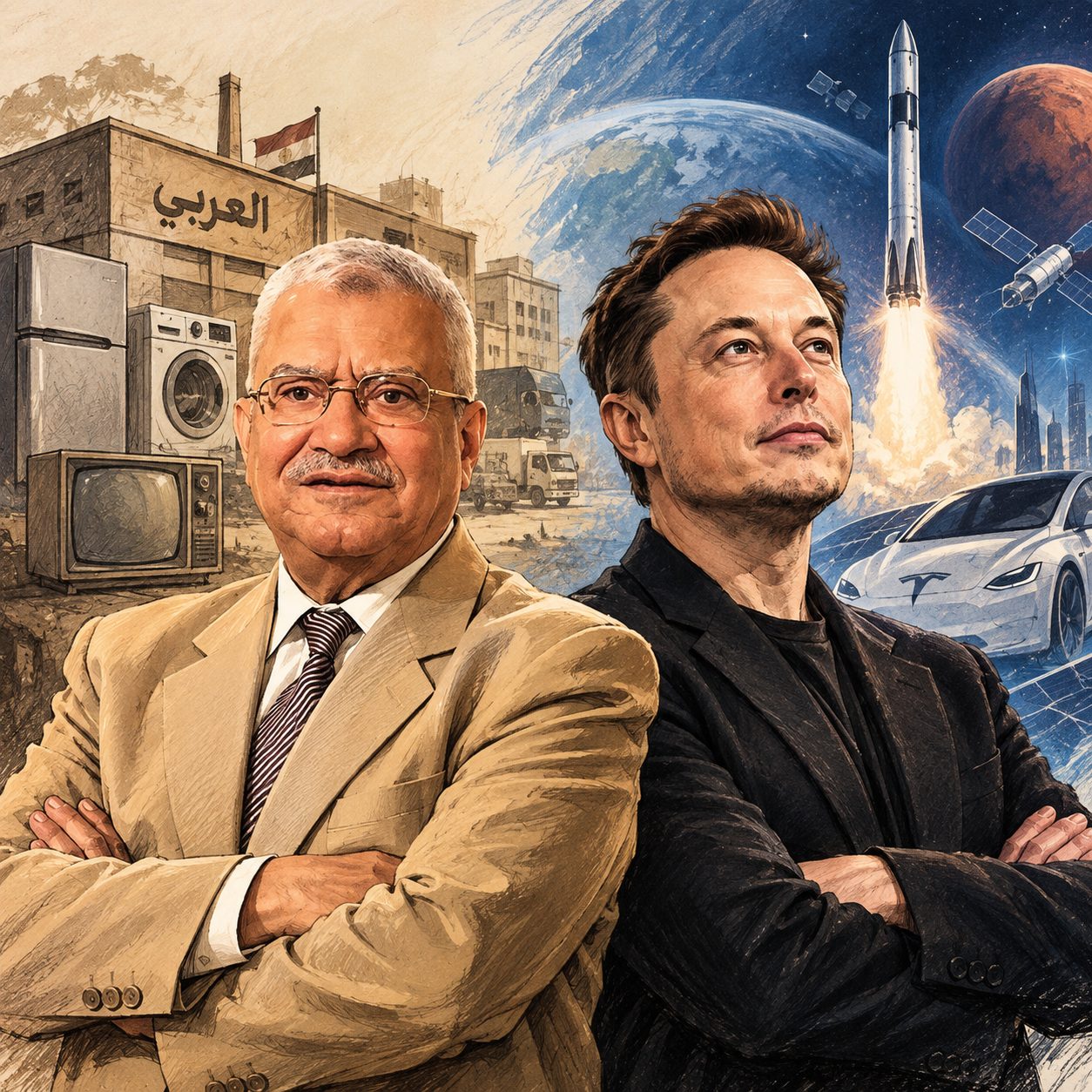
But the unasked question that came to my mind and led me to reconsider the whole theory—and in the following lines, I will tell you how I tried to answer it—is: Why did Elon Musk, who studied physics and economics at the University of Pennsylvania, earned two degrees, and enrolled in a graduate program at Stanford before leaving it to found his first company, Zip2, achieve greater success than El-Hajj Mahmoud El-Araby, one of Egypt's most famous industrialists, who did not complete his education and recounted himself that he left school in fourth grade to work in trade?
By the metric of global reach, the scale of technological industries he entered, and the impact created by his companies, Musk's experience reached a vastly wider scope.
The question here is: Is there a contradiction between Musk's experience and the idea we discussed in the previous article?
I believe the opposite is true.
Elon Musk does not refute the idea… rather, he reveals the missing piece in it.
The confusion here occurs between two concepts that are similar in name but completely different in meaning:
Being academically educated… and thinking with an academic mindset.
The difference between them is almost like the difference between owning a library… and living inside it, never coming out.
A Degree Does Not Create a Mindset
Elon Musk was certainly more educated than El-Hajj Mahmoud El-Araby.
But was he more "academic" in the sense we discussed in the previous article?
Here the answer differs... because Musk did almost the exact opposite of what the traditional academic mind does when life presented him with a real choice: he chose business instead of continuing graduate studies, scientific research, and a prestigious academic career.
Here, Musk had the tools of an academic… but he did not carry the academic's fear of stepping off the prescribed path.
He learned physics, but did not feel obliged to become a physics professor.
He studied economics, but did not view his degree as a contract binding him to a job…
He didn't choose to get a PhD first before launching his project; instead, he saw market movement and moved along with it.
So the issue here is not a contradiction between education and business… but between two ways of utilizing knowledge.
Between someone who learns to prepare for action… and someone who continues education out of fear of taking action.
And the difference between them could be a company capitalized at the value of 10 universities.
And El-Hajj Mahmoud El-Araby Was Not "Uneducated" Either
On the other side, we find another misconception: when we say El-Hajj Mahmoud El-Araby received only a limited amount of formal education, some might imagine his success is proof that education isn't important.
That is an even more dangerous conclusion than the first, because while the man indeed left school… he never stopped learning.
He started working very young, entered the commercial world early, and worked for years in the market before building his company. Then, the journey that began with trading in El-Muski evolved into an industrial conglomerate founded in 1964, which later entered long-term partnerships with Japanese companies, most notably Toshiba, before starting manufacturing in the 1980s.
El-Hajj Mahmoud El-Araby did not attend university… but the market was his university… and the consumer was his professor.
Merchandise was his textbook… and profit and loss were his exam paper.
The thing about the university of the market is that it doesn't give you results at the end of the year… but at the end of the day.
And sometimes, it deducts them directly from your pocket.
El-Hajj Mahmoud El-Araby didn't learn much inside the classroom, but he learned immensely outside it… and this is an important point.
Because the number of years spent studying does not necessarily equal the number of years spent learning.
One man leaves university at age 22 and stops learning… while another never set foot in one, yet spent sixty years learning every single day.
Now, Let's Answer the Difficult Question
If both possessed an entrepreneurial mindset… why did Elon Musk's experience become global on such a massive scale, while El-Araby's empire—despite its vastness—remained different in scope and nature?
The first thing we must do is be cautious with the word "more successful."
Success is not measured by a single ruler… If the metric is global technological impact, the scope of industries entered, and the capability to build companies in space, electric vehicles, and advanced technologies, then Musk's venture reached a whole different scale.
However, if the metric is building a stable industrial institution within a much tougher economic environment, growing it across decades, and turning a small retail business into a massive group that endures across generations… that is a completely different game.
That's why I don't like to weigh both men on the same scale.
But we can ask:
What gave Musk's journey a greater capability to leap forward?
The answer here does not come from education alone.
Rather, it is a combination of three things: Science + Experimental Mindset + Environment.
And this formula is far more potent than any single element on its own.
Science When It Steps Outside University
For Musk, physics was not a degree to hang on the wall. Instead, it was a way to understand problems.
And when he entered the automotive industry, he didn't view cars merely as commodities bought and sold… because you have batteries, energy, materials, efficiency, and engineering.
And when he entered space, he entered an industry inherently reliant on highly complex engineering and physical problems.
Here appears the other side of education that we did not talk about enough in the previous article.
Academic education can become a huge advantage for an entrepreneur… if they refuse to let it become a constraint.
Knowledge gives you a greater ability to see problems others don't… physics makes you understand what is possible and what is impossible… economics helps you understand resources and incentives … and programming allows you to build things that didn't exist before.
But all this knowledge is worthless in business if it remains inside your head.
Value begins when knowledge transforms into a product, an experiment, a company, a decision, or even a mistake you learn from.
That is why the optimal formula for an entrepreneur isn't to be less educated… quite the contrary… to know a lot, but without needing complete certainty before moving.
Mahmoud El-Araby Knew the Market… Musk Combined Market and Science
El-Hajj Mahmoud El-Araby possessed something immensely powerful: commercial intuition forged by thousands of hours of market interaction.
Knowing what the customer wants… how they buy… when they trust you… how to negotiate with suppliers… how to manage inventory… how to build a distribution network… how to preserve reputation… how to transition from a shop to a company, and from a company to factories.
And El-Araby Group indeed transformed from an endeavor started with limited capital in 1964 into a major industrial entity, engaging in partnerships and manufacturing with global corporations.
However, Musk's model added another layer to this commercial mindset: deep technical knowledge.
And here we arrive at the most important takeaway from this article…
The best entrepreneur is neither strictly the academic nor the uneducated… this dichotomy is fundamentally flawed.
The most powerful model is often: someone who knows how to think like a scientist… and act like an entrepreneur.
They doubt… ask… analyze… and after all that, experiment.
And that is the fine line that baffled us.
The academic might say:
"I still need more information."
And the uneducated entrepreneur might say:
"I understand the market and don't need information."
Both fell into a trap… the former has knowledge without action, and the latter has action that might hit the ceiling of his knowledge at any moment.
The most formidable combination, however, is:
To know a lot… and move quickly.
What If the Two Men Swapped Environments?
Here is a question I like to ponder.
What if Mahmoud El-Araby had been born half a century later in Silicon Valley, studied technology and finance, and found investors capable of funding ideas that take years of losses?
Would he still have remained an electronics merchant? God knows best… we don't know.
And what if Elon Musk had started life as a child in an Egyptian village in the 1930s, then was forced to leave school and work in a small shop? Would he have built SpaceX?
I'll tell you again, God knows best, we don't know… and that's also because Elon Musk himself is an immigrant from South Africa…
That is why success stories become absurd when we erase time and place from them.
A human creates part of their opportunity… but the environment creates the other part.
Elon Musk operated within an ecosystem possessing advanced universities, venture capital, massive financial markets, tech companies, engineers, suppliers, and an environment that enables a tech company to scale globally at speed.
As for Mahmoud El-Araby, he started in 1940s and 1950s Egypt, building his experience through a radically different economic, political, and industrial context.
It is unfair to give all credit to the individual when they succeed… just as it is unfair to lay all blame on the environment when they fail… the truth is always more complex.
So, What Do We Learn from Both Men?
The previous article needed just one sentence added to it:
Do not try to get rid of the academic mind… only get rid of its fear of making mistakes.
Take from it research, analysis, methodology, and the ability to understand things at their root; then take from the merchant speed of movement, from the market the humility of experience, from failure the ability to change one's mind, and from the industrialist long-term persistence.
Because knowledge without experience might produce an excellent study for a project that never starts… and experience without knowledge might produce a project that moves quickly in the wrong direction.
When both come together… that is where the impossible is achieved.
Perhaps for this reason, I do not see Elon Musk's journey contradicting Mahmoud El-Araby's… nor do I see it refuting the previous article… rather, it completes the picture.
El-Hajj Mahmoud El-Araby proved that a lack of formal education does not prevent the mind from learning.
And Elon Musk proved that the strength of formal education does not prevent the mind from taking risks.
The issue was never the amount of education… but something else entirely:
Do you use what you've learned merely to understand the world… or to step into it and change something within it?
University can give you an excellent textbook… and the market can give you experience found in no textbook.
But a true entrepreneur knows a third thing:
When to read the book… and when to close it and hit the streets.
Startup 101 Arabia
Weekly Newsletter
Read between the lines before everyone else. Decode the most important economic, tech, and decision-maker movements in the region.. in 5 minutes every Saturday.