
Egyptian Stock Exchange and Hot Money: 'Once Bitten by Soup Blows on Yogurt'... So Have We?
Summary
The Egyptian Stock Exchange suspended trading for half an hour on Sunday, October 25, 2026, following a 10% drop in the EGX100 index, reopening the question of the economy's reliance on hot money and changes to its financing structure.
"Once bitten by soup, one blows on yogurt"
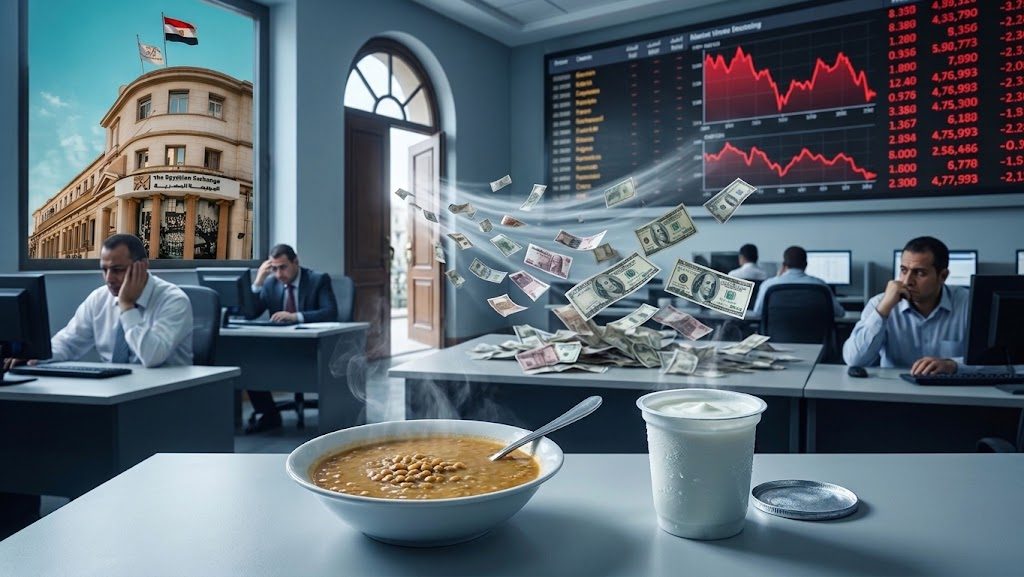
A famous Egyptian proverb describing someone stung by a harsh experience, who then exercises caution even with safe things. In our case, the soup is hot money (Hot Money): it enters emerging markets quickly seeking high returns, and leaves just as fast at the first sign of danger, leaving the stock exchange and FX market to take the sting. Egypt was burned by this money three consecutive times—in 2018, 2020, and 2022.
The question posed by the title is: after these burns, have we blown on the yogurt? That is, has the economy rearranged its financing as a precaution against the next wave, or has it merely settled for improving its ability to absorb the sting whenever it recurs? The session of Sunday, October 25, 2026, raises this question once again.
On that Sunday, the Egyptian Stock Exchange halted trading for half an hour after the EGX100 dropped 10%, in a week that saw foreign outflows from treasury bills and a surge in the dollar rate. As for the claim that hot money brought down the market, the session's numbers do not confirm it. This article distinguishes between what the data proves and the link circulated by people, which no one has proven yet.
What happened in the Egyptian Stock Exchange today?
The EGX100 opened at 23,117.46 points—Thursday's closing level—and did not exceed it during the session. Shortly after 1:00 PM, its decline reached 10% at 20,805.44 points, prompting the exchange to suspend trading across the entire market for half an hour. This was the first market-wide suspension since October 19, 2021, when the threshold was 5%, before the exchange raised it to 10% the following day.
The EGX100 closed down 8.88% at 21,064.53 points, the EGX30 down 3.56% at 49,234.35 points—below the 50,000-point mark—and the EGX70 down 11.07%. Market capitalization losses reached 261 billion EGP at the moment of the halt, before the market narrowed its losses to around 171 billion EGP at the close. Prices of 209 stocks out of 224 traded declined.
What do the numbers prove, and what do they not?
The well-known recipe for hot money begins with heavy inflows that drive prices up, followed by local traders joining in. Then comes a swift exit at the first sign of geopolitical tension, putting pressure on equities, which turns into demand for dollars in the FX market to repatriate proceeds. That is the model; today's numbers, however, tell less than that.
According to the trading table presented by the exchange, foreigners recorded net sales of 70.53 million EGP. However, this figure includes bonds and treasury bills traded on the exchange itself and is not limited to equities. Their net transactions in equities alone are not available to me; therefore, it is inappropriate to draw conclusions from it regarding foreign pressure on equities specifically.
As for the weekly figures, each should be read separately because they pertain to different markets and definitions and do not represent a single movement. According to the stock exchange's weekly report published on October 22, foreigners recorded net equity sales of 5.5 billion EGP, and a net exit from treasury bills in the secondary market totaling 115.07 billion EGP—equivalent to $2.08 billion. In the same week, the dollar jumped by about 1.85 EGP to nearly 55 EGP, its highest historical level according to El-Motawer website. The coincidence of these movements aligns with a dual-pressure mechanism, but determining the share of outflows in the dollar's movement requires more detailed data on flows and the FX market. No official authority has linked today's fall to a specific cause.
The One-Year Cycle
What is striking is that the exit and return were repeated within 2026 itself. In March, the General Manager of Waseela Securities Brokerage was quoted by Al Arabiya as saying that about $6.8 billion in hot money had recently exited. Then, according to Al Arabiya, Arab and foreign transactions in the secondary government debt market recorded net purchases of $11.66 billion in the second quarter. In July, another wave of divestments returned with roughly $459.2 million in one week, coinciding with the dollar exceeding 51 EGP in most banks. Today, the dollar stands near 55 EGP.
These figures are quoted from news sources and I have not verified them against Central Bank or Ministry of Finance data; therefore, they require verification before building upon them. However, the rhythm of exit, return, and exit again, along with its coincidence with the dollar moving to higher levels, warrants questioning.
The 2022 Promise
In the first quarter of 2022, with the outbreak of the Russia-Ukraine war, Maait announced the exit of $22 billion in foreign investments in debt instruments. In July of the same year, he stated that the state had learned the lesson from three consecutive times, and that the government had devised a strategy to avoid relying on this type of money again, turning instead to foreign direct investment and productive sectors, according to published reports. I have not reviewed the full text of the statement.
The acknowledgment was frank, the diagnosis correct, and credit is due to him. But the question is: what came after it?
According to the Central Bank's monthly statistical bulletin, as reported in the press, foreign holdings of treasury bills rose from $31.76 billion at the end of 2024 to $51.30 billion at the end of 2025—an increase of $19.54 billion, or 61.5%, in a single year. They then reached approximately $53.75 billion at the end of January 2026.
It is not correct to compare this balance directly against the $22 billion figure as if they were the same metric; the former is an outstanding balance on a specific date, while the latter is an outflow stream over a period. The balance represents an active exposure to reinvestment or exit risks upon maturity, not an amount that can be assumed to exit immediately; the ease of exit is affected by maturity terms, liquidity, and market mechanisms.
Absorptive Capacity Does Not Mean Less Reliance
The government side responds with an argument that carries weight. In August 2024, Prime Minister Mostafa Madbouly stated that what exited during the global sell-off did not exceed 7% to 8% of the money present in the market, and that the exit occurred through the market without touching foreign reserves, which stood at around $46.5 billion at the time.
This indicates, according to the statement, that the exit wave did not drain reserves, but it alone is not sufficient to judge the cost of absorbing it or a reduction in reliance. The ability to endure outflows is one thing; reducing the need for this money is another. Madbouly noted at the time a slight rise in the dollar rate as a result of what happened—meaning absorption comes at a price, and the question is its current size.
What Do We Need from the Numbers?
No one holds the government responsible for a war in Yemen. However, accountability for a promise made four years ago is legitimate, and there are indicators that can be published. First, the distribution of foreign holdings in treasury bills by maturity terms, as a balance maturing within a month is not like a balance maturing within a year. Second, the ratio of these holdings to net reserves, under a unified definition and matching dates. Third, the real return paid on this money after accounting for inflation and the exchange rate, and what that means for debt servicing costs. Fourth, the composition of foreign direct investment: how much of it adds productive and export capacity, and how much comes in the form of asset deals that create no new capacity? Not all direct investment is necessarily productive.
Finally... the exchange suspended trading for half an hour when the drop hit its limit, which is a legitimate precaution. But if the economy has suffered these shocks repeatedly, what has changed in its financial structure to make it less costly during the next wave? This is how the phrase "we learned the lesson" is measured. For he who was burned by soup blows on yogurt, and we do not yet know whether we are blowing or merely looking at the bowl.

Ibrahim Gamal Ibrahim is an Egyptian journalist and expert in digital media, economic and financial journalism, with more than 20 years of experience across the Middle East and North Africa (MENA) markets. He specializes in leading editorial teams, developing content and digital growth strategies, and integrating artificial intelligence into newsrooms, with extensive experience covering financial markets, monetary policy, and the banking sector. He has held editorial positions at Argaam, Veto, Besraha, Al Mal, and Mubasher.
Profile and all their articlesBeyond The Number

The Early Bird Catches the Worm... Blue Bonds: $1.72 Billion in the UAE while Egypt Has Zero Issuance
Profits of 8 Saudi Banks Grow 5.4% in Q3, Al Rajhi Adds Two-Thirds of the Increase
A White Penny for a Black Day... Why Didn't Gulf Currencies Collapse Despite the Iran War?
Banque du Caire on the Stock Exchange: Capped Pricing in the Final Weeks of the IMF Program
Weekly Newsletter
Read between the lines before everyone else. Decode the most important economic, tech, and decision-maker movements in the region.. in 5 minutes every Saturday.