
A Famous Restaurant Is Not Necessarily a Successful Restaurant

Summary
There is a phrase we hear often in the restaurant world: "This place is very successful… look at the crowd!" However, it can also be one of the most misleading statements when evaluating any food business.
There is a sentence we hear often in the restaurant world:
"This place is very successful… look at how crowded it is!"
And the statement might be true.
However, it can also be one of the most misleading statements when evaluating any food business.
Because crowds tell us only one thing:
That there are customers ready to buy.
But they do not necessarily tell us:
Is the restaurant making a profit?
Are all branches performing the same?
Is the cash flow healthy?
Is food cost under control?
Is labor appropriate for the sales volume?
Is the brand capable of sustaining itself?
Here, we must distinguish between four completely different things:
Popularity
Sales
Profitability
Sustainability
All four may come together in one brand.
But they are not the same thing.
First: Popularity
Let's start with what the customer sees.
A restaurant with long queues.
Plenty of photos on Instagram.
TikTok full of reviews.
Influencers talking about it.
People asking about the nearest branch.
All of this is important.
In fact, very important.
Because any business needs customer demand to continue.
However, popularity primarily measures how interested people are in the brand.
It does not alone measure the quality of the business model.
A product can go viral for a short period.
A strong marketing campaign can boost traffic.
Opening a new branch can generate curiosity.
But the question that must follow immediately is:
What happens when the curiosity fades?
Does the customer return a second time?
Does the customer become a repeat customer?
Are sales stable?
Can the brand retain demand?
Here we move to another level.
Second: Sales
Sales are an important figure.
But they are not the final answer.
Suppose a restaurant achieved sales of 10 million EGP over a certain period.
Does this mean it is successful?
We cannot tell from the number alone.
Because we need to know the cost of generating these sales.
How much was the food cost?
How much was labor?
How much was rent?
How much were utilities?
How much was delivery?
How much was marketing?
How much was waste?
How much were administrative expenses?
And how much was left at the end?
This is why looking at revenue alone can give a very incomplete picture.
Data from the National Restaurant Association for 2024, based on operational and financial data from over 900 restaurant operators in the United States, showed that income before taxes had a median of 2.8% of sales for full-service restaurants and 4.0% for limited-service restaurants in the sample. These figures are not a benchmark to be applied to every restaurant or market, but they illustrate how narrow the margin of error is in this sector.
In other words:
A restaurant may sell a lot… yet retain a very small portion of that figure.
Here comes the first trick
Suppose we have two restaurants:
Restaurant A
Sales: 10 million
Profit: 300 thousand
Restaurant B
Sales: 7 million
Profit: 700 thousand
Which one is more successful?
If we look at sales alone, we would choose A.
But if we look at profit, the picture is completely different.
A achieved a margin of:
300,000 ÷ 10,000,000 = 3%
While B achieved:
700,000 ÷ 7,000,000 = 10%
So:
The highest in sales is not necessarily the best business.
More importantly, this is a simplified comparison; evaluating a real restaurant also requires looking at investment, cash flow, return on capital, performance stability, and other indicators.
The bigger problem: Sales can mask problems
Sometimes sales increase while problems increase alongside them.
Increased demand means:
Larger purchases.
Larger inventory.
More labor.
Pressure on the kitchen.
More deliveries.
Higher energy consumption.
Potentially higher waste.
And a greater need for working capital.
If management does not monitor the relationship between these elements, rising sales can turn into additional pressure instead of profits.
This is why National Restaurant Association data indicates that rising costs pressure profit margins, and that total restaurant expenses in the United States rose by about 36% between 2019 and 2026 in the association's analysis.
Here an important rule emerges:
Growth does not automatically mean profitability.
What about a crowded branch?
Here we enter another problem.
The brand may be successful at the corporate level, but not every branch is necessarily successful.
A branch in a crowded area may achieve excellent sales.
Another branch in a different location may struggle.
A third branch may generate good sales, but its rent is very high.
And a fourth branch may be crowded, but its operating costs eat up most of its margin.
Therefore, it is not enough to ask:
"How much does the brand sell?"
You must also ask:
"How does each branch sell?"
Here lies the importance of indicators such as:
Same-Store Sales
Customer Traffic
Average Check
Food Cost
Labor Cost
Occupancy Cost
Waste
Contribution Margin
EBITDA or Operating Profit depending on the nature of the analysis
and other indicators that help management understand what is really happening.
For example, 2024 National Restaurant Association data showed that restaurants with higher annual sales in the full-service sample recorded a lower median food & non-alcoholic beverage cost than restaurants with lower sales: 31.0% vs. 33.7%, and also recorded a higher median income before taxes: 4.3% vs. 1.1%. The association itself notes that this data is a tool for comparison and analysis, not targets or benchmarks to be imposed on every restaurant.
This leads us to an important idea:
Scale can create economies of scale… if management knows how to leverage it.
Fame does not mean repeat business
There is a big difference between:
A customer who came because the place is a trend
and
A customer who came because they have come to trust the brand.
The first may come once.
The second may come dozens of times.
Here begins the difference between buzz and brand.
Buzz attracts attention.
But a brand builds a relationship.
Therefore, one of the most important questions any food business should ask is:
How many of our customers return again?
Because a brand that constantly relies on acquiring new customers may find itself in a very expensive race.
Whereas a brand that can retain customers begins to build a more stable demand base.
Quality enters the game
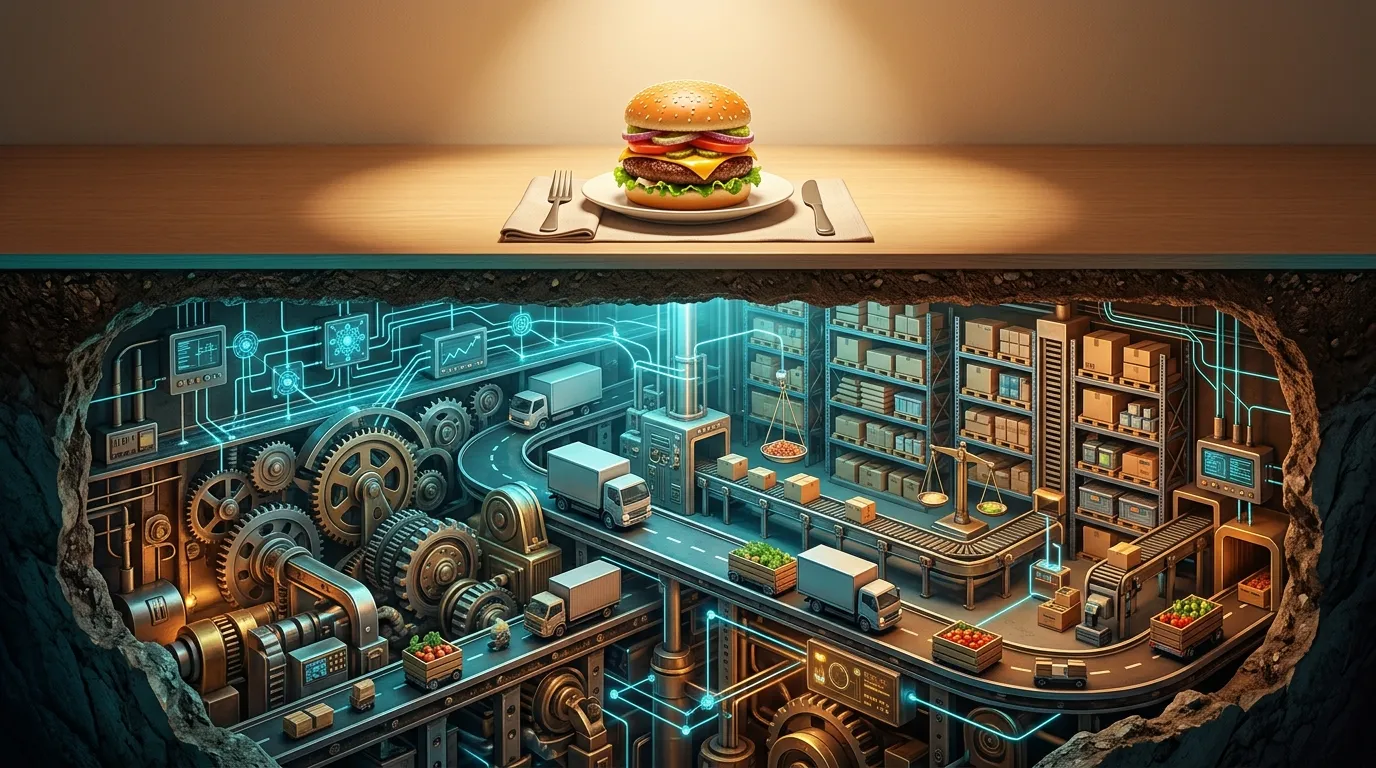
Here we return once again to what the customer does not see.
A brand can be very famous.
However, if quality starts to vary between branches, the customer begins to lose trust.
One time the product is excellent.
One time good.
One time below expectations.
One branch offers an excellent experience.
And another branch offers a different experience.
And here the problem is not merely an "employee made a mistake."
The problem might lie within the system itself:
Unclear specifications.
Insufficient training.
Variations in raw materials.
Weak supervision.
Supply chain issues.
Lack of standardization.
Or operating pressure beyond the system's capacity.
That is why maintaining quality while expanding is one of the true tests for any food brand.
And what about cash flow?
This specific point may be completely invisible to the customer.
A restaurant can be:
Crowded.
Selling daily.
Opening new branches.
And appearing on social media as if it is at its best.
At the same time, management suffers from cash flow pressure.
Why?
Because money is constantly flowing in and out.
Suppliers.
Salaries.
Rent.
Taxes.
Operating expenses.
Equipment.
Maintenance.
Inventory.
Fit-outs for new branches.
And expansion itself requires cash.
Here we must differentiate between:
Profit
and
Cash Flow
A business may appear profitable on paper, but it needs precise cash management to be able to meet its obligations on time.
Therefore, the question:
"Is the brand making money?"
Is not the only question.
There is another question:
"Does the brand have enough cash to keep going?"
So… how do we know if a restaurant is truly successful?
There is no single number that can answer.
However, we can look at a set of indicators together.
1. Customer Demand
Do people want the product?
2. Repeat Business
Do customers return?
3. Same-Store Performance
Do current branches sustain performance?
4. Profitability
Do sales translate into profit?
5. Cash Flow
Is the business capable of funding its operations and obligations?
6. Operational Consistency
Does the customer get the same experience?
7. Supply Chain Stability
Are raw materials available at the right quality and cost?
8. Scalability
Can a new branch be opened without doubling the problems?
If the answers are positive across most of these aspects, we are dealing with a business that is far stronger than just a famous restaurant.
A successful restaurant does not need to be the loudest
There might be a brand that not everyone is talking about.
It doesn't have millions of views.
It isn't always trending.
But it has:
Returning customers.
Stable branches.
Controlled costs.
Consistent quality.
Healthy cash flow.
A clear operating system.
And a supply chain that can support it.
This brand may be less famous…
But it might be a much better business.
Here we reach the core idea:
Fame measures how much people see the brand.
But true success requires measuring what happens behind that visibility.
Conclusion
In the restaurant world, it is easy to be deceived by the hype.
Queues.
New branches.
Ads.
Influencers.
High sales.
All are important signs.
But they are not the complete answer.
Because the real question is not:
"Do people know the brand?"
Nor even:
"Are people buying from it?"
The harder question is:
"Is this business capable of converting this interest into sustainable profit, a consistent experience, and controllable growth?"
Because there is a big difference between being:
Popular
and being:
Profitable
and between being:
Profitable
and being:
Sustainable.
And a true brand is one that can move from the first to the second… then to the third.
What the customer sees is fame.
As for what they don't see… that is what determines whether this fame will turn into a real business or remain just a temporary wave.
In the Next Article
Does a Trend Create a Real Brand?
We will deconstruct one of the most widespread phenomena in the food industry:
A brand that suddenly appears, becomes the talk of the town, generates massive sales… and then interest starts to decline.
The question is not whether a trend is useful.
It certainly is useful.
The real question is:
What did management do with this trend before it ended?
What We Don't See Behind the Food Brand

Weekly Newsletter
Read between the lines before everyone else. Decode the most important economic, tech, and decision-maker movements in the region.. in 5 minutes every Saturday.