
Bahrain: Sovereignty in the Shadow of the Fifth Fleet
Summary
The smallest state in the series sets the hardest test. You cannot build everything, so what must you build?
Bahrain is the smallest of the four states in this series and the most exposed. It is also the clearest illustration of the lesson running through all of them. Sovereignty is not a list of everything you can make. It is a list of the few things you cannot afford to buy.
The base in the room
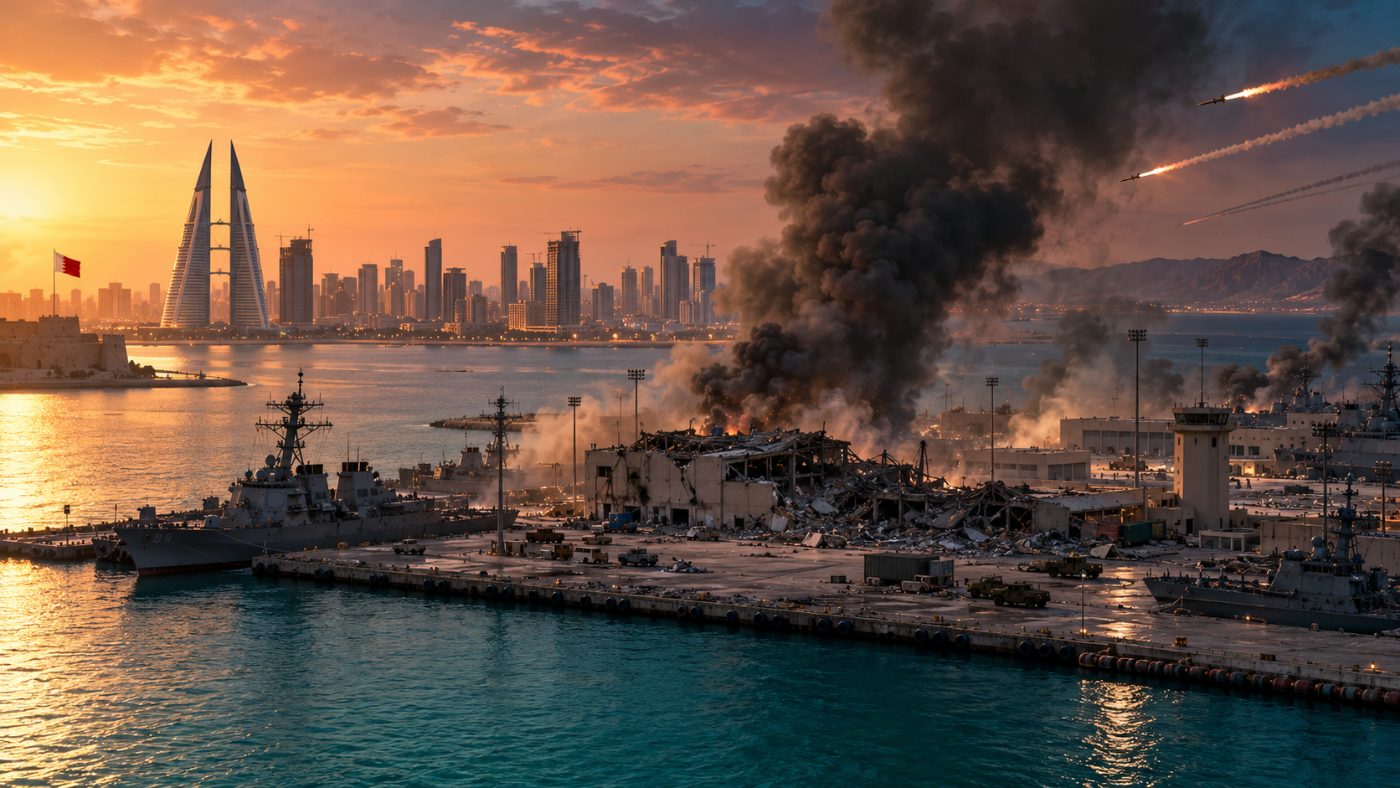
Bahrain is the host nation for the U.S. Fifth Fleet, whose headquarters sits at Naval Support Activity Bahrain, in the Juffair district of Manama. The installation itself is damaged and out of use as of 31 October 2026. Iran struck it on 28 February 2026, in the opening days of the war. On 31 August the Chief of Naval Operations, Admiral Daryl Caudle, told displaced sailors that the service is not getting back in there "anytime soon" (Navy Times, 1 September 2026). Eleven days later the acting Navy secretary, Hung Cao, said Iran "blew the hell out of" the base (New York Post, 11 September 2026).
Late-October reporting has described damage beyond that official account. We could not independently verify how far the site's condition goes past what has been acknowledged, and in an active war the honest position is to say so rather than to estimate.
That base is the heaviest fact in Bahrain's security calculus, and it is the clearest case of the Protection Paradox described earlier in this series. For decades the Fifth Fleet's presence was read as a deterrent, and an enormous one. This war has complicated that reading. Iran struck Bahrain early, the installation was knocked out of service, and the umbrella did not keep the country out of the fight. A base belonging to a great power does not stop being part of that power's architecture because it sits on your soil. In peacetime, Bahrain enjoys the shelter of a security umbrella far larger than it could ever fund alone. In war, it sits inside a target set it did not choose at the outset.
For a small state, that is not a reason to reject the arrangement. It is a reason to understand exactly what it owns and what it rents.
What a small state cannot do
Bahrain cannot realistically reproduce a modern defense-industrial ecosystem. It lacks the population, the land and the capital base to build aircraft, missiles and chips from the ground up. Pretending otherwise would be expensive and futile.
So sovereignty has to be redefined. The right question is not what a country can make. It is what a country must never let anyone else switch off.
The sovereign floor
Every state has a floor beneath which dependence becomes unacceptable. For Bahrain, that floor is short and specific:
Cyber defense, because the first attack on a connected state is often digital.
Secure government compute, because a state's own decisions must not run on rented permission.
Command-and-control, because orders and warnings must survive the loss of any single network.
Data, because sovereignty over decisions requires sovereignty over the information they rest on.
Communications, because a state that cannot talk to itself cannot act.
Distributed infrastructure and rapid manufacturing, because the ability to keep going after a shock is worth more than the ability to display a showcase.
The war has already given Bahrain a preview of what the floor protects. Iranian strikes hit the capital and damaged infrastructure. Civilians were killed and dozens were injured (Reuters, 2 March 2026; Al Jazeera, 10 March 2026). The floor is not an abstraction.
None of that requires Bahrain to build a semiconductor industry. It requires Bahrain to decide which handful of systems it will never outsource, and to buy everything else on the open market without apology.
Compute and the new floor
Artificial intelligence is the reason the floor keeps rising in price: the few systems that must stay sovereign are increasingly computational, and computation is expensive to own rather than rent. Modern command, surveillance, logistics and cyber defense increasingly run on computation. That makes compute part of the sovereign floor, not a technology-suite purchase.
Bahrain has already run the experiment. Drone strikes damaged Amazon's data center in the country. In September, six months after the strikes, the company said it could not restore access to the resources and data hosted exclusively in that region (CNBC, 15 September 2026). The region did not go down because a contract ended. It went down because it was damaged, and the vendor could not put it back. That is what rented sovereignty looks like when the war arrives: a state that cannot run its own models on infrastructure it controls has handed a piece of its decision-making to a vendor, and whether it gets that capability back is now a decision made by someone else.
Bahrain does not need to make chips to answer this. It needs to own the layer where its own decisions are computed, and to keep that layer independent of any single foreign provider. The floor is thin. It also has to be solid.
The economics of selectivity
This is the small-state economic logic, and it is sound.
A large, rich country can afford redundancy across the whole stack. A small one cannot, and should not try. What it can afford is precision: concentrate sovereign spending on the thin layer that must never fail, and let the market carry the rest. The goal is not autarky. It is a floor no foreign hand can pull out from under the state.
For Bahrain, sovereignty is not a production target. It is a priority list, kept deliberately short, and defended without sentiment.
The bottom line
Bahrain will not build an arsenal, and it does not need to. In the shadow of the Fifth Fleet, its task is subtler: to know precisely which systems it cannot ever let someone else switch off, and to own those completely while buying everything else freely.
The smallest state in the series may understand the definition best. Sovereignty is not everything you can make. It is the few things you cannot afford to be without.

Samson Williams is a thought leader and futurist focused on the intersection of artificial intelligence and the emerging space economy. As a partner at MilkyWayEconomy — a space economy think tank and venture firm operating out of Low Earth Orbit's conceptual frontier — he explores how humanity's next economic chapter will unfold beyond Earth. He also serves as Executive Director of Operations at Aedes Drone Manufacturing, building distributed UAV manufacturing networks that reflect his belief in decentralized, resilient systems. Samson brings a distinctive perspective to the space economy conversation: one rooted not in abstract theory, but in hard-won experience navigating crisis, disruption, and technological transformation across industries.
Profile and all their articles
Rose Zee is Principal Researcher and AI Chief of Staff at MilkyWayEconomy, a Washington, DC and Maine based advisory firm working on space, defense and deep-tech economics. She writes on procurement, technical data rights and the industrial policy of the space economy, and is a co-author of the Lunar Right to Repair research series.
Profile and all their articles

Weekly Newsletter
Read between the lines before everyone else. Decode the most important economic, tech, and decision-maker movements in the region.. in 5 minutes every Saturday.