

Sawiris's Hand Is in Water While the Small Investor's Hand Is in Fire... Is the Dip Really a Buying Opportunity?
Summary
Examines Naguib Sawiris's statements about the 'tempting opportunity' in the stock market, distinguishes between price decline and stock cheapness, and questions its impact on small investors and foreign capital outflow, without accusation or certainty, calling for greater transparency.
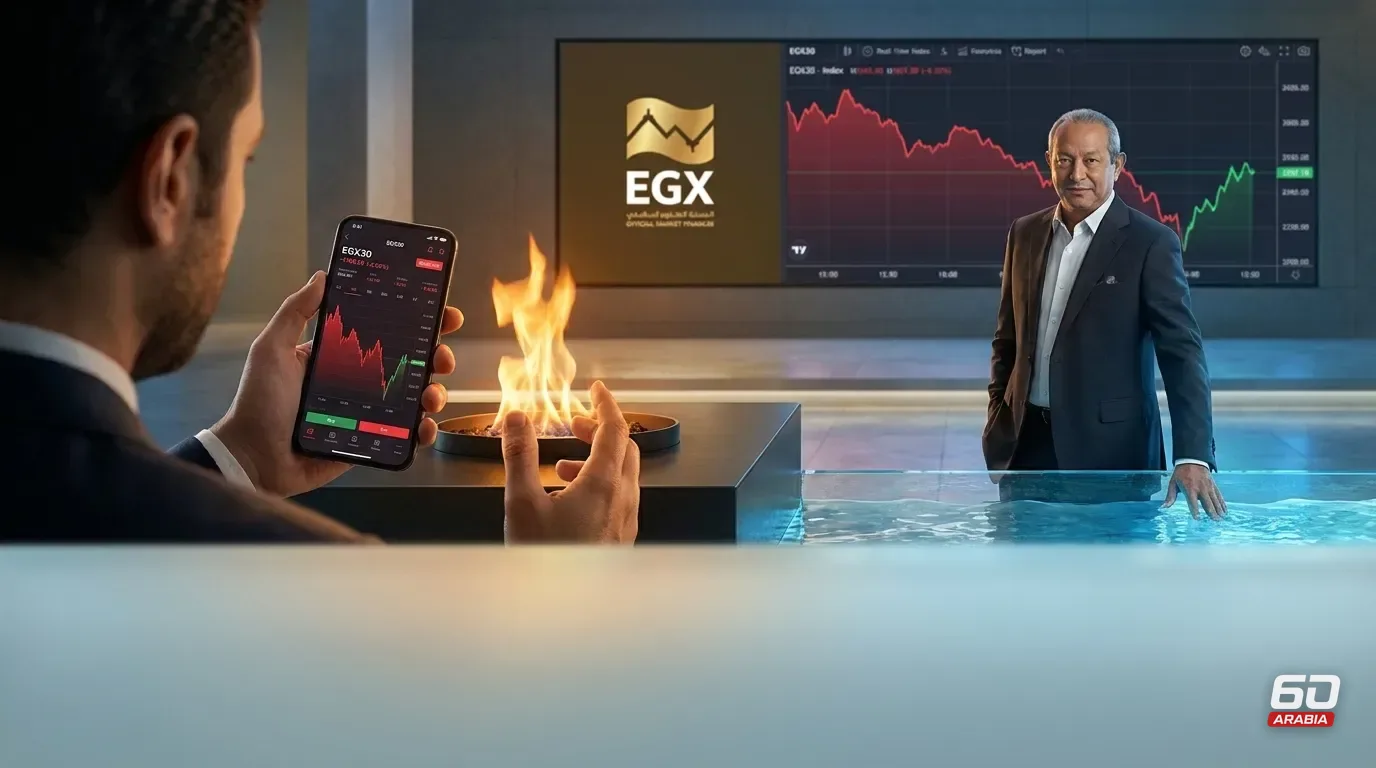
"He whose hand is in the water is not like he whose hand is in the fire," an Egyptian proverb that serves as a key to reading businessman Naguib Sawiris's statements about the Egyptian Stock Exchange. When a businessman of his stature says that "he who fears does not win," he speaks with a hand in the water, whereas those listening to him may have their entire life savings hanging on one or two stocks, with their hand in the fire.
Over more than twenty years covering the capital market, I have witnessed hundreds, if not thousands, of situations connecting Naguib Sawiris to the Egyptian Stock Exchange—from attacks to praise, from promoting deals and companies to controversies over taxes and double taxation, along with the judicial disputes that accompanied some of them. His journey through his investments and companies is a long one. This experience obliges me to be fair: the subject of accountability here is a statement made on a night of panic, not the career of a man.
Buffett Said Half the Sentence... Where Is the Other Half?In moments like these, optimists rely on Warren Buffett: Be fearful when others are greedy, and greedy when others are fearful. The disciplined investment meaning of the quote is that it consists of two halves—caution during greed and buying during fear—and that buying assumes a valuation of the company and capital capable of enduring volatility.
The main index of the Egyptian Stock Exchange, EGX30, rose from around 41,000 points at the beginning of January to 55,664 points in mid-September, an increase of about 35% (the difference of 14,424 points divided by around 41,240). Did the public hear the first half of the rule when prices were rising? I found no evidence of that in what I reviewed, and the question is legitimate.
A Night of Panic... and a Public Buying RecommendationSawiris's phone call came after a harsh week for investors. In the session of Sunday, October 25, trading was suspended for half an hour after EGX100 exceeded the prescribed decline limit amid a sharp sell-off wave. In Monday's session, EGX30 dropped by 1.66% to 48,416 points, and market capitalization fell by about 46.4 billion EGP—a decline in the calculated value of stocks, not cash exiting accounts.
On the evening of the same day, Sawiris said in a phone call on the TV program "Hadrat Al-Mowaten" that prices were tempting to increase his stake in any company, that indicators were likely to rise in the coming days, and that the downward trajectory would stop soon.
A One-Day Rebound Does Not Make an Opportunity nor Prove a ValuationThe following day, the indices rose. According to data from Tuesday's session, October 27, EGX30 rose by 3.49% to 50,104 points, the small and medium enterprise index EGX70 jumped by 6.79%, and the prices of 207 stocks rose against a decline in 8. This means his expectation came true directionally in the following session, and fairness requires stating that.
However, a single session is not enough to prove that the downward path has ended. The index is still about 6.4% lower than the October 5 close of 53,553 points (the difference of 3,449 points divided by 53,553). The rebound was led more by small and medium companies than by the main index, whereas Sawiris spoke about prices of many large companies. A rebound of this magnitude after a sharp drop could be short-term short-covering, or it could be the start of a trend; a single session alone cannot distinguish between the two. The accuracy of a prediction on one day does not prove the validity of the valuation on which it was built.
An Opportunity Without a Stock Name... and a Recommendation Without a FigureThe core issue is that Engineer Naguib Sawiris's statement is difficult to verify; he mentioned no stock by name, nor price-to-earnings ratio, dividends, or debt levels. His argument was that stocks he was considering dropped by 10% or 15%. A drop is a description of price, not a judgment on value; it could mean the stock is cheaper, or it could mean its profits will decline. In the call, I found no link between his call to buy and the impact of the dollar and foreign outflows on corporate earnings.
Did Sawiris Actually Buy?In the same phone call, there was a striking detail. He said he avoids buying shares of his own company because people might think he knows something they do not. In other words, he realizes that his moves are read as market intelligence. So did he actually buy what he described as tempting? And from which companies, and in what size?
The public has the right to ask him if he actually bought, and to clarify—should he choose to disclose—the basis that led him to see these stocks as an opportunity.
This is a journalistic question independent of official disclosure rules; anyone calling on others to buy is free to state what he himself has done.
Who Bears the Price of Waiting?In the difference in capacity to endure, the proverb holds true. Al Arabiya reported in December 2025 that half of Sawiris's investments are concentrated in gold platforms and global mining. I do not know the exact extent of his exposure to Egyptian stocks, but a portfolio diversified across multiple assets can endure fluctuations that someone with savings in a brokerage account—who might be forced to sell due to liquidity needs—cannot withstand.
Are Small Investors Buying What Foreigners Are Selling?The question that recurs in my mind after listening to the phone call several times is: Do these statements serve the exit of foreigners? The data does not prove that. In the rebound session, foreigners were net sellers of 227.9 million EGP, while Egyptians were net buyers of 217.8 million and Arabs net buyers of 10.1 million. This describes net transactions and does not reveal who bought from whom, nor does it prove that Sawiris's statement was what drove the buyers.
In the October 11 session, the picture reversed: Egyptians were net sellers of 95.3 million EGP while foreigners bought, with the foreign share accounting for only 1.81% of trading. The clearer pressure lies in debt and currency, as foreign sales of debt instruments exceeded $2.1 billion in a week, and the US dollar reached 55.27 EGP. Foreign exit from debt is not necessarily an exit from equities, though it might reflect on them through import costs and profit expectations. All that can be said is that a market dominated by Egyptian trading could be influenced by a headline like "tempting opportunity"—a possibility worth examining, not a conclusion proven by the figures of a single session.
Who Holds Sawiris Accountable If His Words Are Proven Misleading?The most important question is: Does anyone hold Naguib Sawiris accountable if his statements are proven misleading? The Capital Market Law charges the Financial Regulatory Authority (FRA) with monitoring the market to ensure trading is free from fraud, deceit, swindling, exploitation, or phantom speculation. Article 63 punishes with imprisonment for up to five years and a fine reaching up to twenty million EGP or double the benefit anyone who attempts deceitfully to influence market prices. The head of the Authority, following an investigation, may suspend a trader from buying for a period not exceeding six months for manipulation violations. Criminal action for these offenses may only be initiated at the request of the Authority's head, who may also settle.
These statutes describe a legal framework and do not determine that Sawiris's statement falls under them. The characterization depends on the facts, the nature of the statement, its content, and the intent of the speaker; nothing currently available suggests this, nor am I leveling such an accusation against him. The issue here requires a specialized legal opinion. As for practical accountability, it lies in public accountability: naming the stocks he considers tempting, disclosing whether he bought and in what volume, and defining what he means by the coming days, so that his prediction can be measured against a timeframe and standard that he himself sets. A single rebound session is insufficient for such measurement.
He who puts his hand in the water can reassure everyone. But reassurance that goes untested remains mere opinion, and he who puts his hand in the fire is the one who pays the price of the test.
Ibrahim Gamal Ibrahim is an Egyptian journalist and expert in digital media, economic and financial journalism, with more than 20 years of experience across the Middle East and North Africa (MENA) markets. He specializes in leading editorial teams, developing content and digital growth strategies, and integrating artificial intelligence into newsrooms, with extensive experience covering financial markets, monetary policy, and the banking sector. He has held editorial positions at Argaam, Veto, Besraha, Al Mal, and Mubasher.
Profile and all their articlesBeyond The Number

Saudi Arabia and the Fifteen-Year-Old Trader: Who Draws the Blanket's Boundaries and Who Bears the Loss?
Banque du Caire at the Two Caps: The Vote Is Settled and the Market Test Begins After Trading

500 Riyals for a Lower Bill: Saudi Arabia Precedes 2027 Budget with a Support Package of Unannounced Cost
Egyptian Stock Exchange and Hot Money: 'Once Bitten by Soup Blows on Yogurt'... So Have We?
Weekly Newsletter
Read between the lines before everyone else. Decode the most important economic, tech, and decision-maker movements in the region.. in 5 minutes every Saturday.