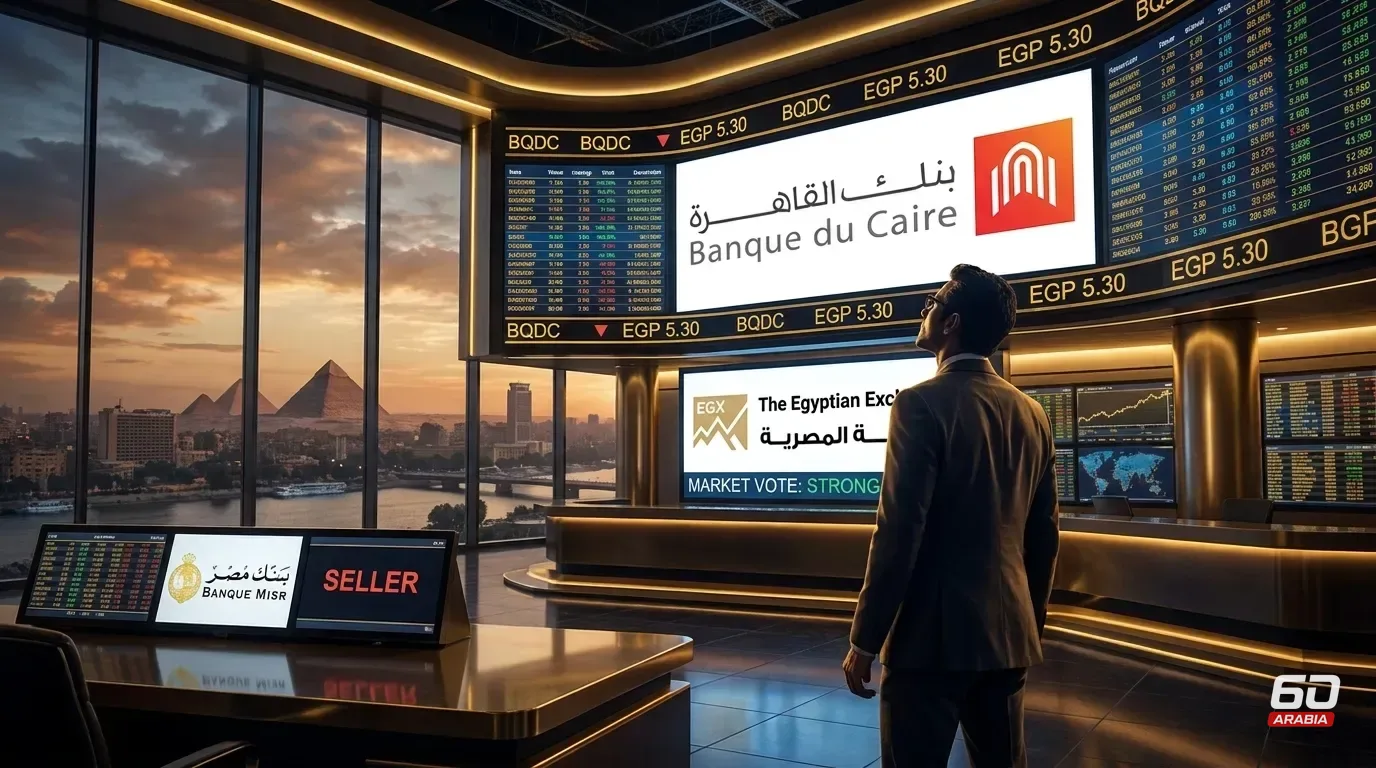
Banque du Caire at the Two Caps: The Vote Is Settled and the Market Test Begins After Trading
Summary
Banque du Caire's IPO reached both price and size caps, accompanied by record demand. However, coverage alone does not reveal fair price or free float; the market will test the stock's value, while upcoming financial results will reveal the sustainability of the bank's profits.
In the markets, as Warren Buffett summarized the idea of his mentor Benjamin Graham: "In the short run, the market is a voting machine; but in the long run, it is a weighing machine." The offering of Banque du Caire came with a strong vote.
The bank announced today the final offering price at EGP 5.30 per share, which is the upper limit of the indicative range (from EGP 4.82 to 5.30), following orders reaching EGP 205.8 billion, approximately $3.72 billion, for a private tranche valued at EGP 34.55 billion.
I have been following the capital market for over 20 years. Finally, more than nine and a half years after the bank was listed on the stock exchange in February 2017, Banque du Caire will actually be offered. The timing of the offering is challenging, caught between high interest rates and a final IMF review; nevertheless, the subscription succeeded, and the price landed at the upper limit. However, the price does not answer everything: what does demand really tell us, and what is the fate of the state-ownership offerings dossier when the IMF program ends?
Subscription Details and Final Offering Price
The offering price was set at EGP 5.30, the ceiling of a price range spanning no more than 10%. The private tranche comprises 6.519 billion shares, representing 95% of the offering and 42.75% of total capital, valued at EGP 34.55 billion (around $625 million), covered approximately six times over.
The retail tranche includes 343.125 million shares, accounting for 2.25% of total capital, worth approximately EGP 1.82 billion, and is expected to close on October 28. The total offering amounts to 6.8625 billion shares, representing 45% of total capital, valued at EGP 36.37 billion ($658 million), with an implied market capitalization of EGP 80.83 billion ($1.46 billion). Execution of the offering is expected on October 29, with trading slated to begin under the ticker BQDC on November 2, subject to regulatory approvals.
Banque du Caire described the tranche as the largest in the history of initial public offerings on the Egyptian Exchange in terms of EGP value, calling the demand record-breaking. These characterizations originate from the bank itself and do not represent an independent judgment. The bank has been listed on the exchange since 2017, so the descriptor "initial offering" requires clarification in light of that. The announcement itself notes that it does not constitute a prospectus.
The Offering Price Between Two Caps
Price was not the only cap. The initial prospectus, approved by the Financial Regulatory Authority on October 18, was for the sale of 30% of capital (4.575 billion shares) and permitted an upsizing of up to 15% of capital (2.2875 billion shares), bringing the total to 45% (6.8625 billion shares). That upsizing option was fully exercised. Thus, 45% is not the result of size negotiations, but rather the ceiling of the permitted greenshoe/upsize option. At the same time, the price range ceiling of 5.30 matched the fair value concluded by the Baker Tilly financial advisory study, according to the Financial Regulatory Authority's decision.
Two caps closed together: fair value prevented the price from exceeding 5.30, and the upsizing option prevented the volume from exceeding 45%. Having exhausted both, the secondary market may absorb part of the unallocated demand, but the order book does not reveal how much of it will convert into actual secondary purchases. This is the true meaning of the "upper limit" in this transaction: not just a single price, but two caps. The difference between 30% and 45% is not a trivial detail: it is the difference between selling 4.575 billion shares and 6.8625 billion shares—an additional EGP 12.12 billion entering the deal at the exact same price.
Every 1% above the offering price equals approximately EGP 364 million on the total offering value; 10% equals about EGP 3.6 billion. This is a mathematical illustration of each percentage point, not an estimate of loss: a higher price was never tested, and we do not know whether the market would have accepted it. Moreover, the party that would bear the cost had it materialized is the seller, Banque Misr, not the bank itself.
The result is that the announced coverage ratio (6.0x) is calculated post-upsizing. Had current demand been measured against the original size of the private tranche (4.346 billion shares, EGP 23.03 billion), coverage would have stood at 8.9x. This is a mathematical exercise based on current demand, not proof that the upsizing occurred solely in response to it; nevertheless, it illustrates what subscription coverage would have looked like had the size not been increased.
What Does the Demand Tell Us?
The 6x coverage applies to the entire private tranche and rises to 19.8x when excluding shares allocated to key anchor/qualified investors. The difference between the two numbers warrants attention. Orders totaled EGP 205.8 billion; dividing this by 19.8 yields approximately EGP 10.4 billion as the maximum value of shares available to non-anchor investors. This implies that the combined allocations of the six anchor investors—EBRD, IFC, Helikon, Sustainable Capital, RWC, and Waha Investments—amount to no less than roughly EGP 24 billion, or around 70% of the private tranche.
This is a minimum threshold, not an estimate; the figure is rounded because 19.8 and 205.8 are rounded numbers. But the trend holds firm: regardless of how coverage is calculated, the amount available to non-anchors cannot exceed EGP 10.4 billion, because total demand does not exceed 205.8. Even if anchor demand is also subtracted from the numerator, their share rises to around 25.4 billion rather than decreasing. Anchor investors took at least 70% of the tranche.
The most important figure is the implication for total capital: roughly EGP 24 billion equates to around 4.5 billion shares, or approximately 30% of the 15.25 billion total shares. EBRD and IFC alone account for $200 million, or about EGP 11.06 billion (13.7% of capital). According to this calculation, the remaining four investors account for roughly 16.3% of the bank—more than the two international financial institutions combined. This distribution warrants explicit disclosure, rather than a mere single-line listing of names.
Here, free float becomes a matter of calculation, not guesswork. Non-anchor buyers in the private tranche hold roughly 12.75% of capital, while the public tranche represents 2.25%. If all six anchor investors are subject to lock-up agreements—which is confirmed only for the two IFIs according to the announcement—then the available float is around 15%. If the other four are not locked up, the float rises to about 31%. If all private tranche buyers were subject to lock-ups, it would drop to 2.25%, a theoretical extreme. The plausible range is thus between 15% and 31%, depending on allocations and restrictions.
The difference between the two extremes is not academic. 15% means roughly EGP 12.1 billion (around $220 million) in free float shares, while 31% means about EGP 25.1 billion (around $455 million). This explains why the stock might move in early trading sessions without massive institutional buying: supply is tight, not because demand is pent up. It also explains why it could reverse just as quickly upon the first sale following lock-up expiration. Supply, not subscription frenzy, is the decisive variable in the opening weeks.
The announcement does not present order distribution across the price range nor allocation details, so we do not know what price would have balanced supply and demand. What we do know is that the price settled at the ceiling, the volume was exhausted, and pricing was determined on the unreserved one-third of the tranche. As for whether the market would have accepted a higher price, that is a question trading will answer, not the press release.
What Do the Multiples Say?
According to the numbers I am reviewing, EGP 5.30 represents about 5x projected 2025 earnings of EGP 16.1 billion. The price-to-book (P/B) ratio stands at 1.21x based on end-of-year equity (EGP 66.8 billion), corresponding to a 24.1% return on equity on the same basis (16.1 ÷ 66.8). Meanwhile, the reported ROE of 29.7% is calculated on average equity (EGP 54.2 billion), which corresponds on average to a non-standard analytical ratio: Market Cap ÷ Average Equity = 1.49x. Both bases are correct and non-contradictory: conventional P/B is measured against the latest balance sheet balance, while ROE uses average equity. However, any comparison between multiple and return must use the same basis; for modeling purposes, the consistent basis is the 1.49 ratio alongside 29.7%.
A 5x multiple implies an earnings yield close to 20%. This figure holds little meaning until compared with treasury bill yields at the time of offering. In a high-interest-rate economy, a low multiple may reflect risk pricing rather than proof of cheapness. Under Gordon's constant growth model, using a discount rate of 24–26%, if ROE remains at 29.7%, fair value approaches 1.5x book value; if ROE reverts to 22% with 12% growth, it drops to around 0.8x. This is a rough calculation intended to demonstrate valuation sensitivity to return, not to generate a precise fair value. The gap between the two scenarios is everything—a wager on return sustainability rather than the multiple alone. Therefore, I do not label the stock cheap or expensive before ROE stabilizes.
Net interest margin rose from 3.6% in 2017 to 7.3% in 2025, then to 7.4% in H1 2026. Questioning its sustainability is legitimate, but the answer does not start from scratch: between April 2025 and February 2026, the Central Bank cut interest rates by 825 basis points, yet the margin held firm and slightly increased. According to published results, credit goes to a mix of low-cost deposits and fixed-yield loans. In other words, the most likely risk is not falling interest rates, but rather slowing loan growth or rising deposit costs. These are not minor details; they represent the difference between a multiple on peak earnings and a multiple on sustainable earnings.
Furthermore, H1 2026 net profit was reported at EGP 8.6 billion in the August financial results and EGP 8.9 billion in the offering statement—a variance of EGP 300 million (3.5%). The difference is not massive, but it requires reconciliation before building a multiple upon it.
Anchor Investors' Conditions
EBRD and IFC are committing $100 million each, accounting for roughly 30% of the offering size. Their commitment is conditional upon the completion of the private offering, and each retains the right to terminate its agreement if condition precedents are not met. The agreements signed with Banque du Caire and Banque Misr contain covenants regarding governance, transparency, anti-corruption, compliance with international sanctions, environmental and social management systems, a sufficient number of independent board members, and a climate transition plan.
However, the publicly disclosed language is best-efforts phrasing: "working to develop and improve certain internal policies," without disclosed KPIs, deadlines, or consequences. Lock-up periods are unspecified in the announcement, linked to ongoing compliance with conditions without stating their duration. The free float timeline hinges on these periods: who is locked up and when lock-ups expire. As for float size, we have calculated it: between 15% and 31% under plausible scenarios, and 2.25% in the theoretical extreme.
The IMF Journey and Beyond
The IMF mission began discussions on October 25 for the eighth and final review ahead of disbursing about $1.5 billion from the loan facility and around $800 million from the Resilience and Sustainability Facility, subject to Executive Board approval, while the program expires on December 15. In short, what is on the table is around $2.3 billion—more than three times the total value of the offering ($658 million). The offering does not finance anything close to that scale; its true value lies in signaling.
The IMF's July statement had estimated divestment proceeds at roughly $520 million while noting slow progress. Comparing the two figures is approximate due to differing timelines and entities. The announcement does not link the offering timeline to review dates, nor does it clarify how proceeds are counted toward program targets.
The price announcement does not specify the seller or destination of proceeds. However, the prospectus and Financial Regulatory Authority decision define this as a secondary sale: Banque Misr sells 45% and retains 55%, with Banque du Caire receiving no fresh capital. What is happening is ownership redistribution, not growth financing. This alters the meaning of "divestment": the state sells a substantial minority stake without relinquishing control. Furthermore, rules for counting proceeds toward program targets remain undisclosed, which alone justifies caution when comparing them against declared divestment targets. $658 million in total may not mean $658 million in the IMF's accounting.
The broader question is: after December, and with a national transformation program spanning 2027 to 2030 without a new funding agreement, what will keep the government committed to its asset sale timeline? Anchor investor covenants bind the bank, not the government. The only remaining discipline will be listing rules, periodic disclosure requirements, and pressure from new shareholders. This is precisely what upcoming state asset offerings will test.
What I Am Watching For
First, I am waiting for allocation disclosures and lock-up periods to verify the math: is the anchor share truly 70% of the tranche and 30% of total capital? Who is locked up and for how long? With free float ranging between 15% and 31% in plausible scenarios, the lock-up schedule will dictate when float expands or contracts.
Second, I am waiting for the retail tranche results after its closing on October 28, representing just 2.25% of total capital—a tiny figure indicating that the "public offering" is public more in name than in scale.
Third, I am watching for the destination of proceeds; as noted, this is a secondary sale, so the remaining question is whether proceeds are transferred to the treasury or retained at Banque Misr.
Fourth and most importantly, I am waiting for the first quarterly results following listing, as they will clarify the baseline earnings figure (8.6 vs 8.9 billion), margin dynamics, and whether margins held up following the rate-cutting cycle. This is the substance of "weighing," not the opening trading price.
Demand settled the vote, deserving credit amidst difficult timing and after a wait exceeding nine and a half years. However, the vote took place on a deal that hit both its caps: EGP 5.30 in price and 45% in volume. As for weighing, that begins on November 2, and the first thing it will test is not whether the stock stabilizes at 5.30—since with a free float between 15% and 31%, the price can be defended with limited demand—but whether 5.30 was the correct price. The real weighing will manifest in returns and margins a full year later, and in the state's ability to continue selling after the IMF umbrella expires. Succeeding in selling shares is one thing; succeeding in discovering their true price is quite another. The price in this transaction was known in advance: 5.30. What trading will resolve is not the price at which it sold, but whether that was the right price all along.
Ibrahim Gamal Ibrahim is an Egyptian journalist and expert in digital media, economic and financial journalism, with more than 20 years of experience across the Middle East and North Africa (MENA) markets. He specializes in leading editorial teams, developing content and digital growth strategies, and integrating artificial intelligence into newsrooms, with extensive experience covering financial markets, monetary policy, and the banking sector. He has held editorial positions at Argaam, Veto, Besraha, Al Mal, and Mubasher.
Profile and all their articlesBeyond The Number
500 Riyals for a Lower Bill: Saudi Arabia Precedes 2027 Budget with a Support Package of Unannounced Cost
Egyptian Stock Exchange and Hot Money: 'Once Bitten by Soup Blows on Yogurt'... So Have We?
The Early Bird Catches the Worm... Blue Bonds: $1.72 Billion in the UAE while Egypt Has Zero Issuance
Profits of 8 Saudi Banks Grow 5.4% in Q3, Al Rajhi Adds Two-Thirds of the Increase
Weekly Newsletter
Read between the lines before everyone else. Decode the most important economic, tech, and decision-maker movements in the region.. in 5 minutes every Saturday.