
Will EGX30 Reach 50,000 Points? Probability, Timeframe, and Decline Conditions

Summary
50,000 points is no longer a distant number for the EGX30; the real risk begins if foreign institutional selling coincides with a weakening pound and declining debt inflows. Then, the probabilities shift rapidly.
The EGX30 index enters Thursday's session, September 24, just 7.8% away from the 50,000-point level. It closed Wednesday at 54,224.93 points after a 1.29% decline, having recorded a peak of 56,931.41 points during September. The distance to 50,000 is therefore no longer large enough to rule out, but it alone is not sufficient to conclude that the market is heading there.
The index actually tested this level less than three months ago, closing at 49,825.58 points on June 29, before rebounding above 50,000 in the following session. This precedent is important because it reminds us that touching a level is one thing, and remaining below it is another.
What is the probability that the EGX30 will return to 50,000, how much time does it need, and what must happen in the economy and capital flows for this probability to move from the margins to center stage?
We can confidently say that if the EGX30 remains within the volatility regime that has prevailed since June, the probability of closing at or below 50,000 points at least once hovers around 3% to 4% over 20 trading sessions, rising to about 11% to 14% over 40 sessions, and reaching a range of nearly 17% to 23% over 60 sessions.
This is what statistical readings revealed when asking a specific question: What happens if price behavior remains close to the regime witnessed in recent months? On this basis, 50,000 is not the base case for the coming month, but it becomes a risk with clearer weight as the horizon extends to two or three months.
The Risk Begins Before 50,000
If the EGX30 reaches 53,000 points while the remaining market characteristics stay unchanged, the probability of dropping to 50,000 over the following 20 sessions rises in our tests to about 11% to 13%. At 52,500, it climbs to nearly 17% to 20%; thus, the first 1,200 or 1,700 points of the current decline are statistically more significant than the last thousand points before reaching 50,000. A market declining from 54,200 to 53,000 has not merely covered part of the distance, but has approached a zone where the probabilities of a deeper drop begin to accelerate.
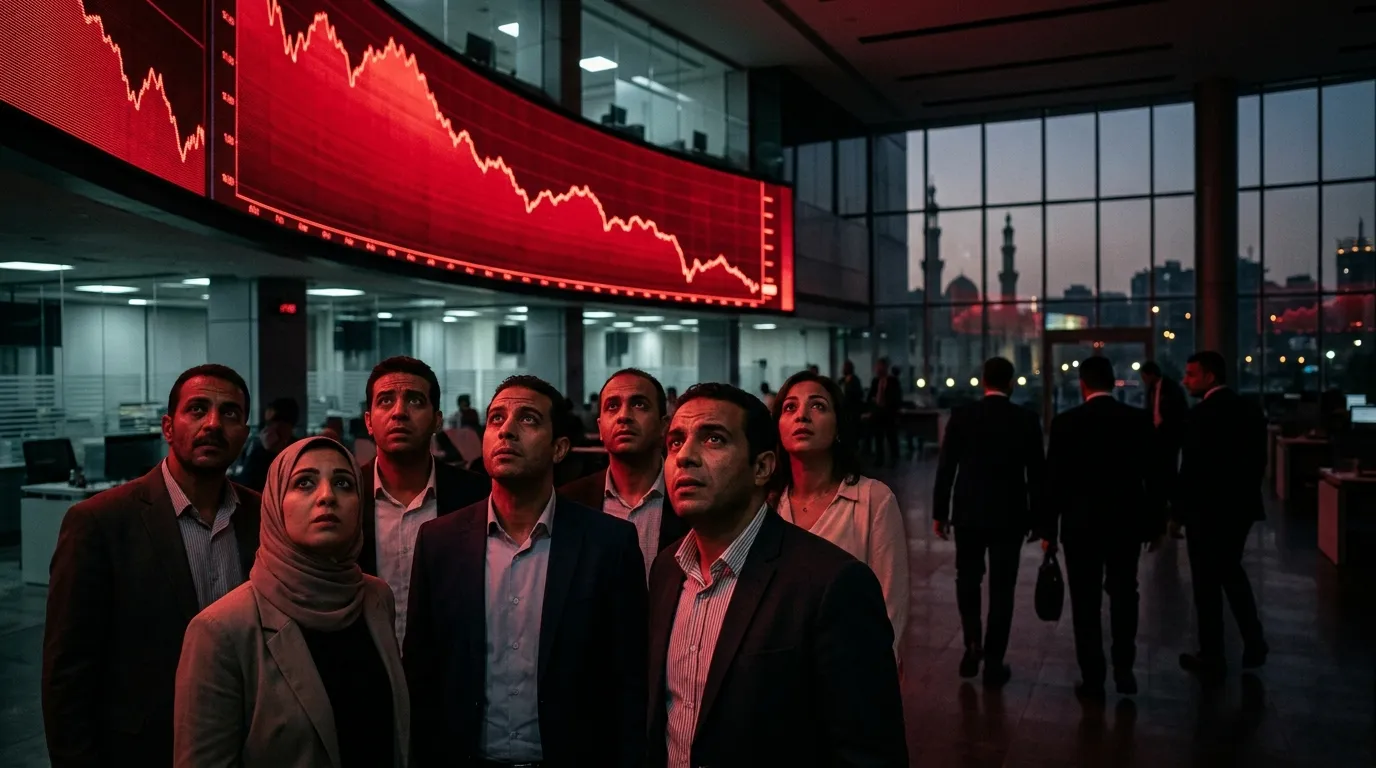
However, price alone does not tell us whether this shift has begun; Wednesday's session provided a clear signal of weakness, as the EGX30, EGX70, and EGX100 all declined together. Total turnover reached about 9.2 billion EGP, meaning the drop did not occur in an inactive market, and notably, capital was distributed across investor categories. Egyptian retail investors recorded net purchases of about 567.1 million EGP, while foreign institutions recorded net sales approaching 484.5 million EGP, with retail investors accounting for over three-quarters of total trades.
This might seem contradictory at first glance. How can retail investors buy so aggressively while the index continues to fall?
The answer is that an invested pound does not carry the same weight in every stock. Where institutional selling is concentrated in the heavyweights of the EGX30, broad retail purchases spread across other stocks can supply liquidity to the market without preventing the main index from falling. Therefore, retail activity by itself does not constitute a sufficient line of defense for the index level.
In this context, foreign institutional stock sales should not be turned into a narrative that foreign capital is leaving Egypt. Asharq Bloomberg reported on September 23 that foreign portfolios were moving to buy Treasury bills, coinciding with the pound strengthening to around 51.47 EGP to the dollar.
This is a pivotal point. A foreign investor may sell equities and buy debt simultaneously. If that happens, we are looking at a reallocation of risk within Egyptian assets rather than a comprehensive capital outflow. We already saw the alternative scenario during the spring sell-off: according to the IMF, non-resident holdings of domestic government debt fell from $39.1 billion in February to $22.2 billion in early April, coinciding with a 14% to 17% depreciation of the pound. Portfolio inflows later returned, and holdings approached pre-shock levels, while the pound recovered much of its losses.
Thus, what we need to monitor is not equities in isolation. The most dangerous shift begins when equities, the pound, and debt instruments align in the same direction.
Three Future Paths for the Market
The most pessimistic path could begin if the market shifts into a regime similar to the February-to-April period, a timeframe during which daily volatility rose markedly and concurrent pressures emerged in foreign portfolios and the exchange rate. If we re-imagine this trajectory using volatility values from that period instead of recent months, we find that the picture changes completely, with the probability of reaching 50,000 rising to about 23% to 25% over 20 sessions, to roughly 39% to 42% over 40 sessions, and approaching half over a 60-session horizon.
For this to become the appropriate regime to explain the current market, we must see more than just a drop in the EGX30. We need sustained foreign institutional selling across multiple sessions, a broader decline across equities, and then clear weakness in the pound or a drop in debt inflows. At that point, a self-reinforcing feedback loop would begin: capital outflows increase currency pressure, currency weakness heightens inflation and interest rate risks, and consequently, the required equity risk premium rises.
Oil could serve as an accelerating factor in this loop. Brent crude closed Wednesday at $103.08 per barrel, up 3.86%, despite Saudi Arabia restarting the East-West pipeline and resuming part of its crude export capacity away from the Strait of Hormuz. This sharp volatility reflects that the oil market remains caught between improving supply and regional political risks.
The second path, which aligns most closely with current data, assumes a continued correction in equities without translating into a broader currency and debt crisis. In this case, the EGX30 may continue moving below 54,000 and approach 53,000, while local liquidity continues to absorb part of the selling and foreign debt inflows persist. Here, next month's estimates for reaching 50,000 remain near the 3% to 4% range.
This path is supported by stronger buffers than Egypt possessed in previous waves. Net international reserves reached $57.214 billion by the end of August, while the IMF stated that Egypt entered the latest wave of regional tension with a stronger macroeconomic position, although high debt and refinancing needs remain genuine vulnerabilities.
Additionally, the Central Bank's Monetary Policy Committee meets today after keeping the deposit rate at 19% and the lending rate at 20% in August. Annual urban inflation dropped to 14.5% in August, while core inflation rose slightly to 14.9%. Therefore, what matters to the market is not just the decision, but what the Central Bank says about the impact of energy, inflation, and the exchange rate on the path ahead.
Abroad, the US Federal Reserve raised interest rates this month to a range of 3.75% to 4%. Consequently, Egyptian assets now compete with higher dollar yields than were available prior to the decision, increasing the sensitivity of portfolio flows to any further escalation in domestic risks.
The most optimistic path begins if energy markets calm down, the pound remains stable, foreign capital stays in debt instruments, and foreign institutional selling in equities eases. When calibrating the model to the relatively low volatility prevailing since August, the probability of reaching 50,000 drops to about 1% over 20 sessions, and to nearly 3% to 6% over 40 sessions.
The probability of reaching 50,000 points within a month of trading remains low, hovering around 3% to 4%. It could rise to about 11% to 14% over two months. However, it can jump to over 20% within a single month if the market shifts into a stress regime similar to what occurred in the spring.
The dividing line between these scenarios will not emerge at 50,000 itself; it will appear before that. If the EGX30 approaches 53,000 while institutional selling continues, the pound weakens, and foreign debt flows turn outward, the market will have already provided the answer investors are seeking. However, if the currency and debt remain stable, the drop may remain painful, but it will stay a correction that has not yet acquired the conditions to make 50,000 the central scenario.
Weekly Newsletter
Read between the lines before everyone else. Decode the most important economic, tech, and decision-maker movements in the region.. in 5 minutes every Saturday.