

Retail Investors Buy What Institutions Sell... Who Prices Risk in the Egyptian Stock Exchange?
Summary
The decline in Egyptian shares broadened despite the Gulf rebound, while retail investors continued buying what institutions sold. Why did Cairo diverge? And who holds the heaviest sway in Tuesday's session?
In Sunday's article on September 13, the Egyptian Stock Exchange test was clear as I explained why I consider that the drop in EGX30 alone is not enough to say that the entire market has repriced risk. What was required was to monitor whether the pressure would spill over from blue-chip stocks into the broader market, showing up in a larger number of declining stocks and liquidity confirming the move. After Sunday and Monday's sessions, we got the first answer: yes, selling broadened. But the second answer was more important, because the identity of who sold and who bought does not fully align with the simplified narrative of investors fleeing en masse from a market facing elevated regional risks.
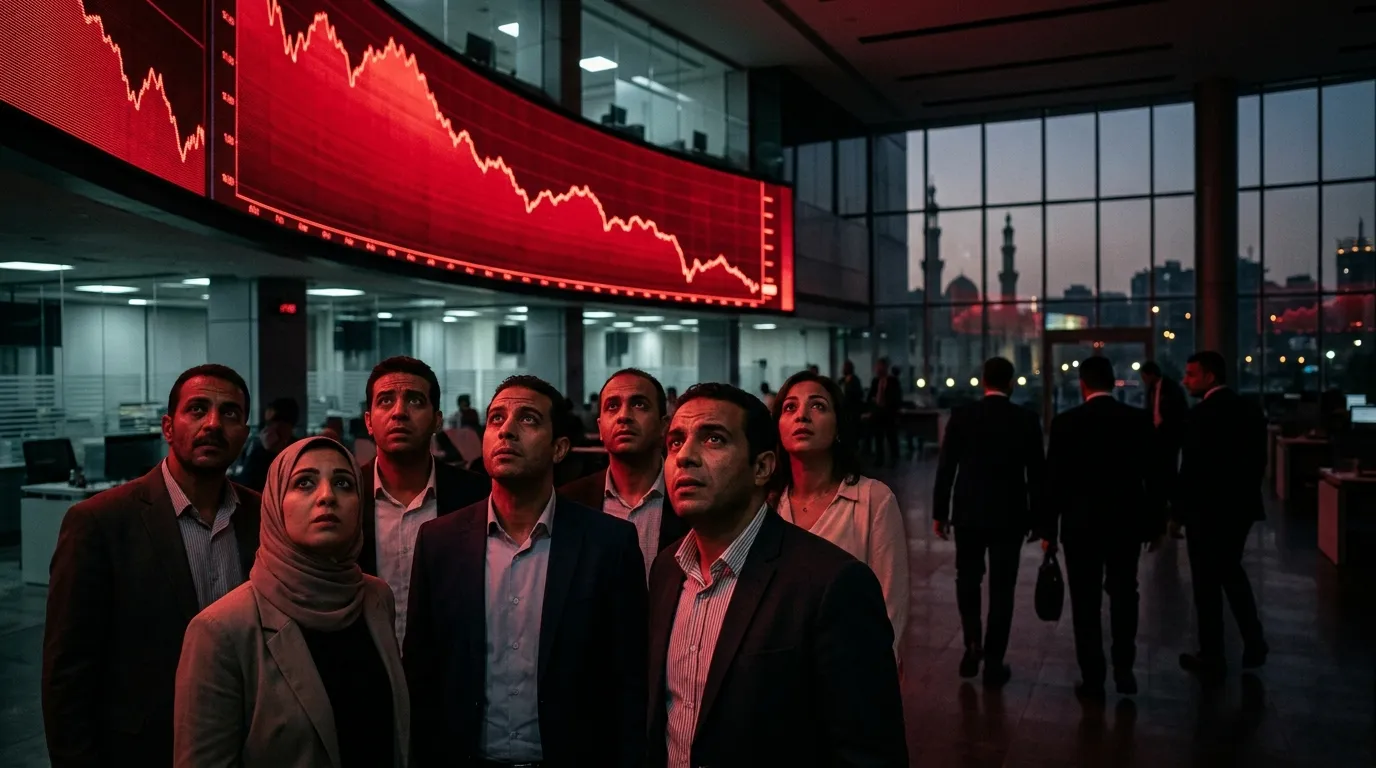
EGX30 ended Monday's session on September 14 down by 1.56% at 54,796.55 points, after losing 1.09% on Sunday. More importantly, EGX70 fell 2.67% and EGX100 declined 2.30%, following their rise in Thursday's session on September 10. The number of declining stocks expanded from 110 on Thursday to 161 on Sunday, then 184 on Monday, compared to only 31 advancing stocks in the latest session. Equity trading value on Monday also rose to around 13.2 billion EGP.
In this sense, what we were monitoring on Sunday morning came to pass; pressure is no longer confined to a main index that could be distorted by the weights of a limited number of stocks. The broader market entered the repricing process. However, the broadening decline did not settle its underlying cause.
Retail Investors on the Other Side
During the sessions of September 10, 13, and 14, Egyptian retail investors recorded cumulative net buying of approximately 1.38 billion EGP, according to calculations of published trading data. Conversely, Egyptian institutions recorded net selling of about 824 million EGP, and Arab institutions around 503 million. In Monday's session alone, Egyptian retail investors were net buyers of around 425 million EGP, while Egyptian institutions sold nearly 413 million and Arab institutions around 80 million. Foreign institutions, meanwhile, ended the session as net buyers of about 103 million EGP.
These numbers do not mean that the individual investor is more confident or better able to read risks. Buying the dip might be an attempt to average down position costs, a difference in investment horizon, or speculative activity. Net transaction data cannot separate these motivations.
What it can prove is narrower, yet more useful: Egyptian retail investors were standing on the opposite side of a large portion of institutional supply while market losses widened, and the numbers also put an end to another common explanation. What happened in stocks was not a broad wave of foreign exit. Foreign institutions sold on Thursday, then turned into net buyers on Sunday and Monday, ending their net transactions across the three sessions with limited selling of approximately 40 million EGP only.
This judgment specifically applies to equities and alone is not suitable to measure the stance of foreign capital regarding all Egyptian assets. However, it is important for understanding what appeared on the EGX screen: domestic and Arab institutions were clearer on the selling side, while Egyptian retail continued to absorb part of the supply.
Cairo Diverged from the Gulf
In Sunday's session, the regional link was easier to read. EGX30 dropped by 1.09% concurrently with Saudi TASI losing around 1.3%, amid the ongoing repercussions of the Saudi East-West pipeline shutdown and rising risks surrounding energy export routes. Monday, however, broke this picture: TASI rose by about 0.1%, Dubai gained 0.5%, and Abu Dhabi 0.1%, while EGX30's decline accelerated to 1.56%. Qatar slipped by around 0.3%. In other words, the geopolitical factor did not disappear, but it was no longer sufficient on its own to explain why Cairo continued to fall when Gulf markets regained part of their balance.
One economic explanation is that elevated oil does not carry the same impact for an energy exporter as it does for an importer; a price rise can offset part of the risk premium in an oil-exporting economy through revenues, whereas Egypt remains more vulnerable to cost, import, and inflation channels.
During Cairo's trading hours on Monday, Brent crude surged to around $108 per barrel as supply concerns renewed. After the Egyptian Stock Exchange closed, it pared a large portion of its gains to end the day at $105.68, up by about 1%. This chronological detail is important: the oil surge during Cairo's session was part of the environment the market dealt with, whereas the end-of-day price is one of the pieces of information carried into Tuesday's session.
The picture grows more complex with the cost of money.
After the Egyptian market closed, the yield on 10-year US Treasury bonds breached 5% for the first time since October 2023. This jump does not explain a drop that had already occurred in Cairo, but it became part of the external conditions under which the stock exchange approaches Tuesday's session. On the same day, the Federal Reserve begins its meeting running through Wednesday, September 16. According to a Reuters poll, about 85% of participating economists expected a quarter-percentage-point rate hike, while futures were pricing in nearly a 90% probability of a hike.
For Egypt, two distinct factors converge here: oil above $100 increases vulnerability to import costs and inflation, while a high dollar yield makes US fixed-income instruments a stronger competitor for capital and raises global financing costs. The effect of each cannot be statistically isolated from just three Egyptian sessions, but their combination offers a stronger economic explanation for Cairo's persistent weakness than reducing the entire movement to a war headline.
Even Maritime Corridors Do Not Tell a Single Story
The story of Hormuz, East-West, and Bab el-Mandeb that we followed on Sunday has not ended, but it now requires a more selective reading. Prior to Monday's session, vessel-tracking data reported by Reuters showed that commodity ship traffic through Hormuz over the weekend remained below the average of the previous ten days. Bab el-Mandeb, however, gave a different signal: 24 commodity ships transited on Saturday and 27 on Sunday, compared to an average of about 27 ships daily over the preceding ten days. Elevated security risk had not, up to that point, turned into a collapse in transit traffic.
During Monday's session, Maersk and Hapag-Lloyd announced the return of four additional container services to the Suez Canal route instead of sailing around the Cape of Good Hope. The decision is contingent on continued security stability, but it serves as an important counter-evidence to any reading assuming that growing risk near Bab el-Mandeb had already caused a new setback in canal traffic.
Here emerges the gap between Sunday's article and the picture with which the market enters Tuesday. We were watching whether the energy and corridor shock would transfer from blue-chip stocks to the broader market, and it did. However, subsequent data prevented us from relying solely on the equation "regional escalation equals Egyptian decline": some Gulf markets regained their balance, Bab el-Mandeb did not witness a collapse in vessel traffic, and additional container services returned to the Suez Canal, while Egyptian equities remained weak and domestic and Arab institutional selling expanded. Therefore, Tuesday's test does not begin with EGX30's first movement.
If Egyptian and Arab institutional selling continues, and EGX70 remains weaker than the blue chips with a wide count of declining stocks, the signal will be that de-risking within portfolios is not over yet, even without new security news. Conversely, if institutional supply recedes and market breadth improves, any rebound will become more meaningful than a rally manufactured by a few heavyweight stocks. In the background, investors will begin pricing in the Fed meeting while watching oil and US yields at the same time.
On Sunday, the question was "Will pressure transfer from the index to the market?" After two sessions, we know it did.
As for Tuesday's question, it has become harder: How long can retail investors continue buying what institutions sell? And which of the two sides will force the other to reprice risk?


Weekly Newsletter
Read between the lines before everyone else. Decode the most important economic, tech, and decision-maker movements in the region.. in 5 minutes every Saturday.