

Castus Tracks 70,000 Square Meters of Sargassum Using AI off the Coast of Florida
Castus Technologies has completed the first operational test of its platform in tracking 70,000 square meters of Sargassum off Florida, in collaboration with ScienceWerx and funded by NOAA.
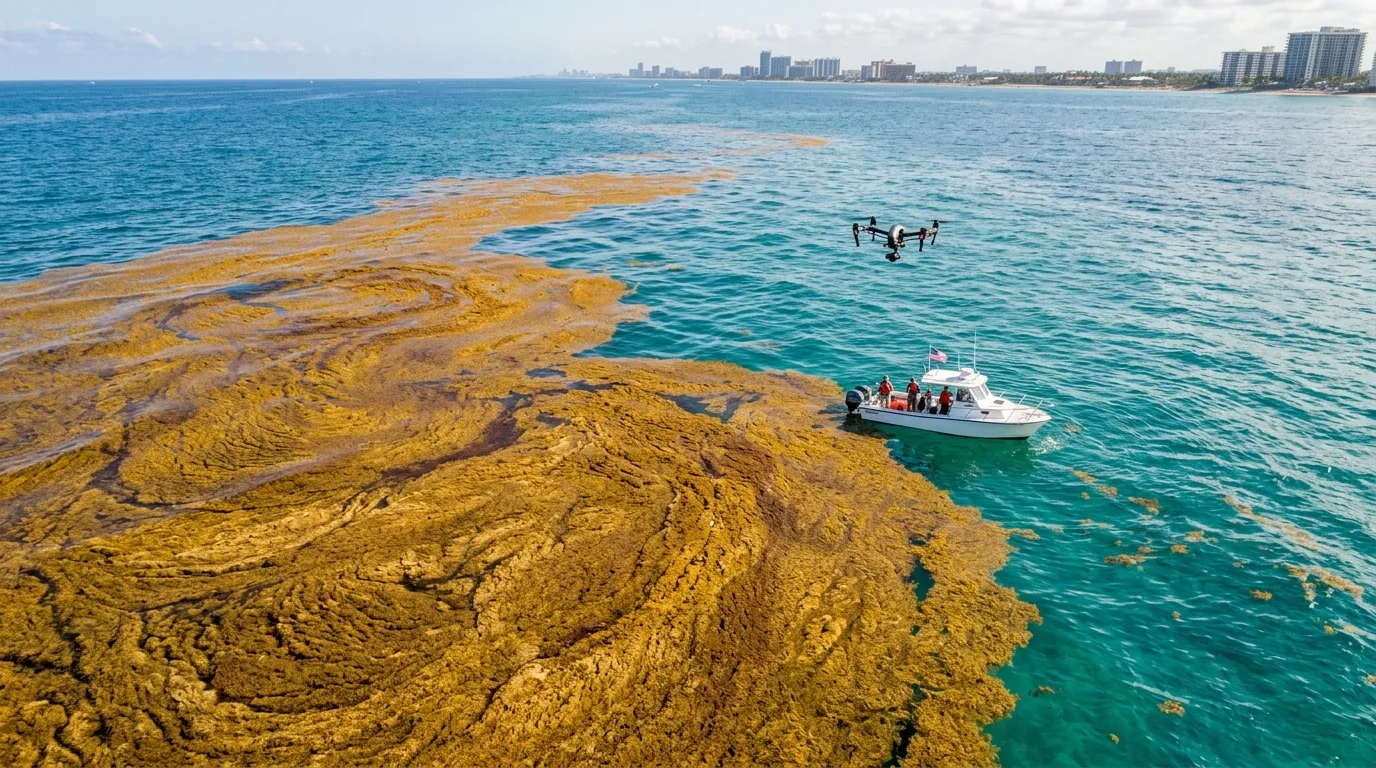
Castus Technologies announced the success of its historic operational test in tracking and locating more than 70,000 square meters of Sargassum seaweed in the Atlantic Ocean, approximately four miles off the coast of Fort Lauderdale, Florida, on August 13, 2026.
The test was conducted over three days: on August 11 and 12, the company ran its artificial intelligence algorithms to identify aggregation points of floating matter within a 12-mile radius, then utilized satellite imagery from Planet Labs to confirm the masses, before the field team set out to verify coordinates using drones and marine documentation tools.
The test was conducted in collaboration with the International SeaKeepers Society, Debris Free Oceans, and ScienceWerx, as part of an active grant funded by the National Oceanic and Atmospheric Administration (NOAA). The company notes that its platform is designed to serve broader applications beyond Sargassum tracking, including oil spill tracking and maritime search and rescue.
The platform relies on a Bayesian probability engine that integrates ocean current, wind, and satellite data to predict the trajectories of floating objects, thereby transitioning response teams from open-ended search to data-driven, precise interception.
What do these terms mean?
Sargassum: A type of floating marine algae that aggregates into massive rafts on the ocean surface. Its unusual bloom phenomenon has become an environmental concern threatening coastlines and coral reefs in the Caribbean and the Gulf of Mexico.
Bayesian Probability Engine: A mathematical method that integrates multi-source data, such as ocean currents and winds, to calculate the probability of a target's presence at a specific location, with its accuracy automatically improving as new data is added.
Technology Readiness Level 7 (TRL 7): An international metric that evaluates a technology's readiness for actual deployment. Level 7 indicates that the system has been tested in a real operational environment and proven effective in real-world conditions.
Weekly Newsletter
Read between the lines before everyone else. Decode the most important economic, tech, and decision-maker movements in the region.. in 5 minutes every Saturday.