

When Artificial Intelligence Becomes a Programmable Electrical Load
Summary
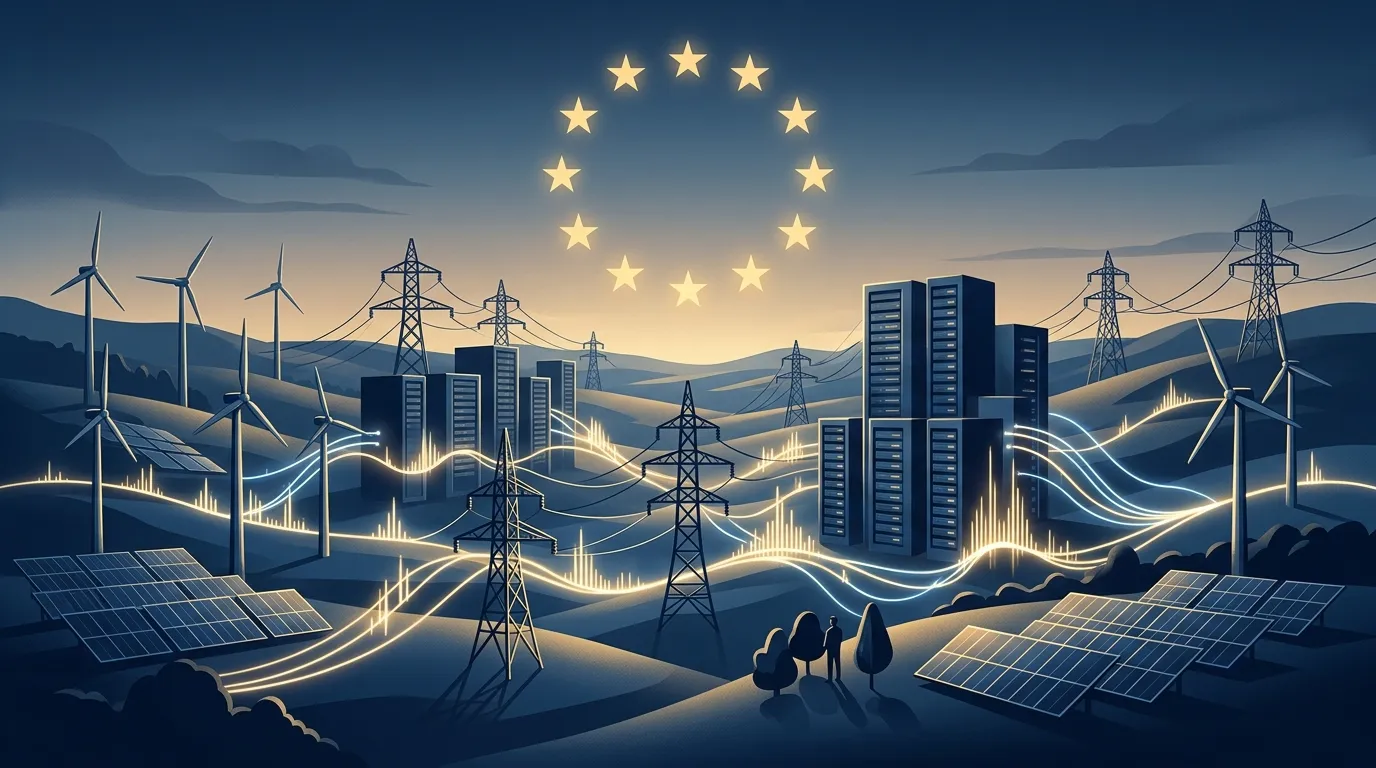
Will artificial intelligence in Europe become a tool for grid balancing? When computing is measured by the timing of renewable energy consumption, the algorithm itself could turn into a critical new grid resource.
In 2025, the installed capacity of data centers in the European Union reached about 12 GW, and it could exceed 28 GW by 2030. This rapid growth is beginning to change how Europe treats artificial intelligence, as expanding computing capacity is no longer separated from the tougher question regarding the source of electricity and the ability of power grids to supply it.
Data centers currently consume nearly 2.5% of the European Union's electricity. At the same time, Brussels wants to expand computing infrastructure to support "AI factories" and reduce reliance on companies and infrastructure outside Europe. However, data center construction in some regions is moving faster than the expansion of power grids. Consequently, AI regulation has become directly linked to energy policy.
A broad portion of the European AI Regulation, the AI Act, came into effect on August 2, 2026, including obligations for General-Purpose AI models. An additional compliance deadline falls on December 2 for certain generative content systems that were already on the market before August.
One of the less discussed rules relates to energy itself. A model provider must include in its technical documentation the known or estimated energy consumption of the model. If direct measurement is not possible, it can be estimated from the scale of computational resources used. The European Commission can also establish a standardized methodology to make these calculations comparable and verifiable.
blockquote>This step reveals how much energy a model might consume, but it does not necessarily clarify where the electricity came from or when it was generated. This is an important gap because solar and wind generation vary throughout the day and from one country to another. A kilowatt-hour of renewable electricity available at noon in Spain does not serve the same function for a congested grid in Northern Europe in the evening.
For this reason, European energy efficiency rules also require large data centers to provide information on their performance. The data includes Power Usage Effectiveness (PUE), water consumption, heat reuse, and the Renewable Energy Factor. Data centers can account for renewable electricity through guarantees of origin, Power Purchase Agreements (PPAs), or on-site renewable generation.
Nevertheless, the fundamental problem remains. Regulators may know how much energy a specific model consumed and simultaneously know that the data center purchases a high proportion of renewable electricity, without knowing whether the computing actually took place during the hours when that clean electricity was available.
A data center could buy an amount of renewable electricity equivalent to its consumption over the course of the year, yet operate at full capacity during hours when wind and solar production are low. The annual accounting may look good, while at those specific moments the grid is forced to run alternative sources, import electricity, or handle additional congestion.
This explains the European Commission's growing interest in the concept of flexibility—that is, the ability of data centers to shift the timing of their consumption according to the state of the power grid.
Some AI workloads do not require immediate execution. Training a large model, or running massive batches of non-urgent tasks (batch inference), can in many cases be shifted to hours when electricity is more abundant. Work can sometimes even be distributed across different data centers if network latency, data governance, and technical infrastructure permit.
Here, artificial intelligence becomes part of the solution to the renewable energy challenge, rather than merely a driver of increased demand.
If wind generation increases overnight, a larger share of computational loads can be scheduled during those hours. If the grid becomes congested during peak hours, certain tasks can be deferred. This is known in the power sector as demand response—adjusting demand to align with grid conditions.
This capability may prove far more important than incremental improvements in cooling efficiency. A grid increasingly reliant on solar and wind needs consumers capable of shifting the timing of their power use. Data centers possess this flexibility across a portion of their workloads in a way that hospitals, trains, or many industrial plants simply do not.
However, flexibility is not absolute. Conversational AI, search engines, and certain industrial applications demand real-time responses and cannot be delayed for hours. Furthermore, shifting workloads across data centers faces constraints related to network latency, data security, digital sovereignty, and the physical location of advanced chips.
Nonetheless, training runs and non-urgent tasks are large enough to significantly impact grid planning. This marks a critical shift in perspective: the question is no longer merely how much electricity a data center consumes, but when and where that consumption occurs, and how adaptable it is.
This also explains why the PUE metric alone is insufficient to evaluate data center sustainability. A facility may become more energy-efficient per compute task, yet its overall consumption rises because the total number of servers and processing units grows rapidly.
Efficiency improvements lower the cost of computing, and lower costs encourage higher utilization. Technical progress can thus slow the growth of electricity consumption without necessarily reducing it. With Europe's plans to scale up its computing capacity, this point becomes far more critical than simple comparisons between a more efficient data center and a less efficient one.
blockquote>During the fourth quarter of 2026, these developments will coincide with the continuing legislative trajectory of the Cloud and AI Development Act and ongoing work on a European framework for rating data center sustainability. The general direction is clear: Europe is attempting to integrate AI expansion directly into power grid planning, rather than treating it as a digital sector that demands power only after data centers are built.
The most important indicator moving forward will not be the number of new gigawatts from solar and wind alone. What matters most is Europe's capability to understand when and where AI consumes electricity, and then redirect the flexible portion of that consumption to the hours and regions where clean power is available.
If achieved, the role of data centers within the energy system will transform. They will no longer function merely as power consumers; instead, portions of their load will become schedulable based on grid conditions. At that point, the algorithm itself becomes an element of European electricity management.
Before it happens
2027 and the Battle to Own the Tourist's Bill

من لا يقيس الكربون سيدفع ثمنه في ٢٠٢٧

$500 Million Seeking a Buyer! Nigeria Achieves a Quantum Leap in the Knowledge Economy

September Between Hormuz and the Fed: How Does the War Reach the Gulf Investor's Pocket?
Weekly Newsletter
Read between the lines before everyone else. Decode the most important economic, tech, and decision-maker movements in the region.. in 5 minutes every Saturday.